

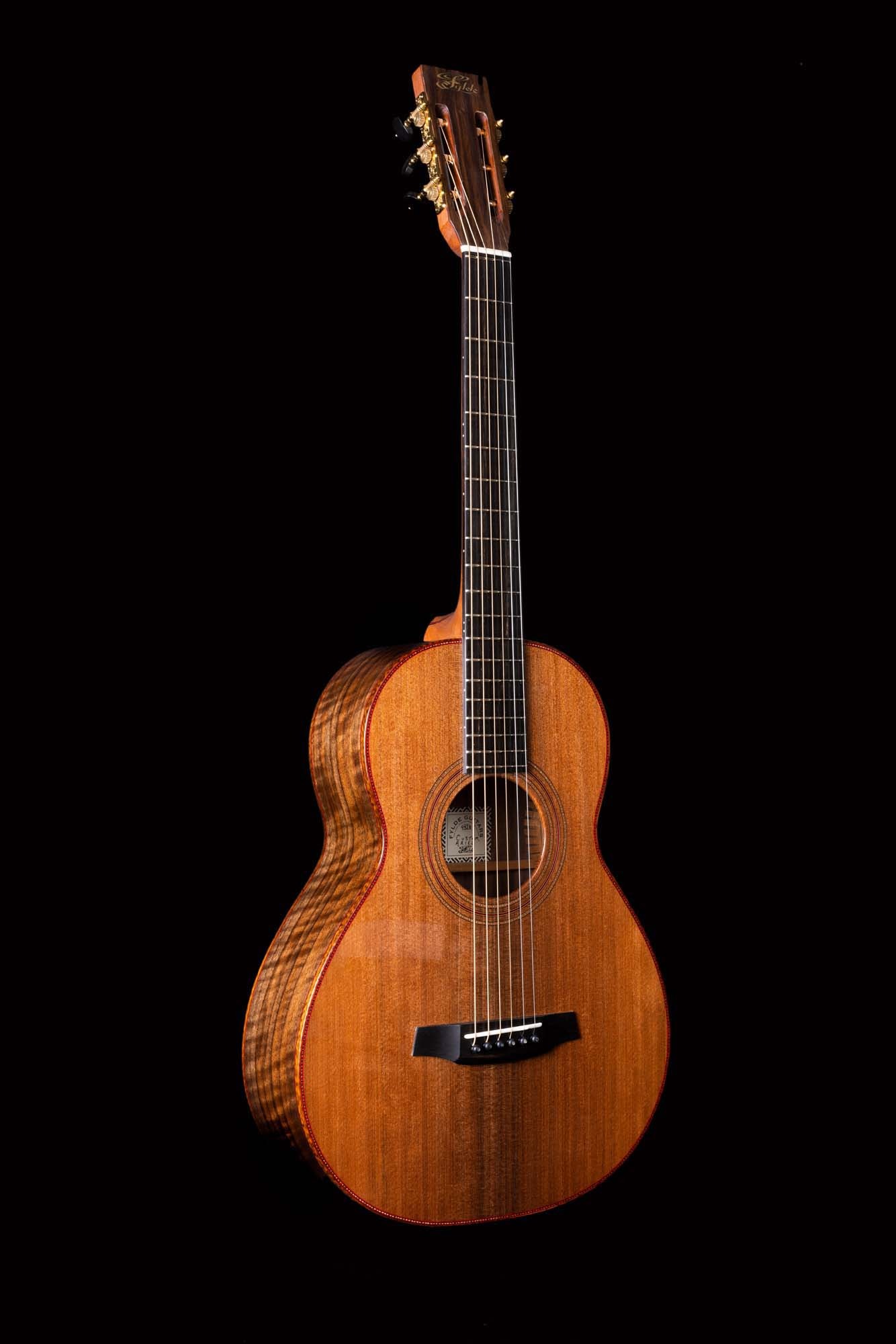
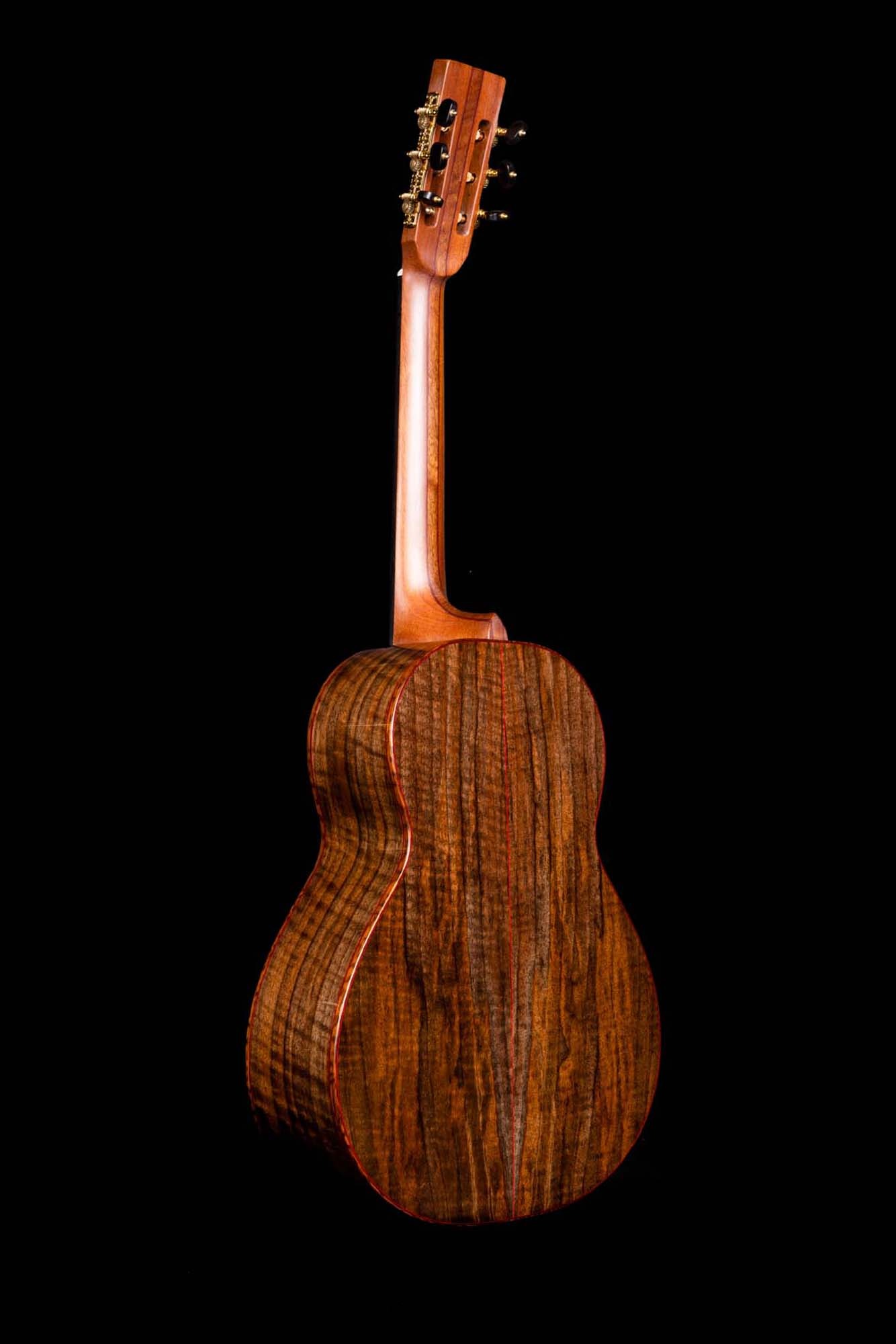
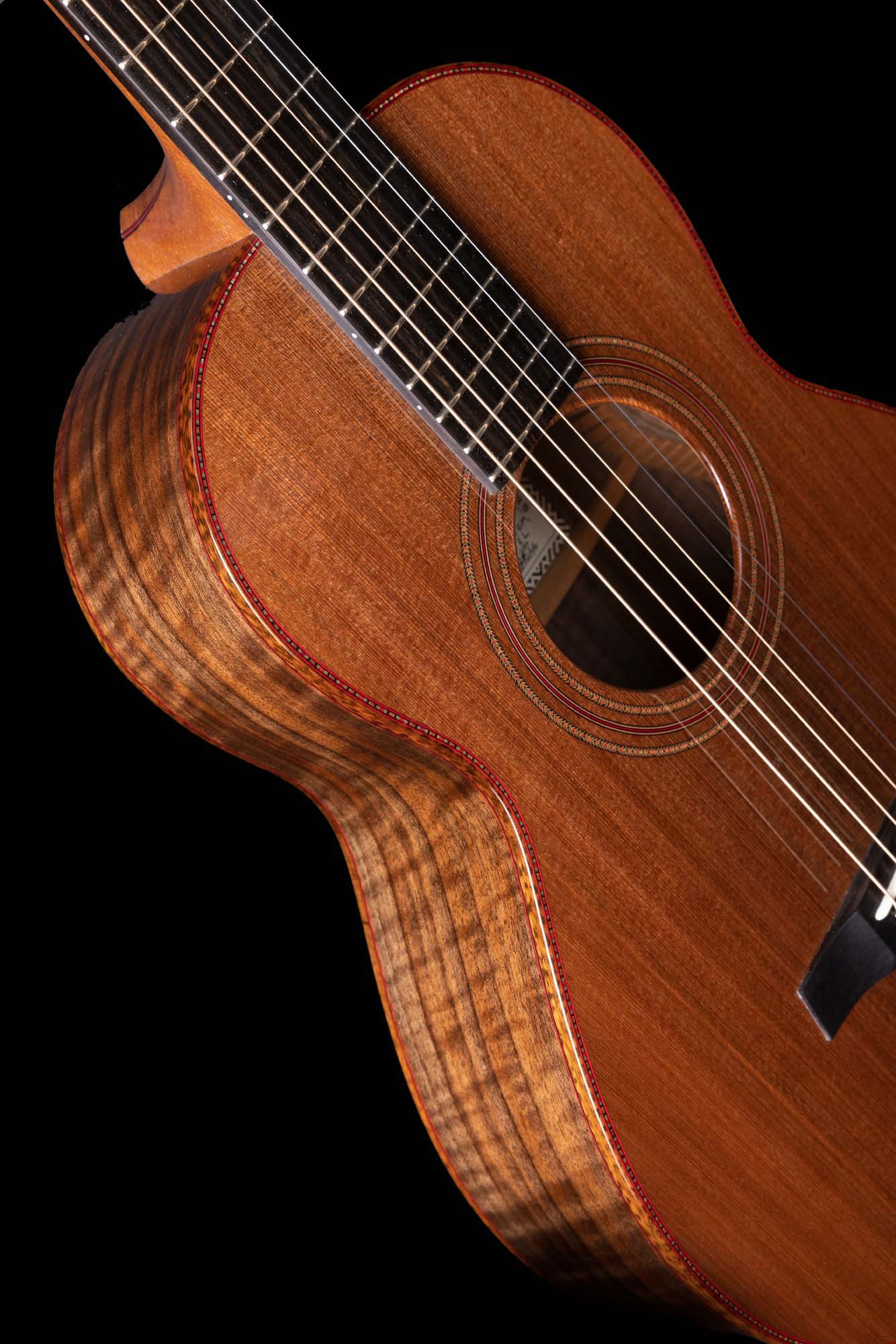
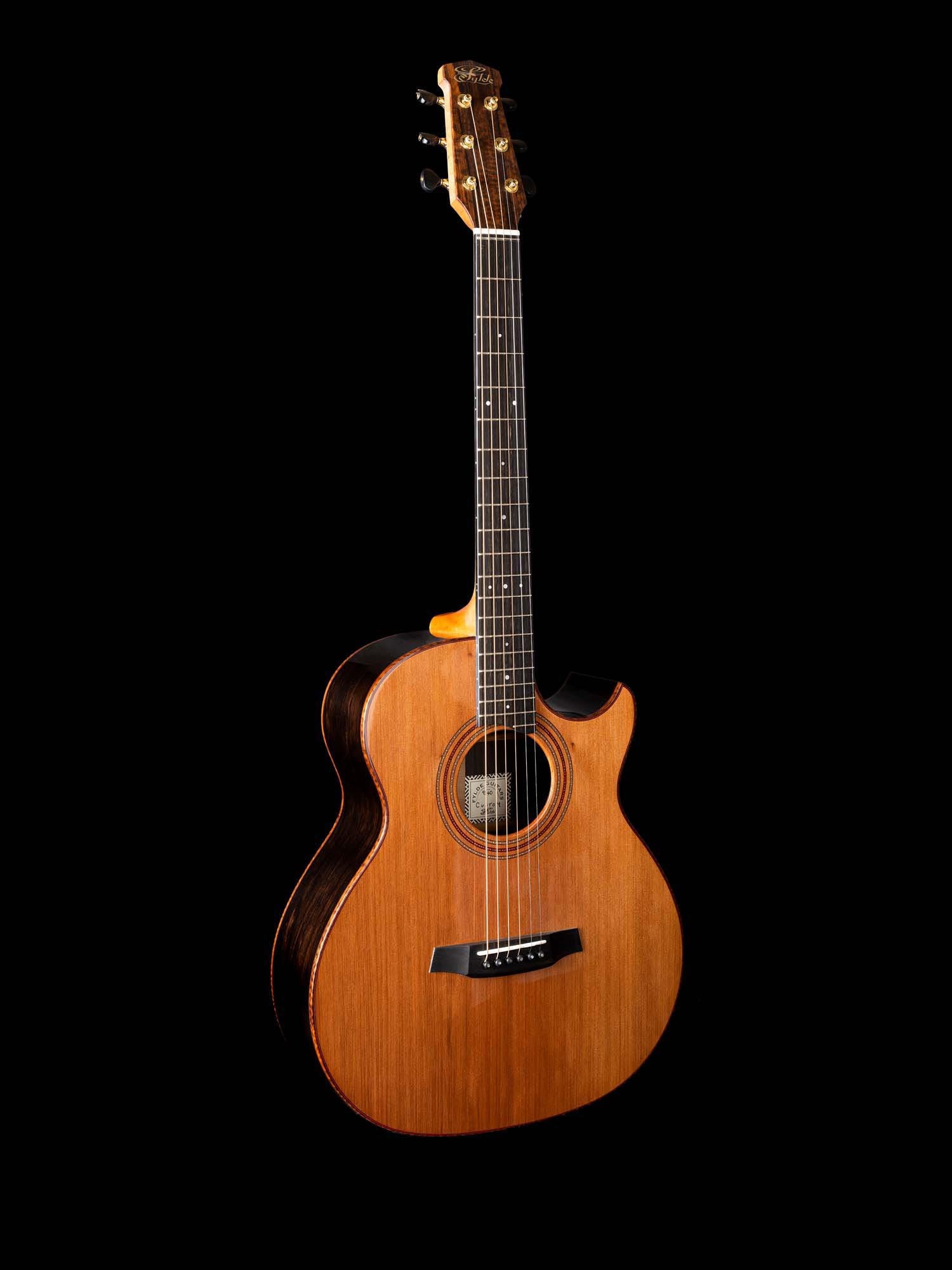
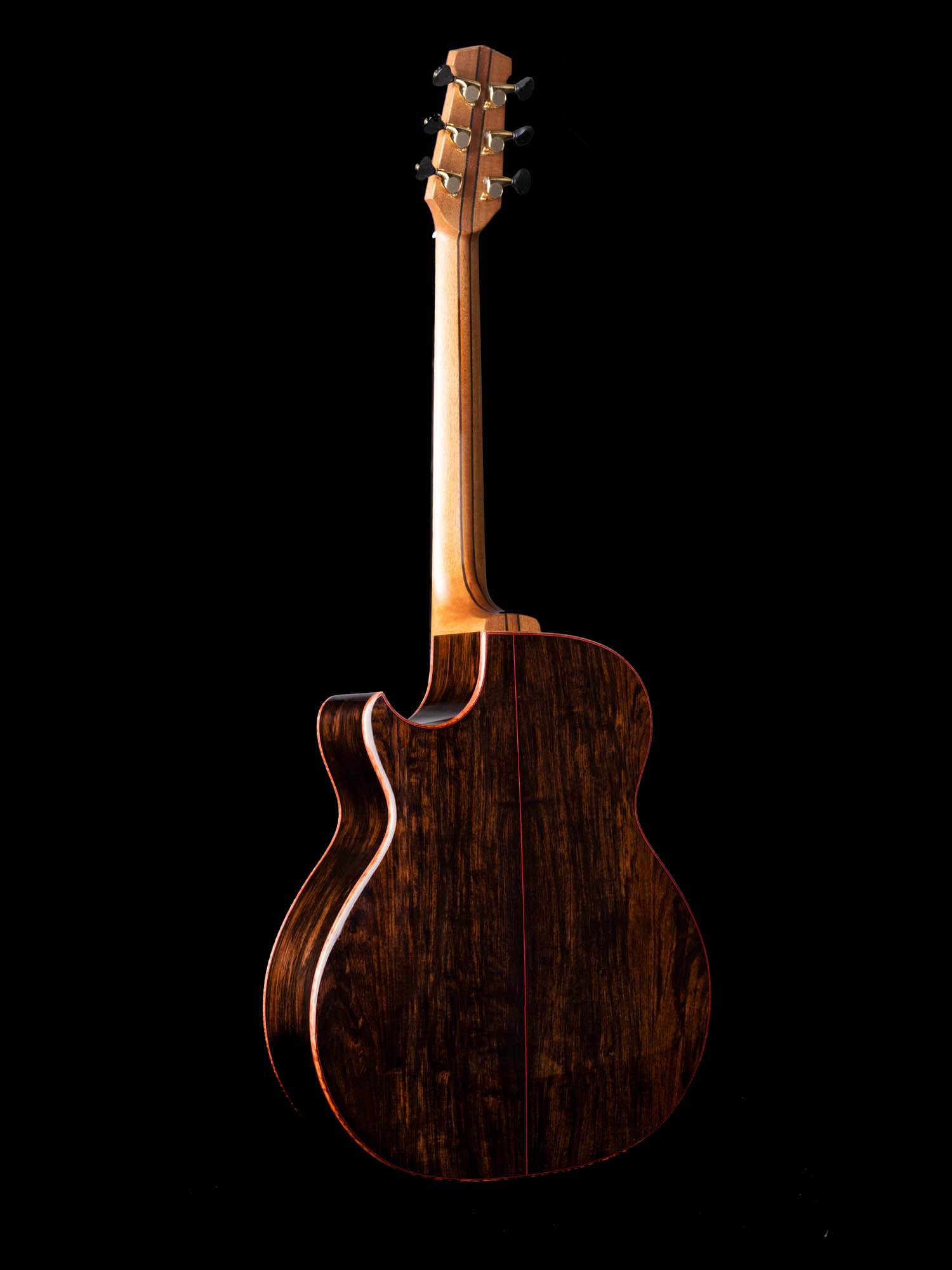
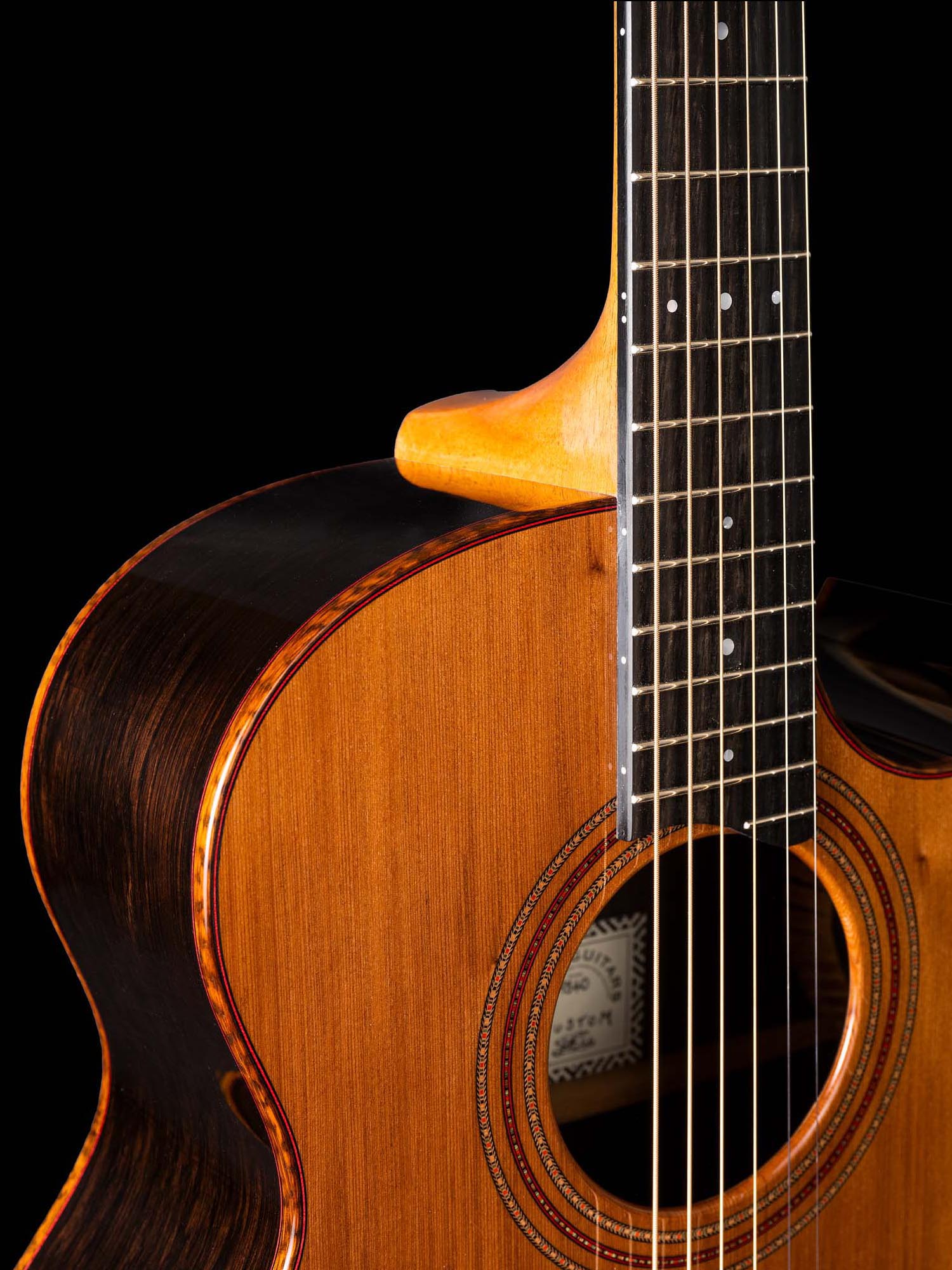
January: Custom Walnut Ariel for Chris Turpin

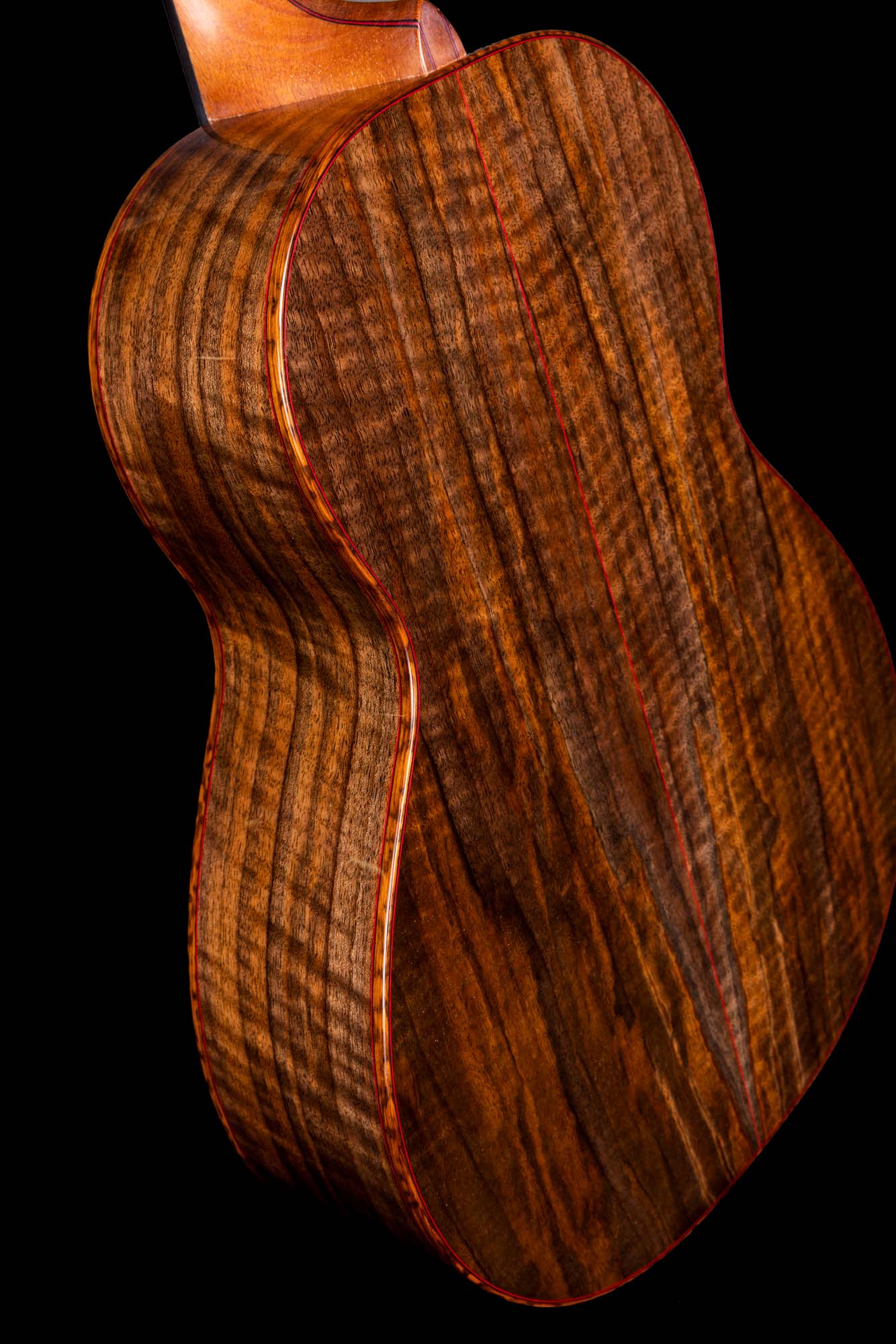
The Ariel is a wonderful size and shape and covers a much wider musical range than you might expect from such a small guitar, plus the choice of possible timbers is so much greater because of its size. This time, it’s figured Claro Walnut and Sinker Redwood, with a little bling from Snakewood bindings and exotic Gotoh Tuners – aren’t they lovely?
Chris is one half of the duo “Ida Mae”, with his wife Stephanie. They work mostly in the USA, then come home to refresh when they can.
He was put in touch by John Smith (hooray), and we have since discovered a number of other connections. It was very easy to decide what guitar to make for him by referencing various pictures and videos.
Chris made this little video for us, it’s a snippet from one of the songs from their new Album .
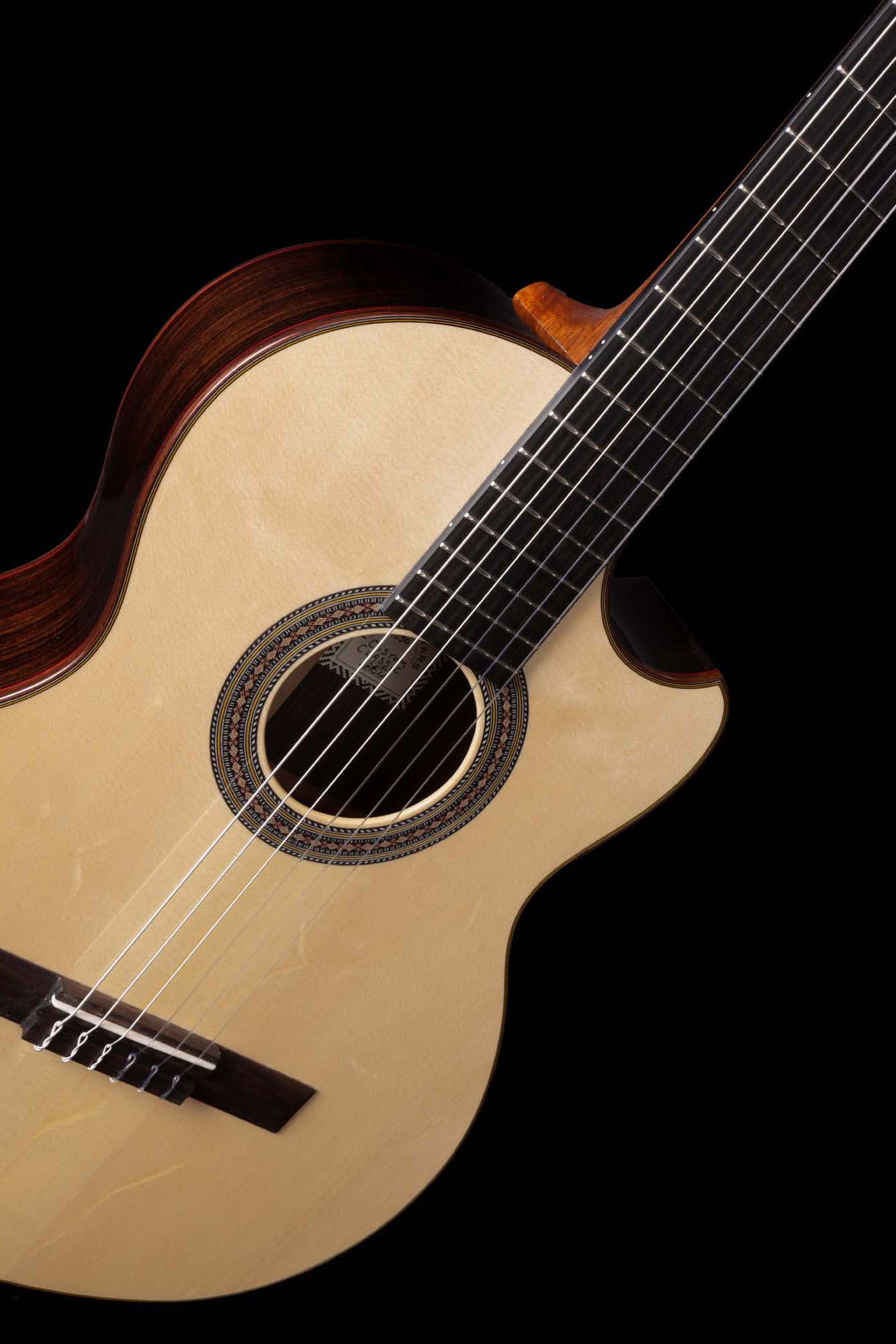
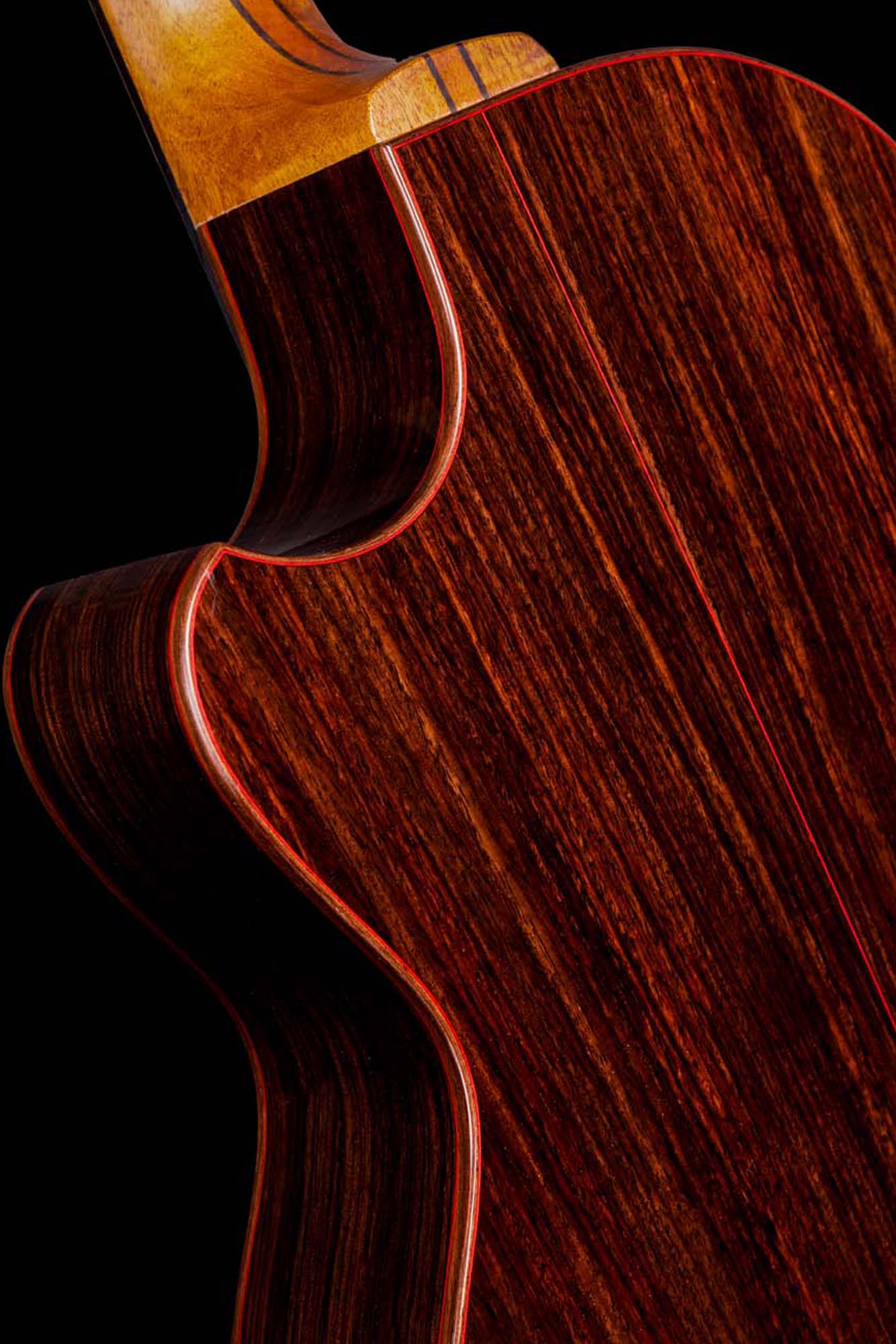
January: Electro Classic to USA
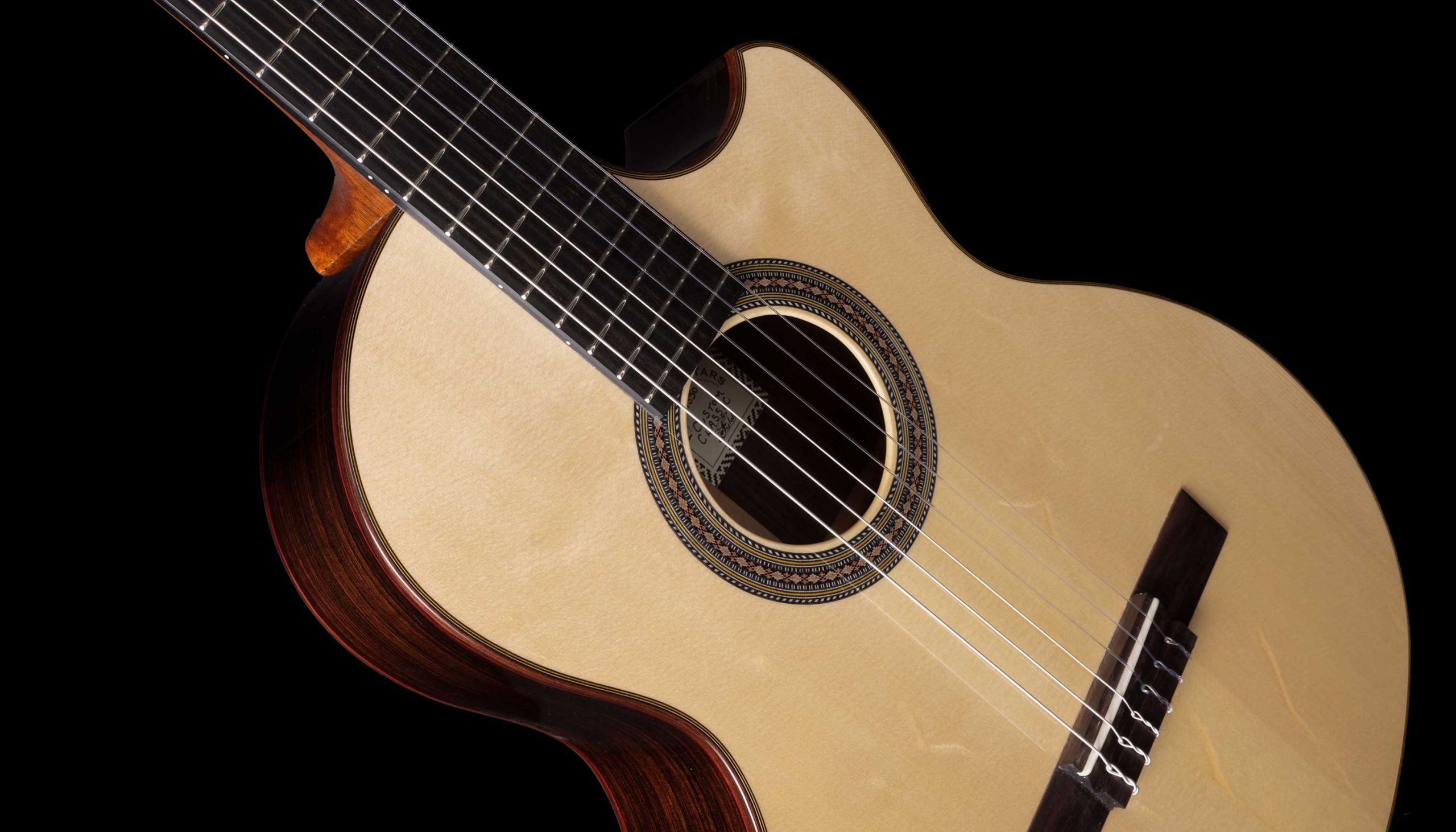
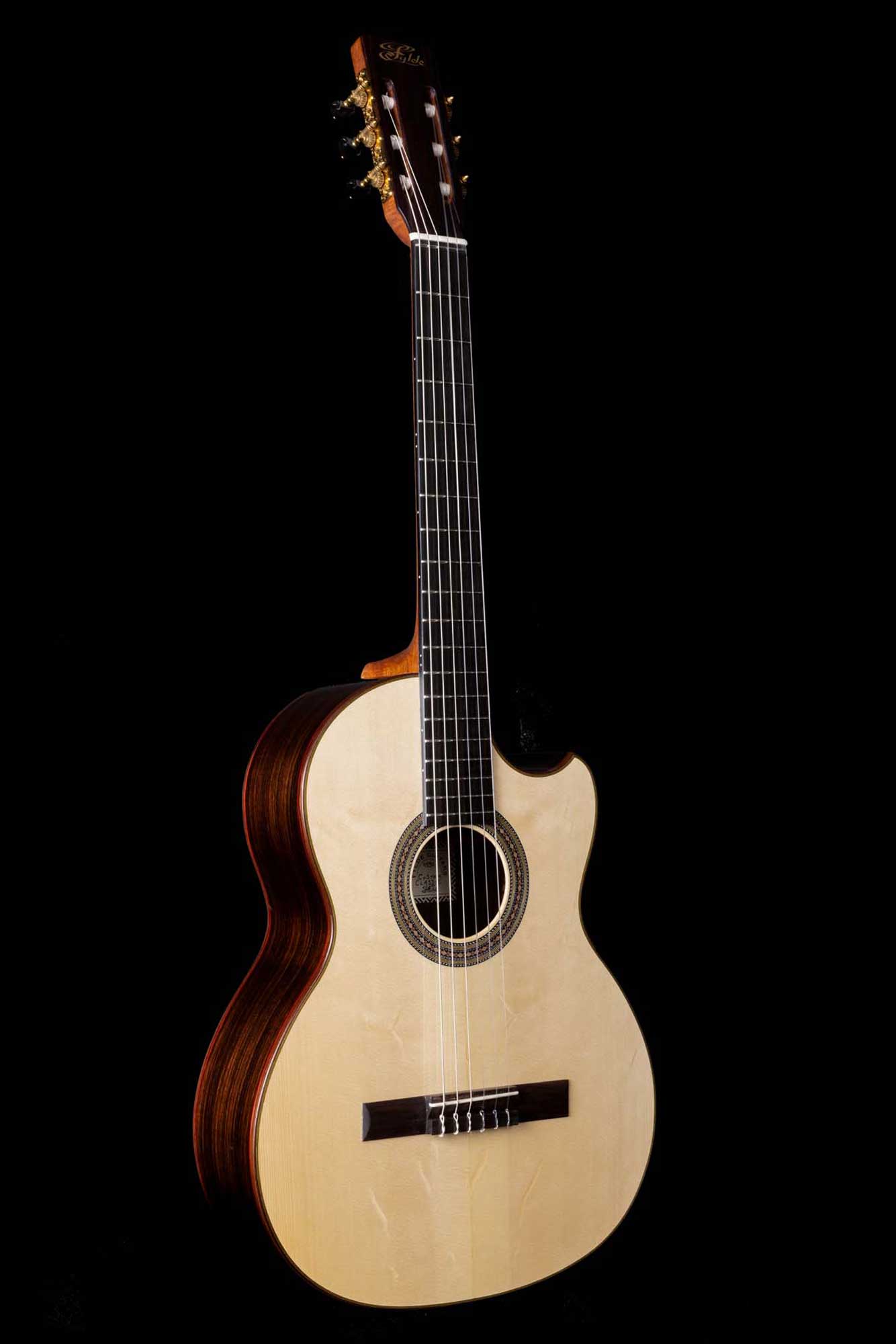
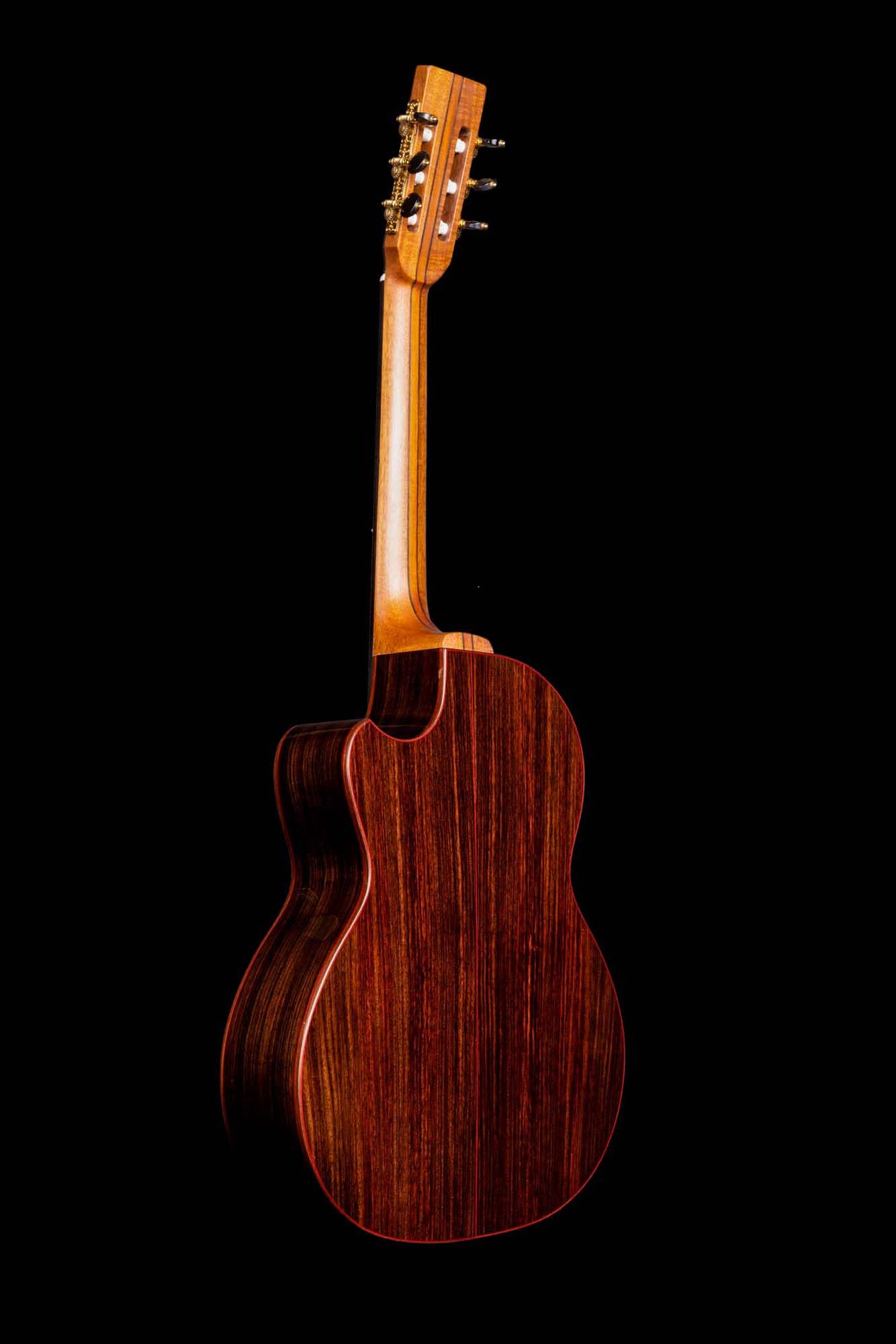
We made this for one of Will’s online students in America. Who would have thought, a few years ago, that you could teach guitar to someone on the other side of the world? Hopefully I’ll be able to show videos of its new owner playing it before too long.
January: Fret slot cutter
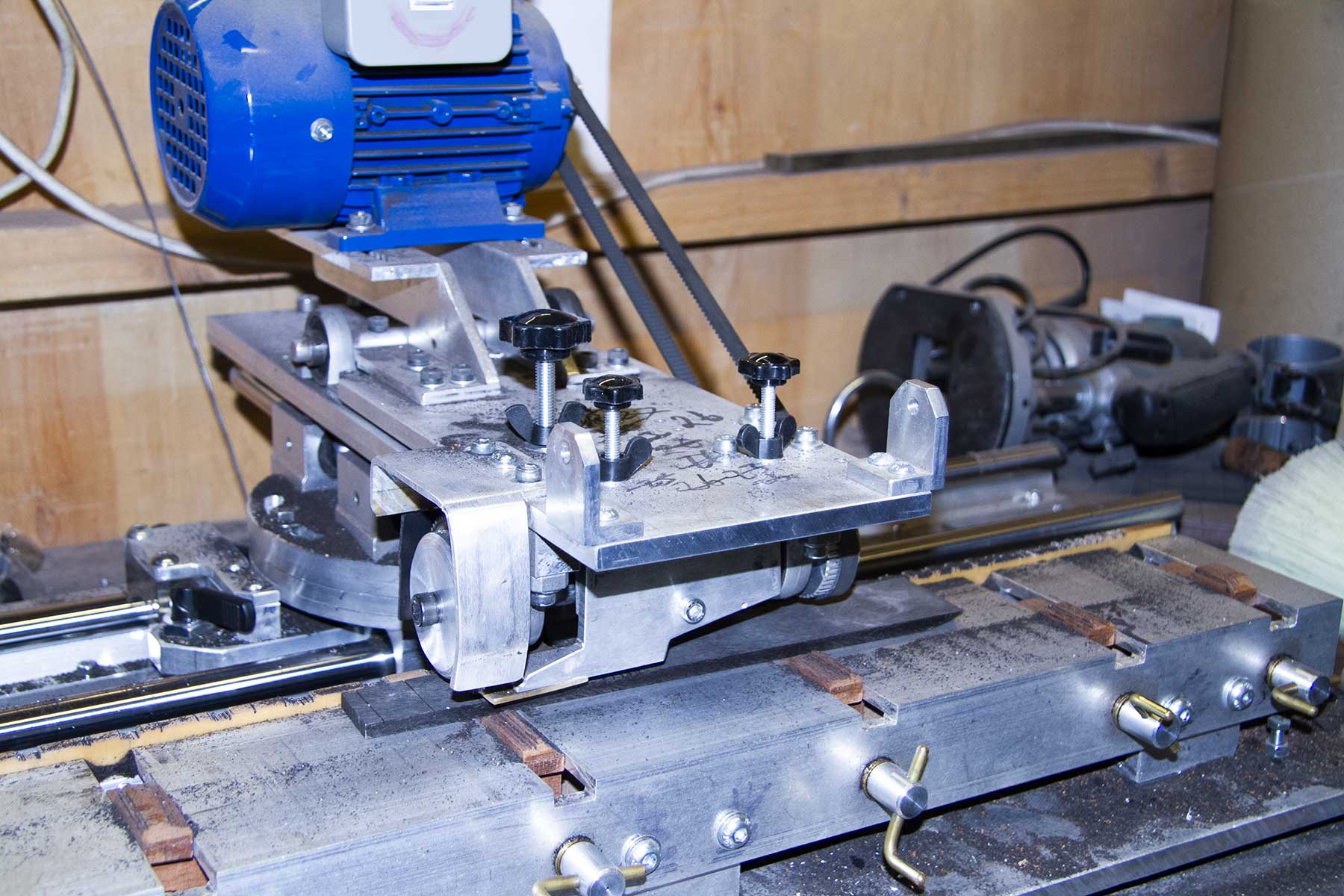
Just a little more fun in aluminium. An upgrade to the fancy fret slotting machine that I showed a while ago. I’ve taken the handle off to show things more clearly. The two smaller black headed screws operate a brass “shoe” running against the fingerboard surface. Now I can control the slot depth measured from the top of fingerboard, or by using the larger screw at the back I can control the depth measured from the bottom of the fingerboard. I suppose somebody is going to ask me why I need to do both.
I’ve also added a guard for the saw blade. How modern. We didn’t have blade guards when I was a lad, I hope I’m not getting soft. I suppose I could explain that we didn’t have very much of anything when I was a lad, I wore my sister’s hand me down shoes. True. There are a few jokes there which I will avoid.
January: I have doors!
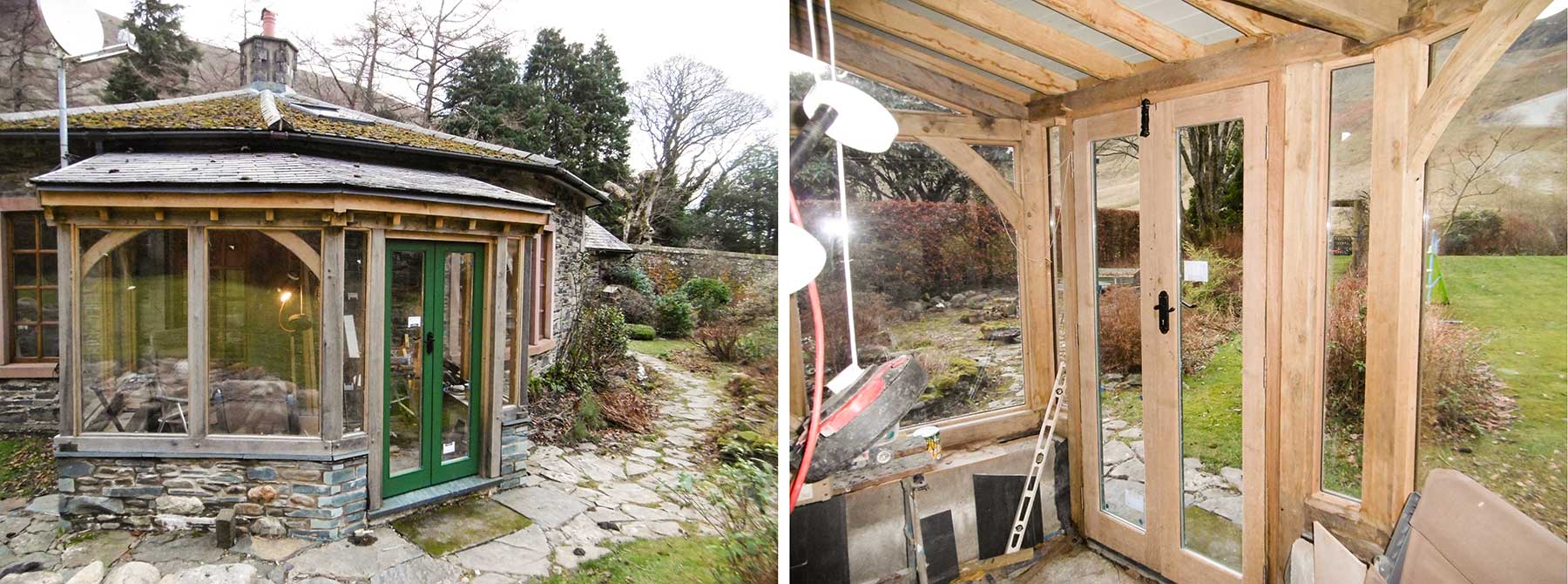
At long last, I can now get into my Green Oak Conservatory. I’ll be able to finish it off without getting wet now. The doors are made of kiln dried oak, so they need a different treatment to the “green oak” used for the main structure. I suppose it is a little confusing that I’ve painted them green – the green oak isn’t painted green, and the oak that is painted green, isn’t green oak. Isn’t English wonderful?
Stefan Sobell told me “looks like building work done by a guitar maker”, which I think is a compliment.
All I need now is rain, snow and sun, and I can keep away from all of them. And a shelf for my whisky, I shan’t be keeping away from that.
March: Guitar for Ukraine raises over £10,000

This story was in the recent brief newsletter, and now I can tell you how it worked out. I had several offers for the guitar in the first few minutes, and enquiries from three different continents, it quickly sold for over £10,000.
Because it was important to raise as much money as possible, I tried to make the price “attractive” to start off, but also to encourage “further offers”. It was bit nerve wracking, but it seems to have worked, and I had the final, very pleasing bid just before the “shut off” time. The money is now with the charity chosen by the donor, and he is in touch with the successful buyer.
Every day since then, I’ve heard of another one or two people who have added their own donations to the same cause. All good, very good in fact.
The new owner, someone who’s a regular newsletter reader, has quite a collection of UK made guitars, but of course I shall continue to tempt him.
March: New Guitar for Antiono Forcione
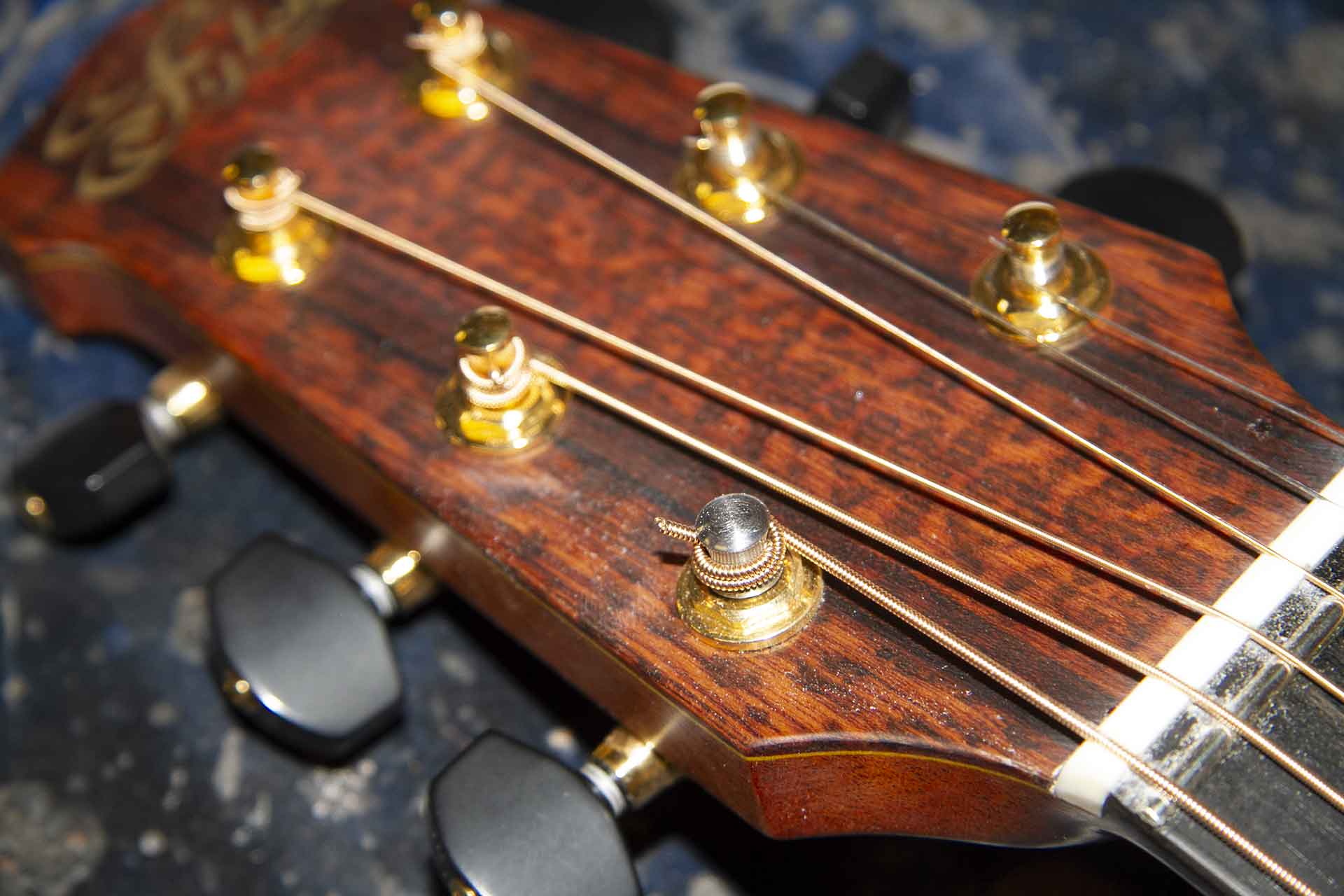
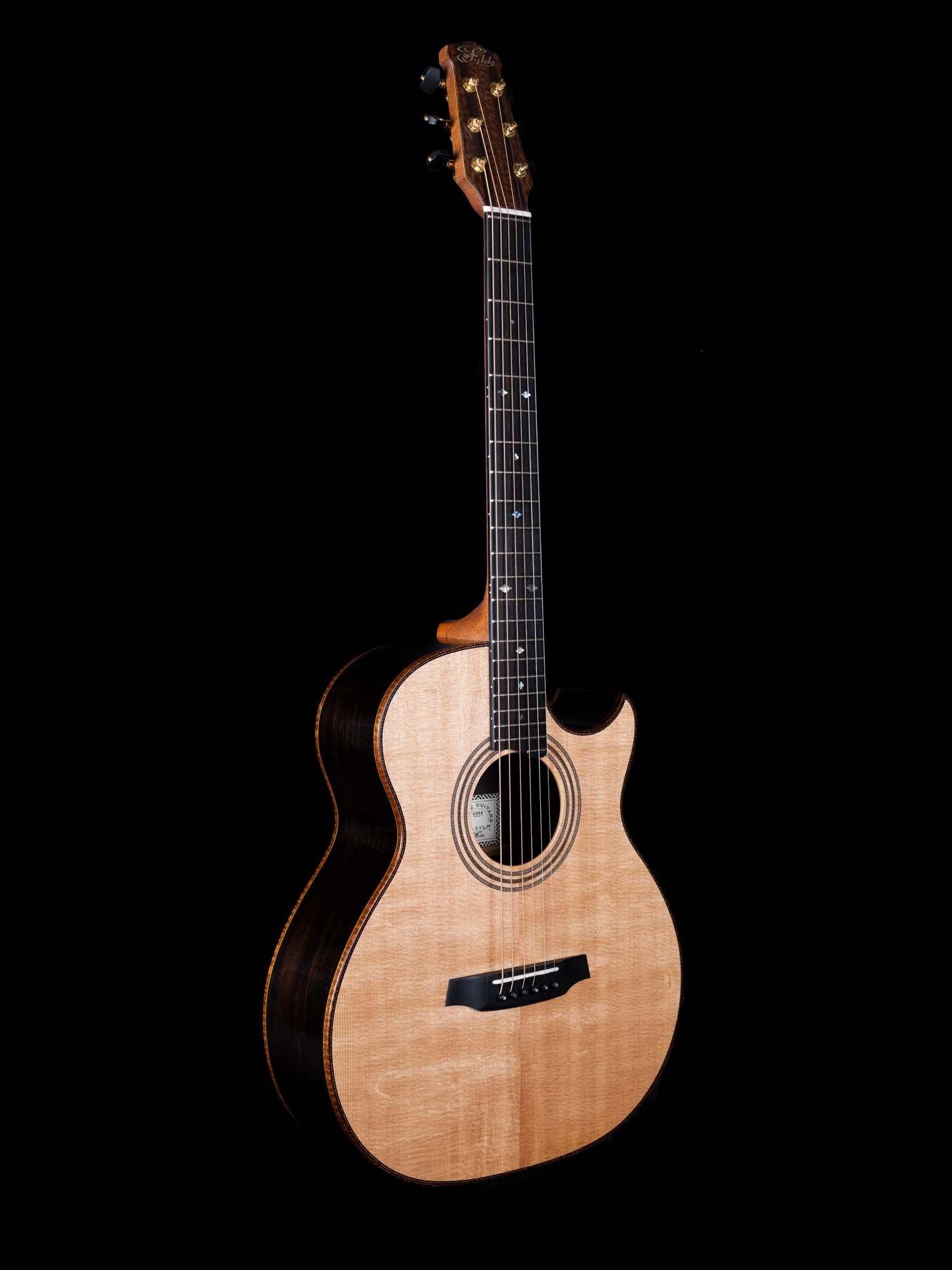
Well, I’m saying it’s “new”, because we have only just finished it, but it’s exactly the same as the first one we made for him maybe eight years ago. Antonio wanted a second guitar to keep abroad and help make his constant travelling a lot easier.
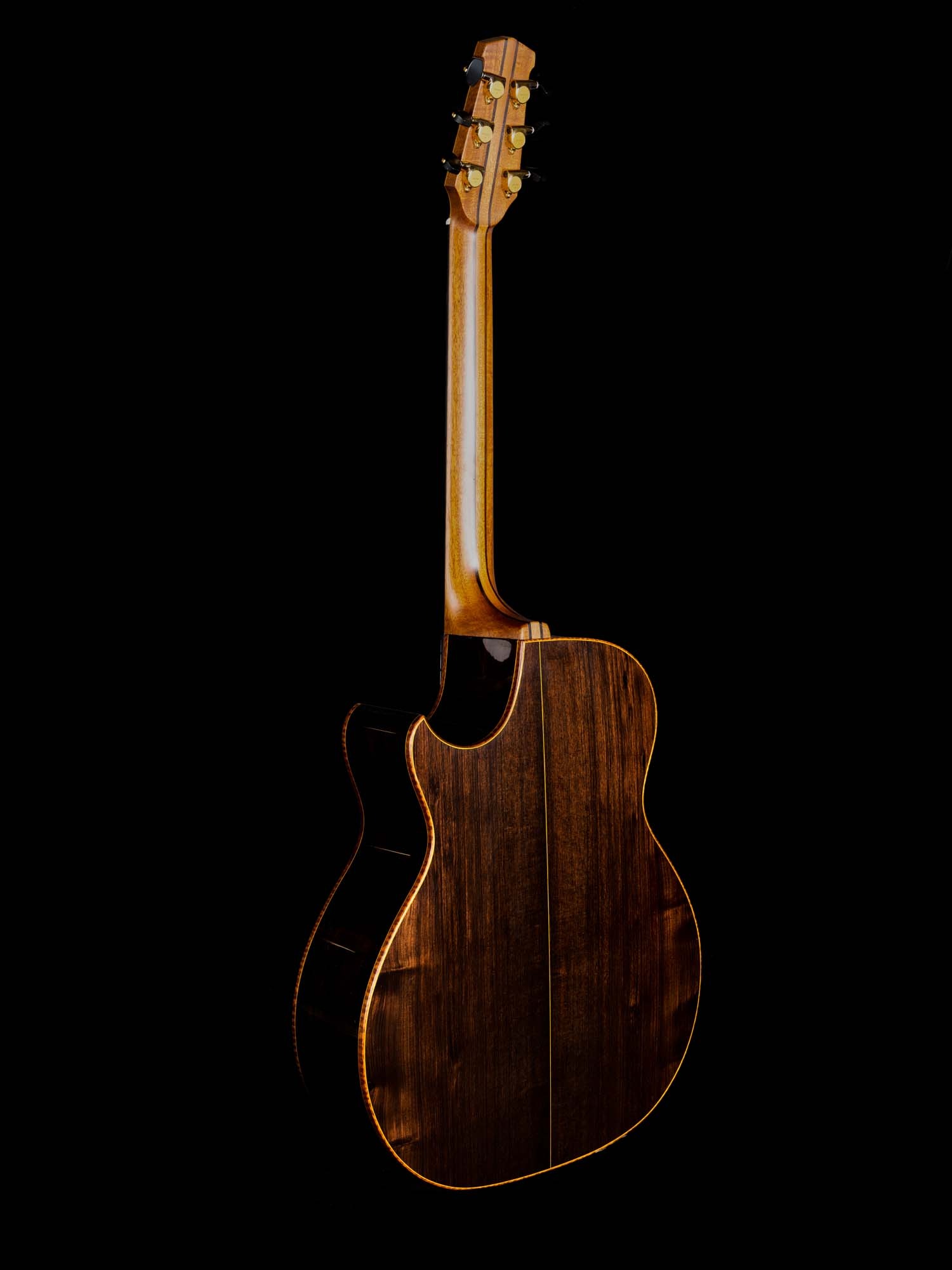
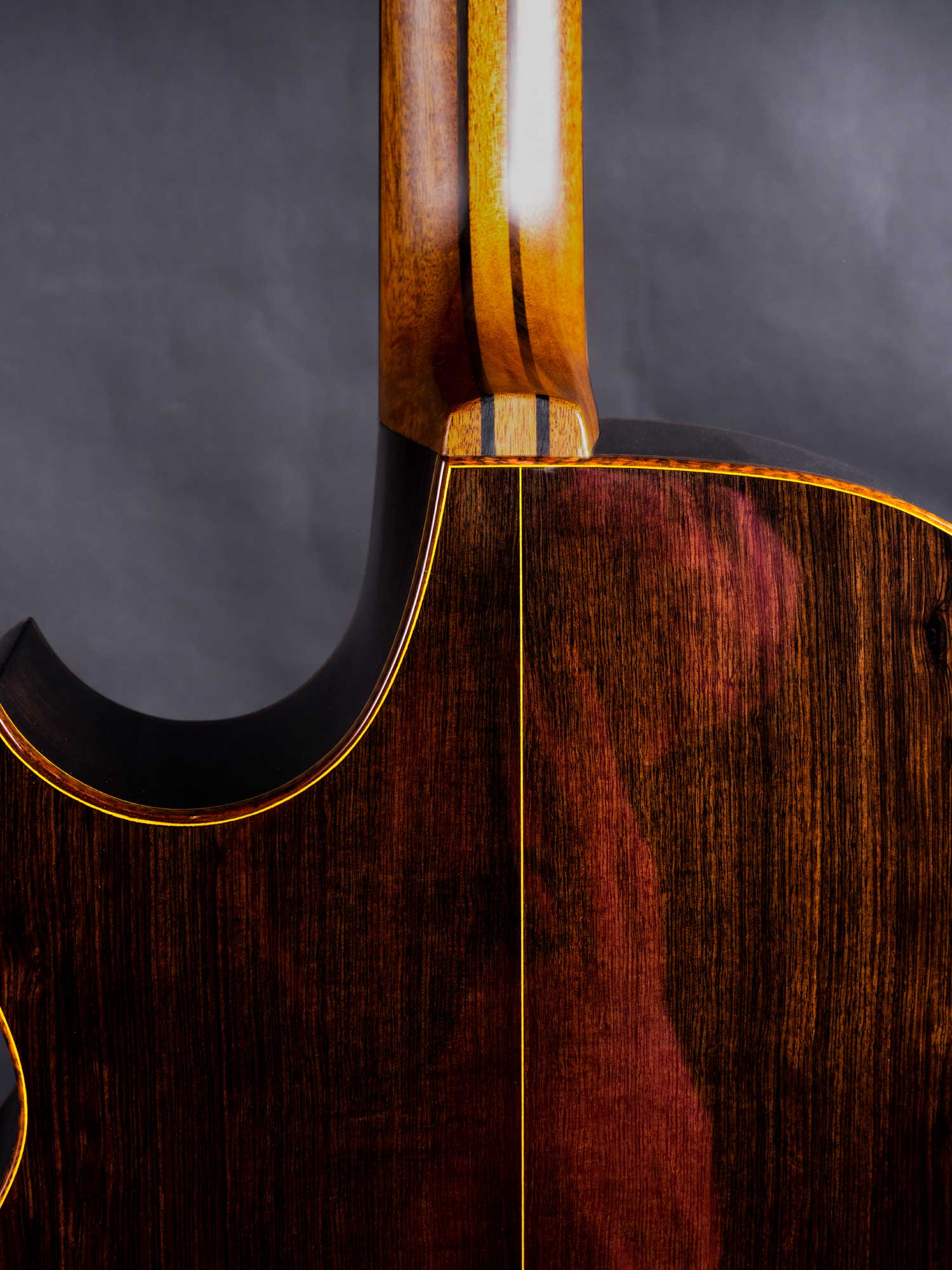
Alchemist style body, but with a long scale, African Blackwood back and sides, exceptional Sitka Spruce soundboard, laminated neck with “Twisty” heel.
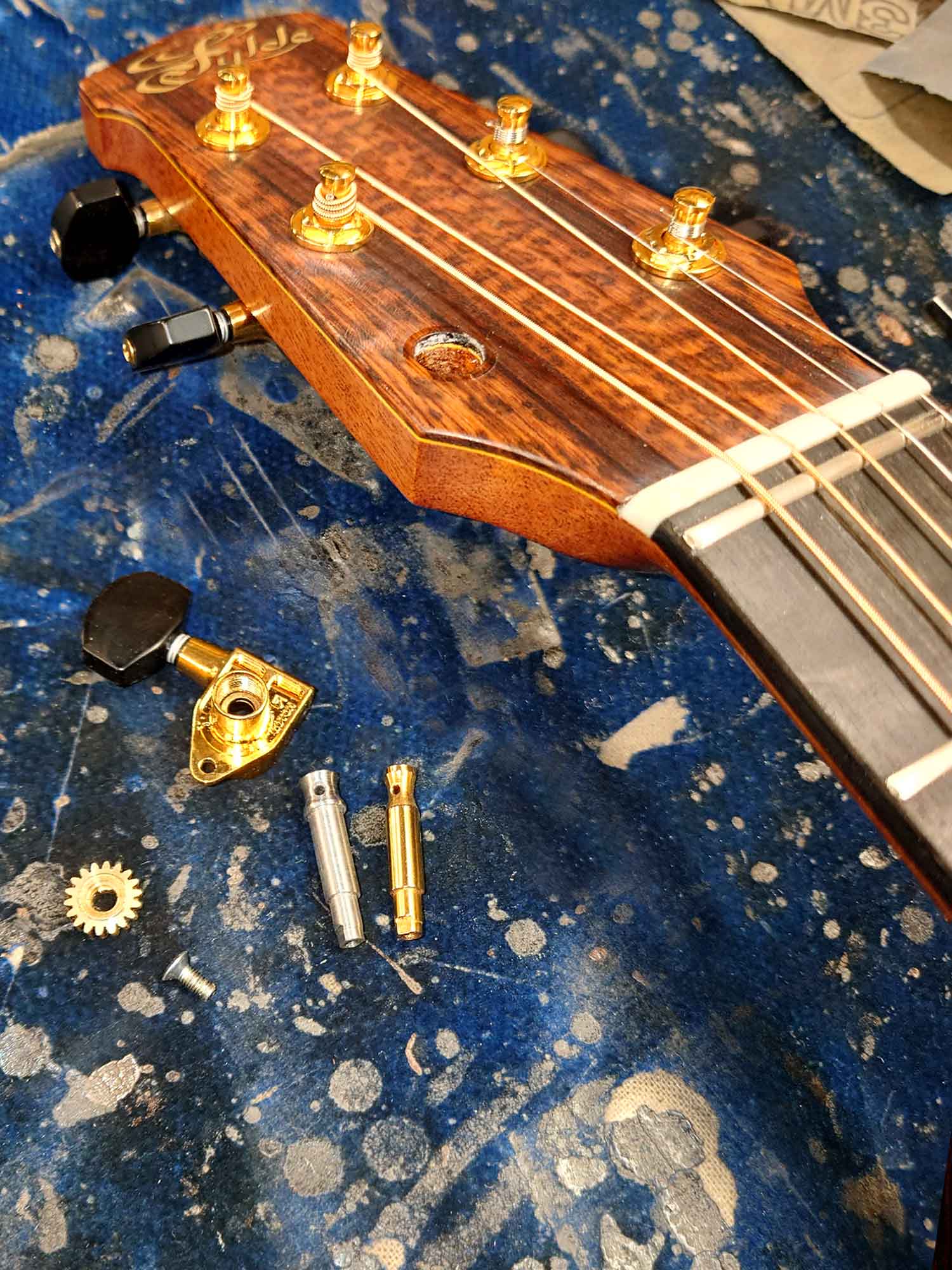
It has a slightly smaller headstock than usual for easy access while playing, and the bass tuner is modified to get a much lower ratio (like me, Antonio doesn’t like the modern fashion for high ratio tuners). I made a new tuner post with a larger diameter at the capstan end so he can change tuning, fast. It involved some very delicate machining and thread cutting and cannot now be assembled back into the tuner body until after the tuner is installed on the headstock, so any future repairers are going to be a bit baffled. Alex thought of a nifty dodge to remove and replace the backplate without damage while I did the engineering part.
The frets on the bass side have been ground down to minimise intonation problems when tuned very low, you can hear how it all works in the video below.
March: Antonio Forcione featuring Giuseppe Urso
It’s a shame Antonio isn’t facing the camera for most of this, but he does turn eventually, and you can see him retuning on the fly at about 3.50.
March: Octavius and Mark Knopfler
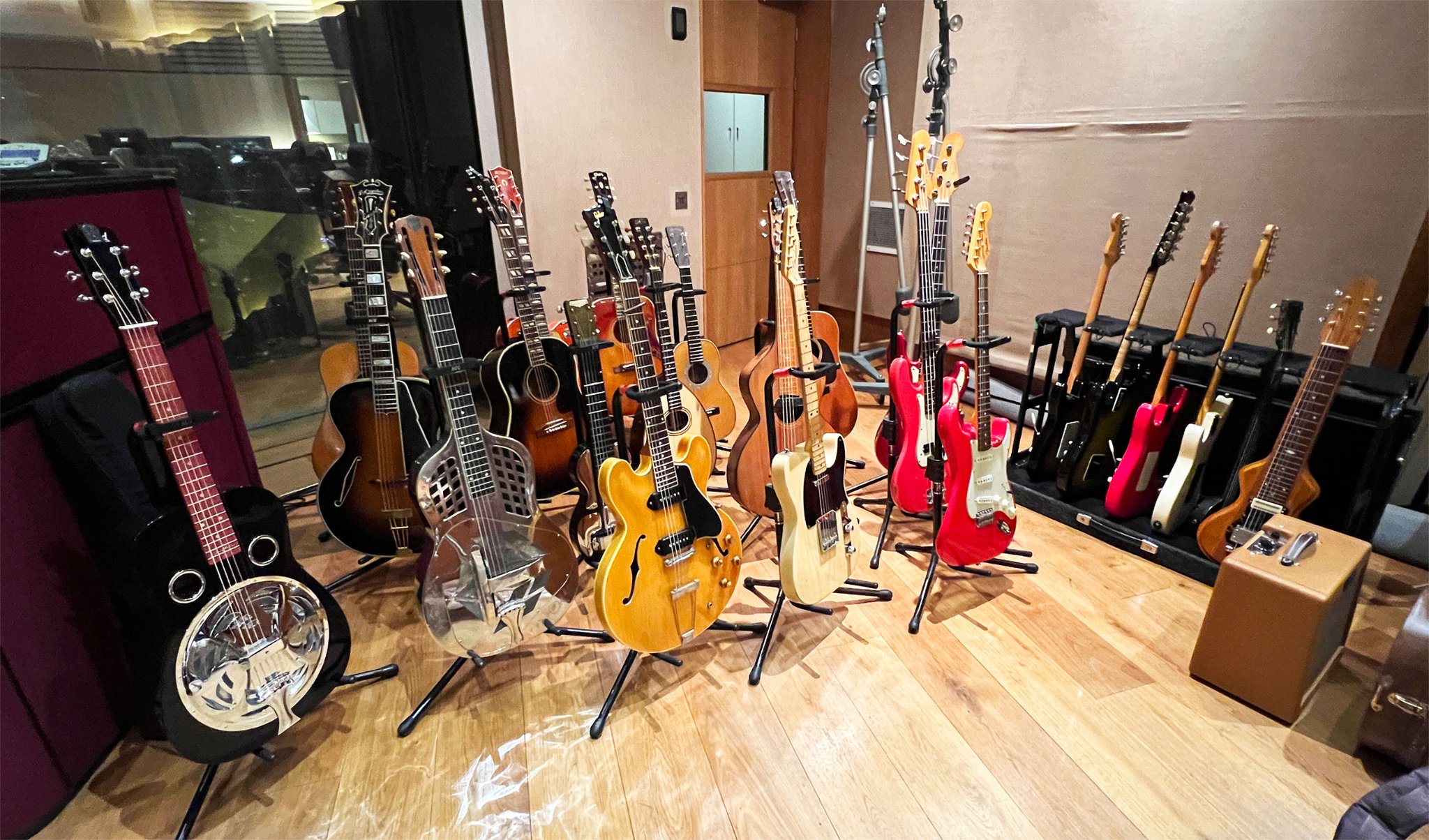
George Sansome spotted this (does he have eagle eyes or what?).
In case you can’t see it, in amongst the many thousands of pounds worth of vintage gear, there is a lonely Fylde Octavius bouzouki. I mailed Richard Bennett about it and he told me the story. He leaves this bouzouki at the studio in London and keeps his Arch Top with him in Nashville. The Octavius was used in three or four tracks on Marks’ latest album, I wonder if I’ll be able to spot them?
The recording was a first meeting up for the team since covid, but they still had massive safety measures in place, including having their own beer supply to avoid going out. Now there is a thought.
Richard will have his own album out soon. I will report back.
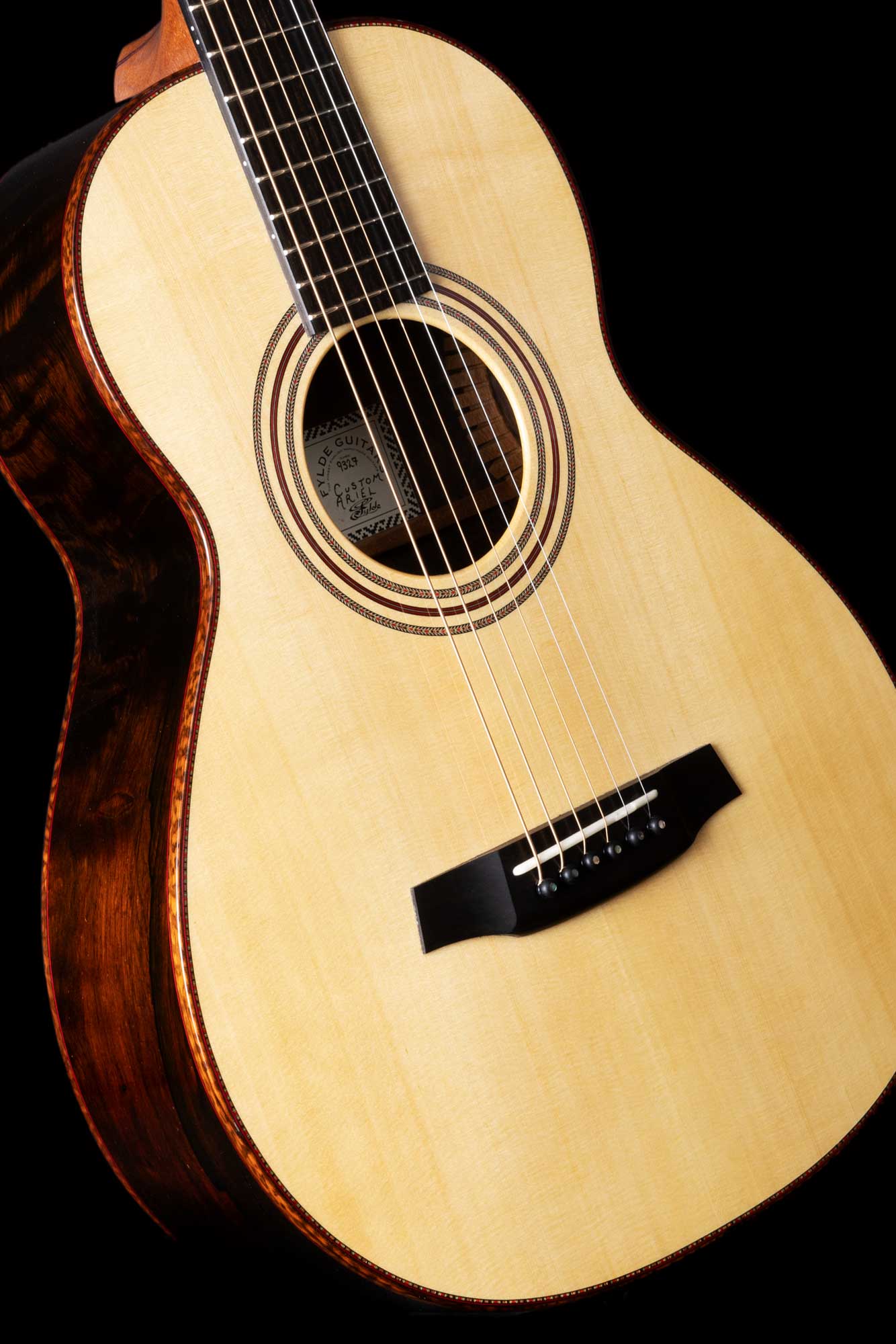
May: Rio Ariel
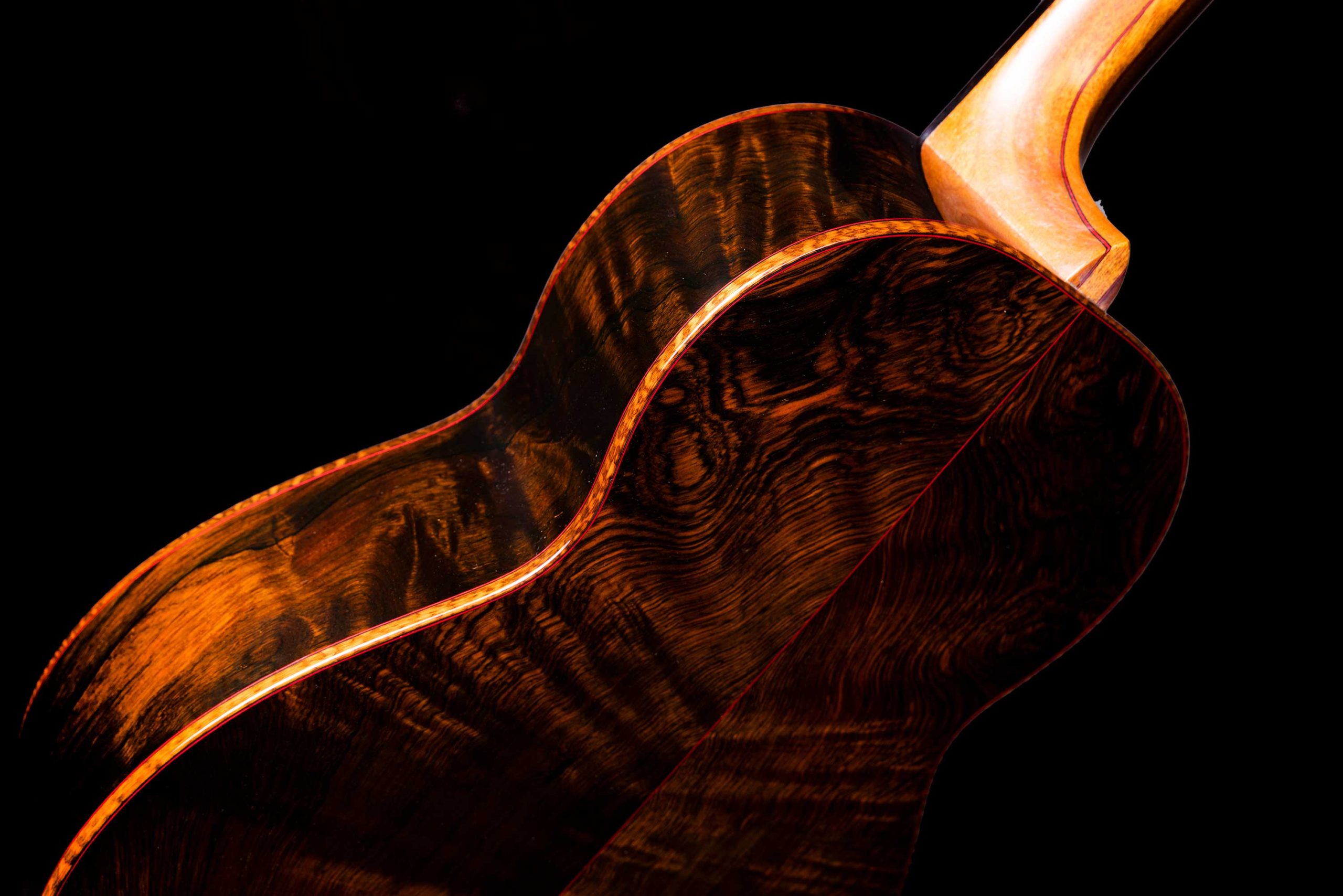
We made this some time ago, but other stories have pushed it back in the queue to get into the newsletter, and I can’t leave it any longer!
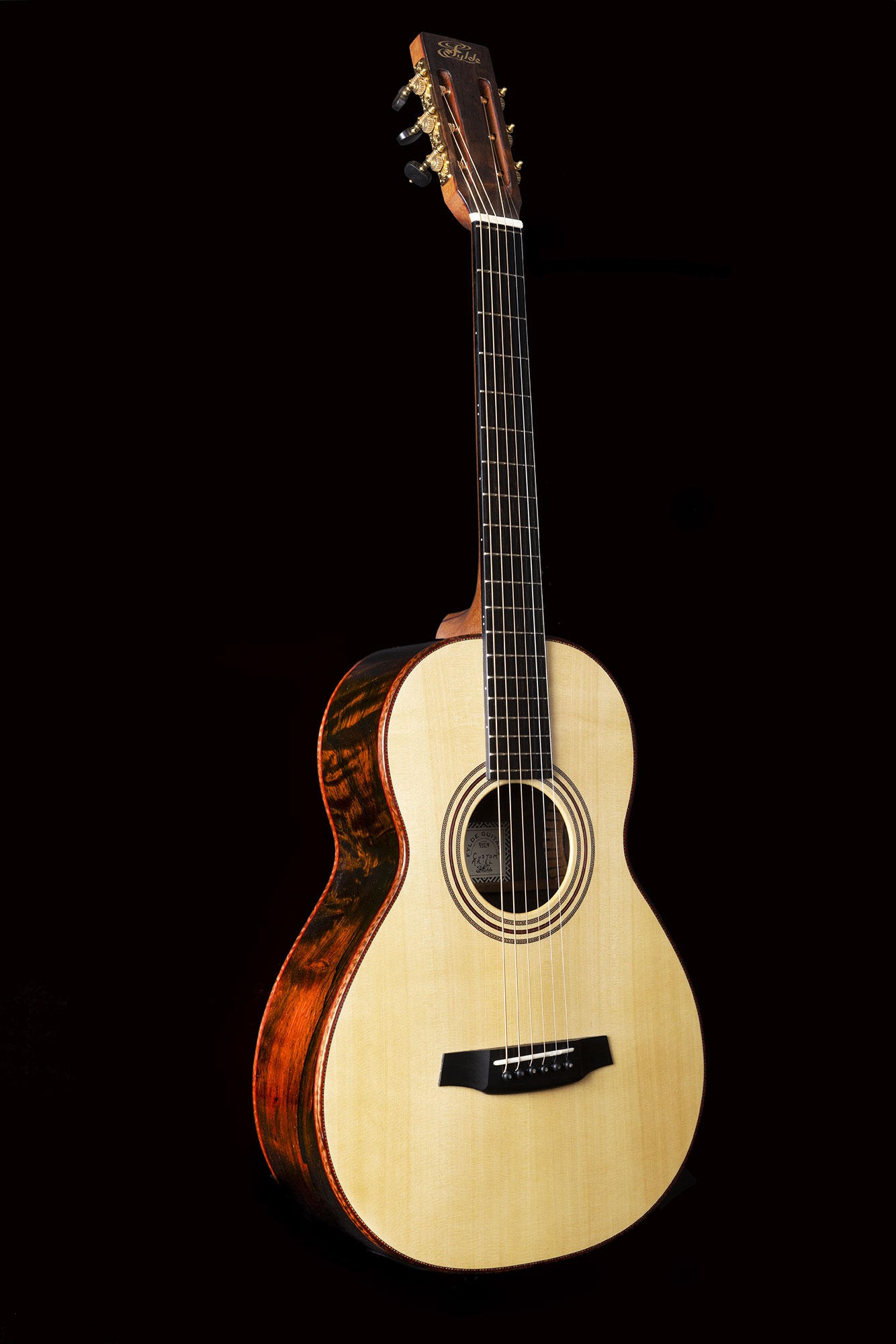
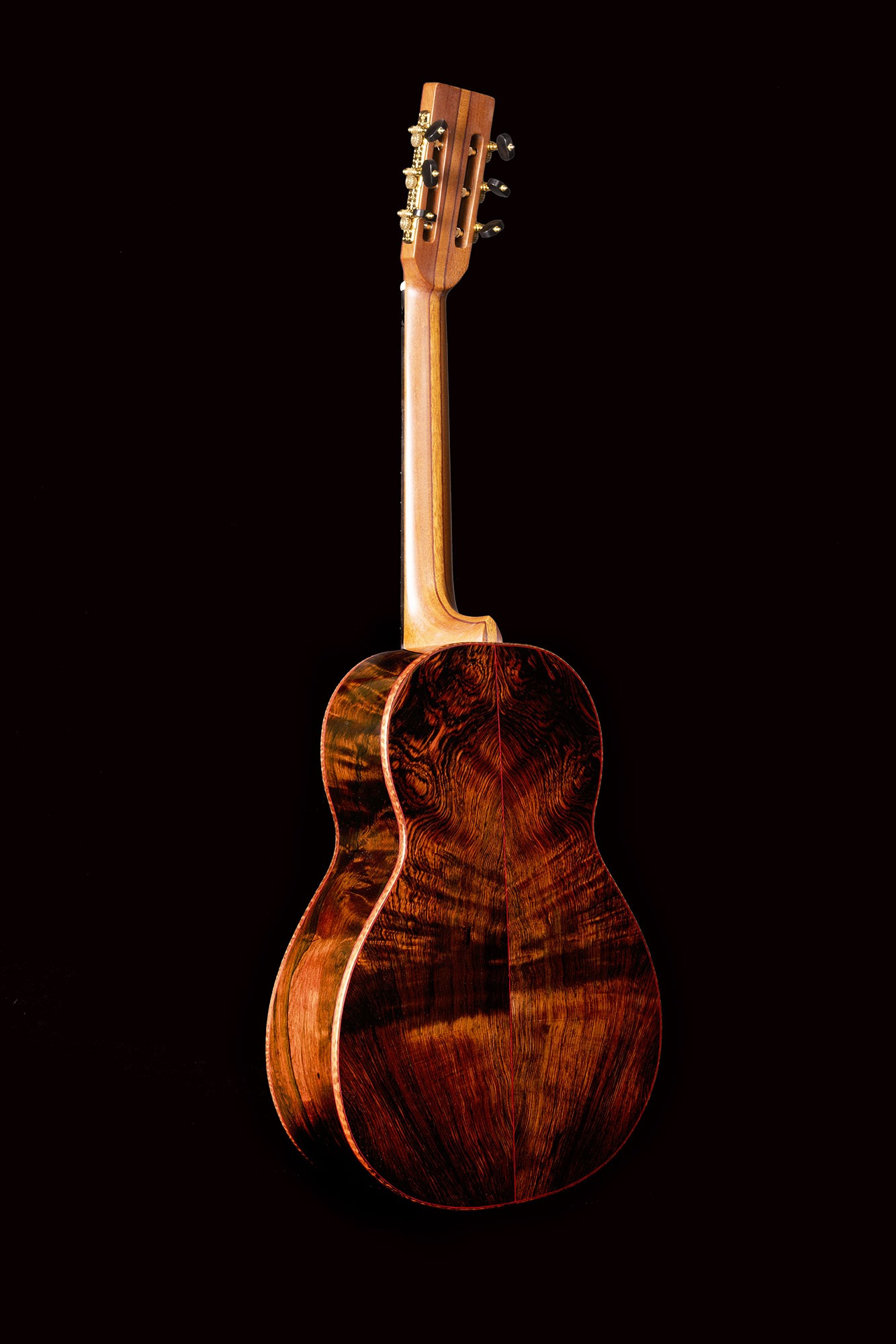
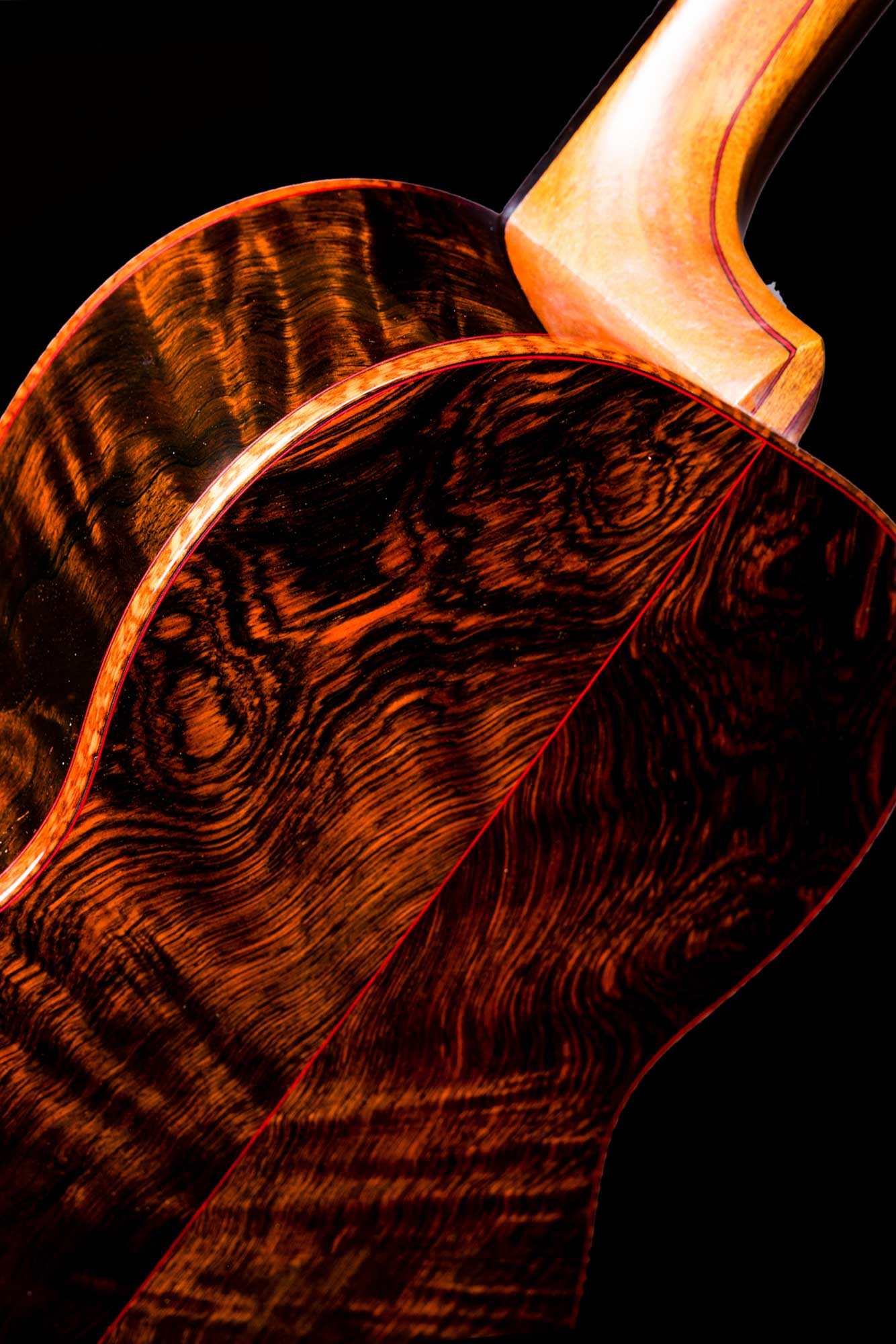
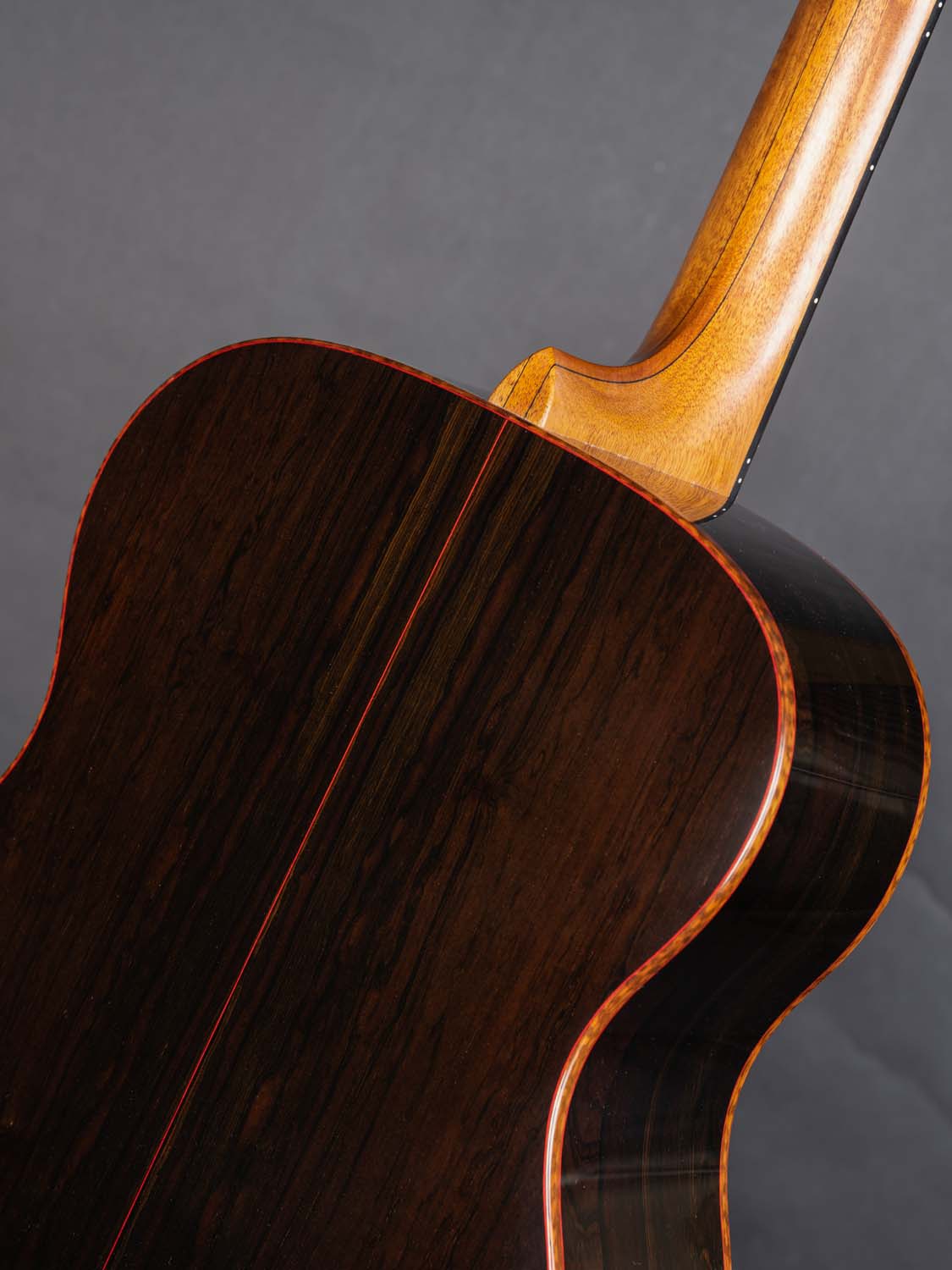
The brief was to use the most exotic Brazilian Rosewood that I had. That sort of instruction can be liberating but does add an extra responsibility. I have some very highly figured material, but some is so extreme that I’d be wary of its stability, and some players do question its ” Musicality” as well. Fortunately, as I’ve said before, the Ariel is so small that I have a lot more wood to choose from, I can remove any suspect areas and small knots etc so I’m using the very best material even within the extreme colour and grain. This piece reminds me of a guitar I saw on a Segovia album sleeve many, many years ago.
The top is Yellow Cedar that came in a billet from Alaska amongst a parcel of Bracewood. It’s exceptionally fine grained and stiff, so again, the Ariel size works well, as I don’t need to be scared of making it rather thinner than usual. That’s a big factor in guitar making, and something where fifty or even sixty years of pushing the boundaries bit by bit counts for an awful lot.
Other details- Snakewood bindings because I’m in love with it at the moment. Paul doesn’t love it as much as me, because I hand the bending over to him, I don’t think my hands could deal with it now, that’s the other side of the fifty years thing. A rather pretty laminated neck, red inlay lines at all the borders and delicate Gotoh 510 tuners.
The owner is very pleased.
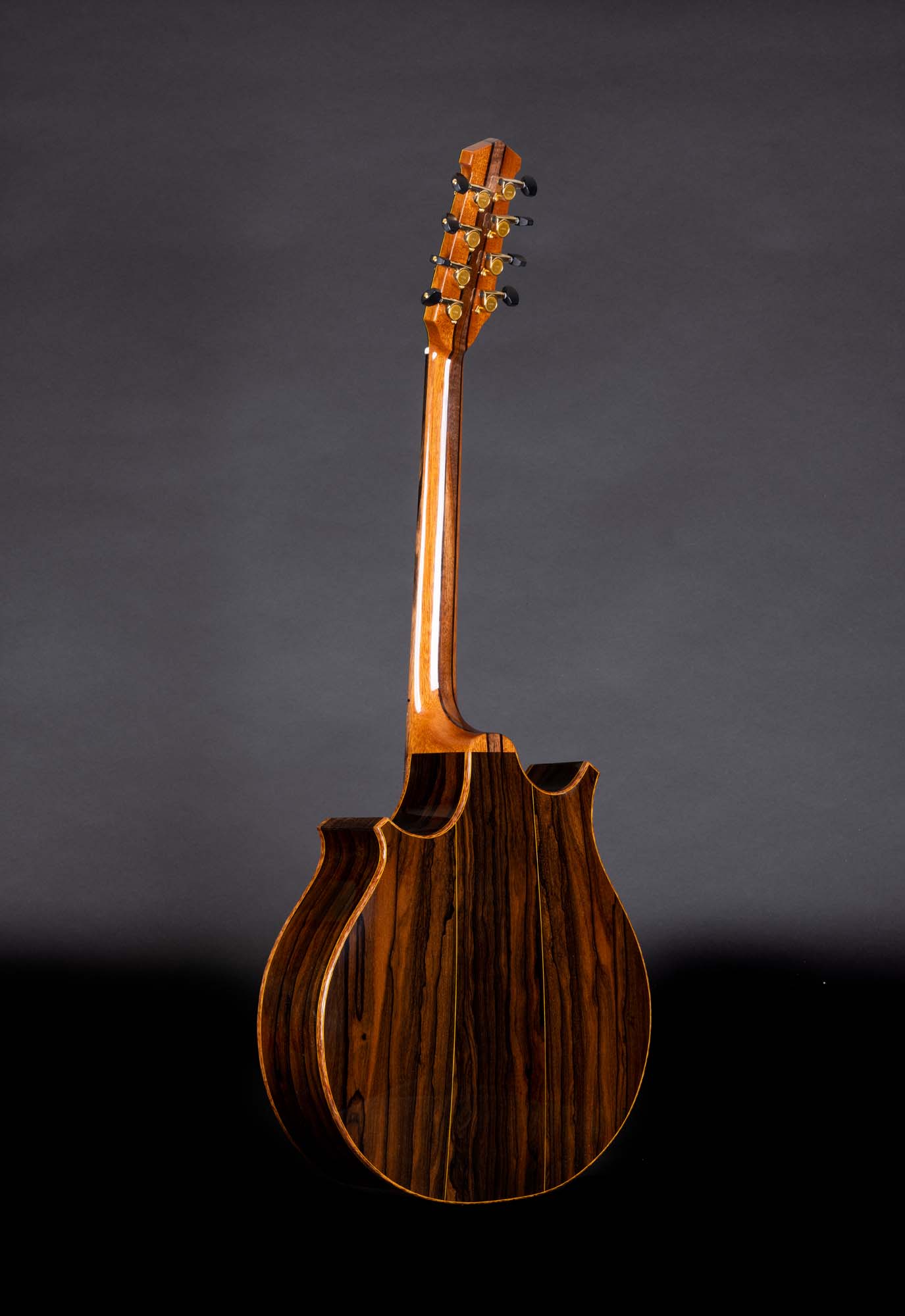
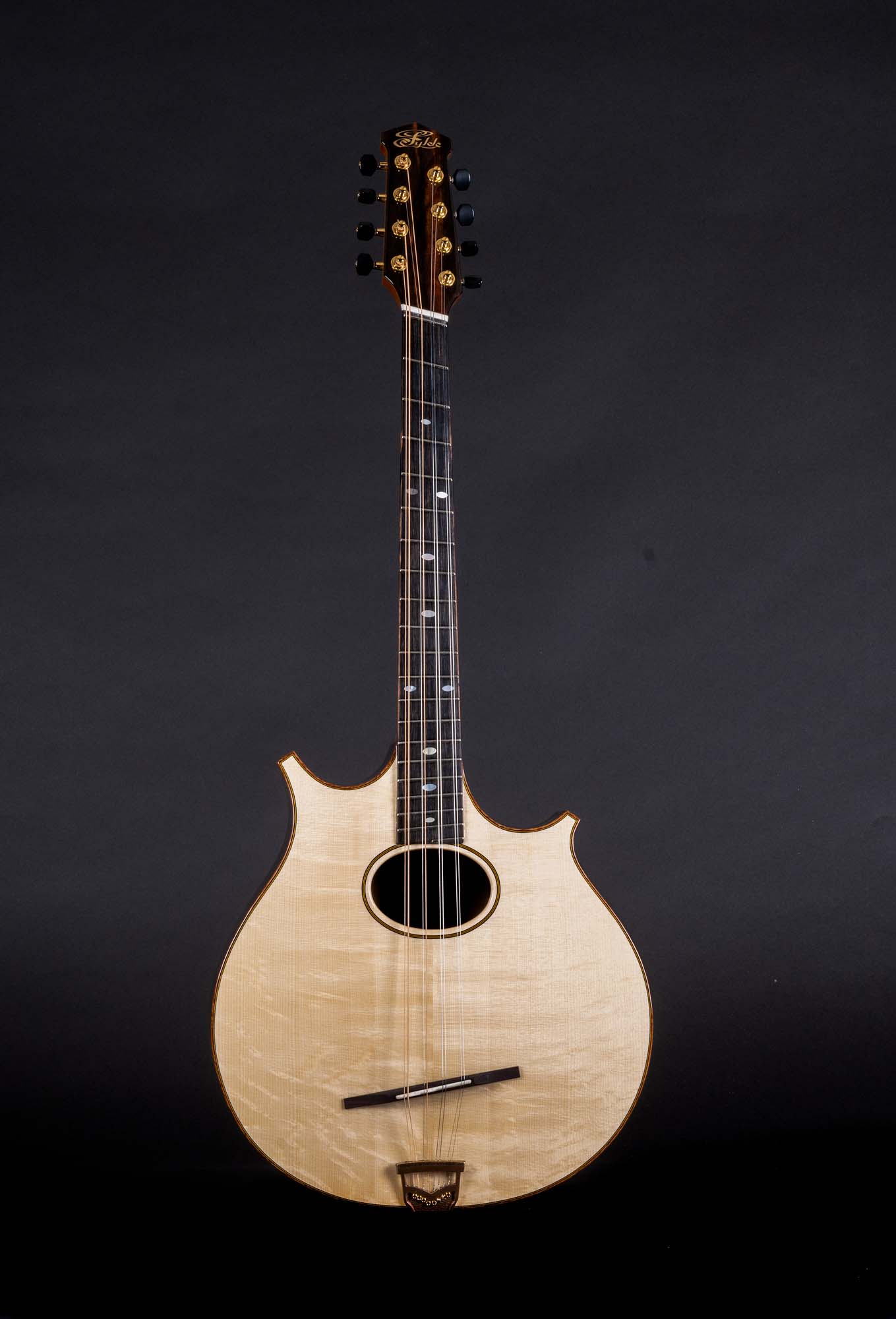
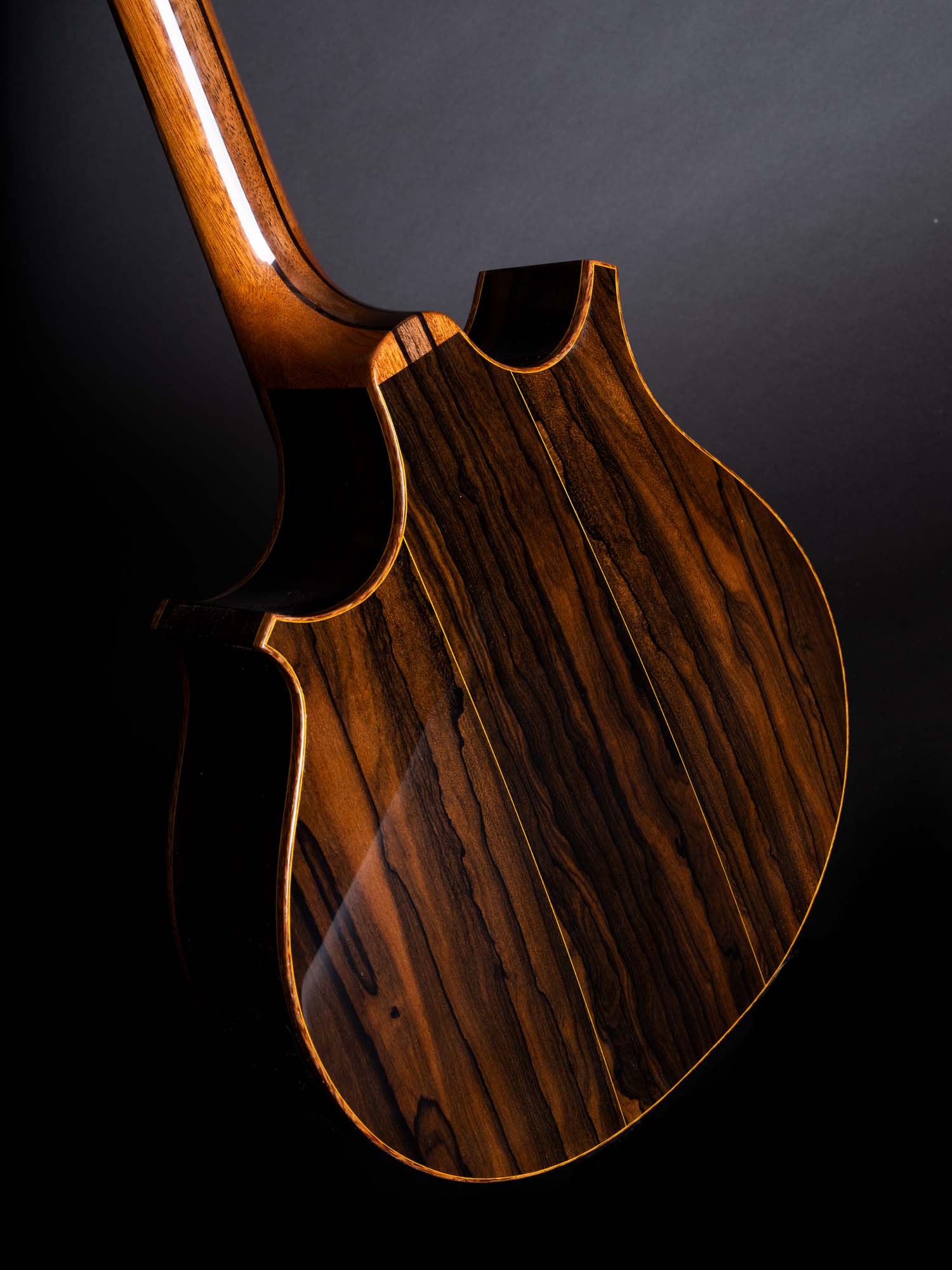
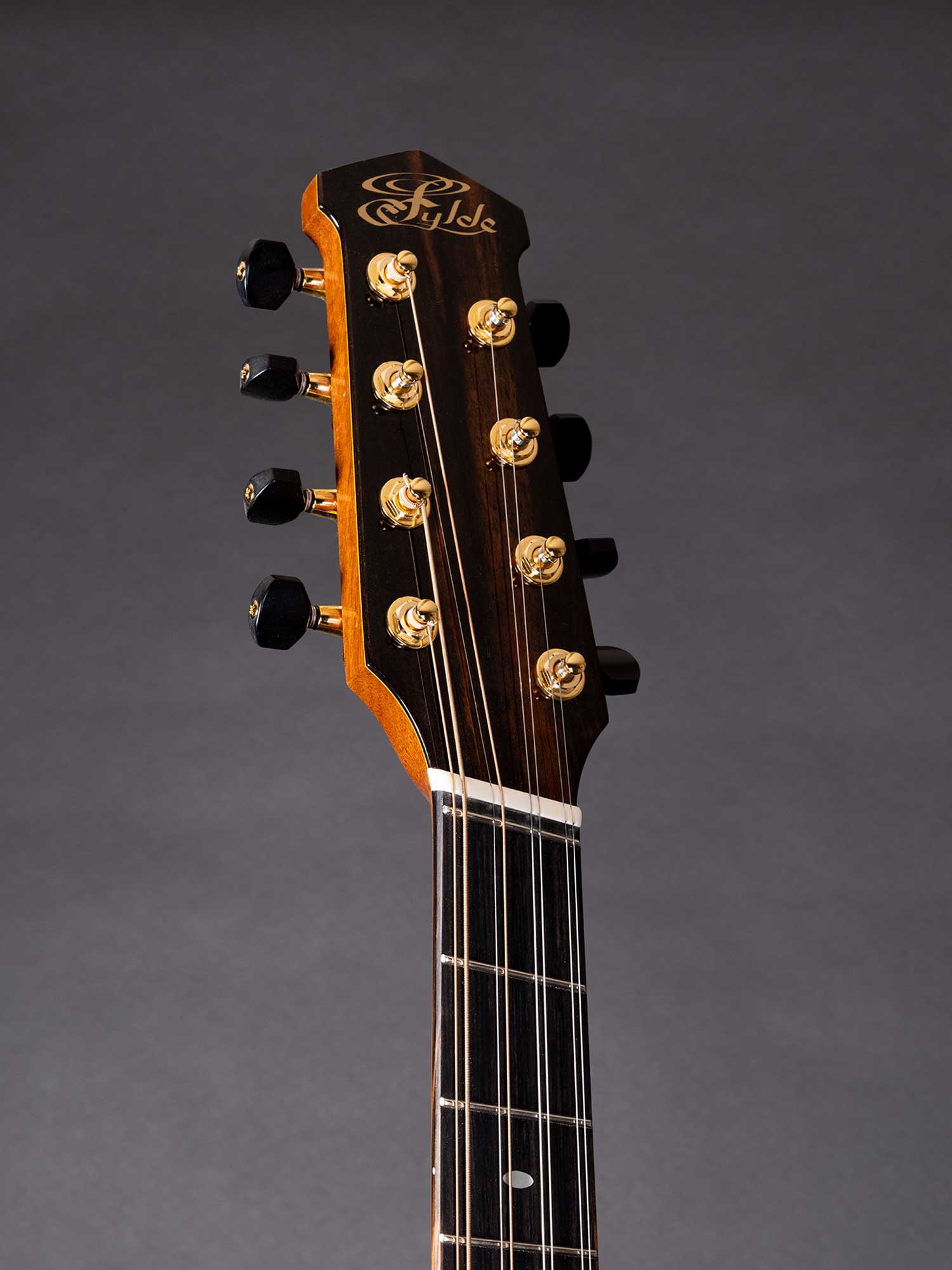
May: Siricote fan fret bouzouki
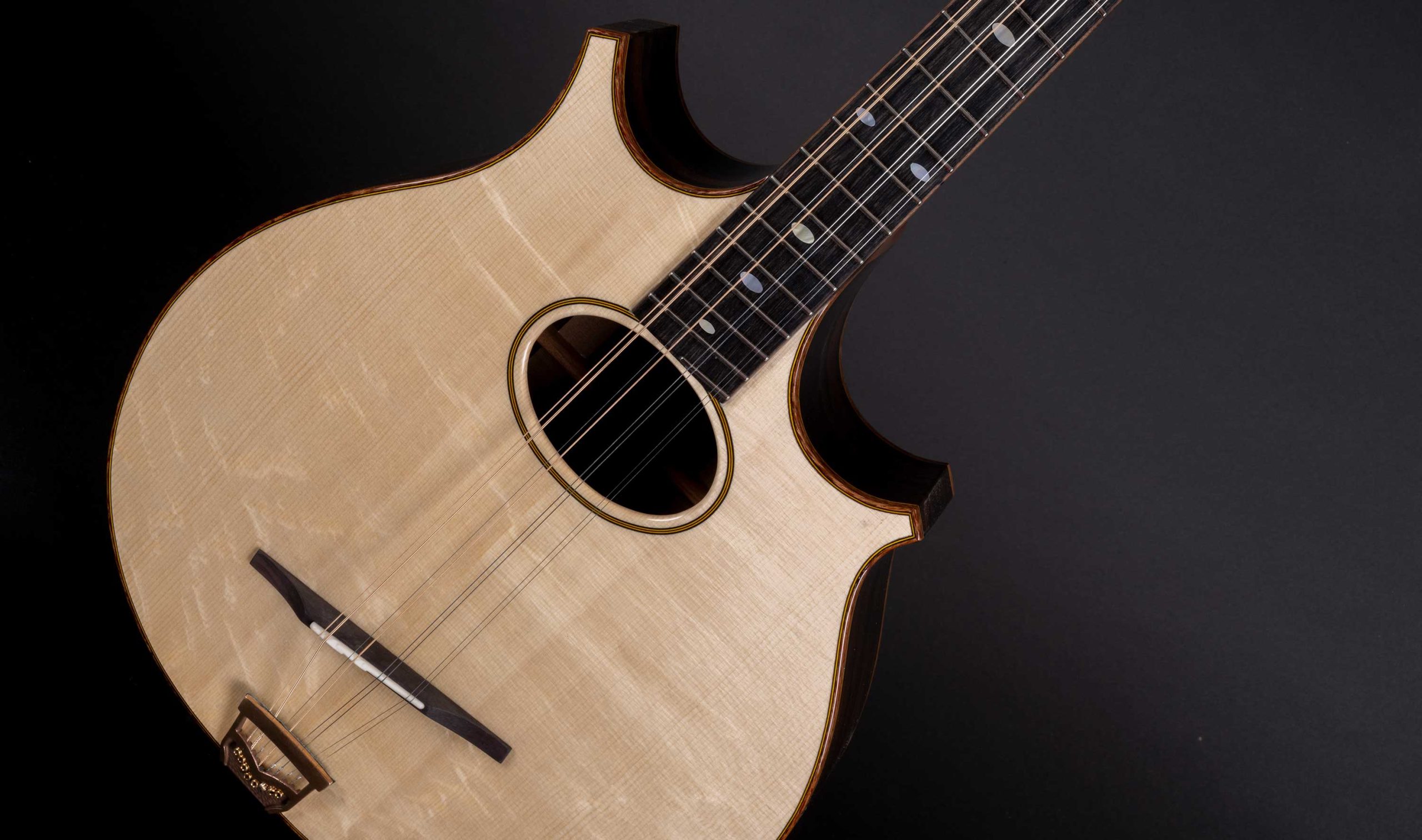
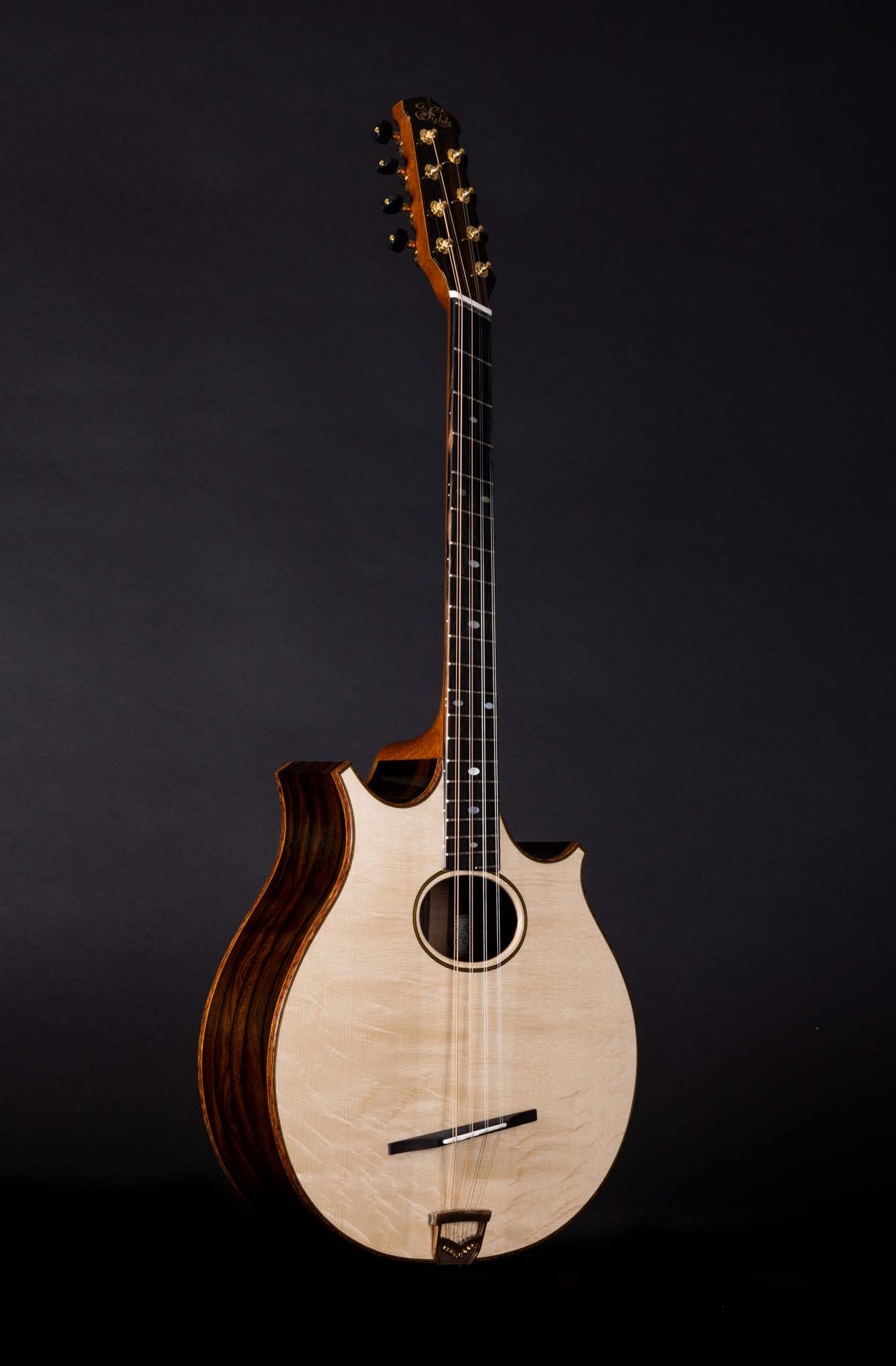
A custom bouzouki inspired by the very unusual instrument we built for Troy Donockley maybe ten years ago, but with different timbers and details.
This one is made largely from Siricote, and I wish I hadn’t agreed to that, I had forgotten how allergic I am to this timber. Even though Paul did the bending and I did manage to keep away from most of the woodwork, it still “got me” and I haven’t completely recovered, six months later. But doesn’t it look nice? The Bearclaw Spruce and the fan frets were more customer requests, but ones that I quite like and don’t hurt me. I do suffer for my art, I should be living in a garret, eating day old Baguettes and drinking Absinthe. What is Absinthe anyway? Is it like Laphroaig?
The bindings are Coconut, bordered by gold lines. The neck is two laminations of Mahogany, one of Walnut, and two ebony lines. The head veneer is Macassar Ebony, and the fingerboard is Ebony with oval pearl inlays to match the soundhole.
All rather splendid, I’ll get more pictures when the custom-made case arrives.
May: AND NOW, WHAT YOU HAVE ALL BEEN WAITING FOR - IT'S ENGINEERING TIME!
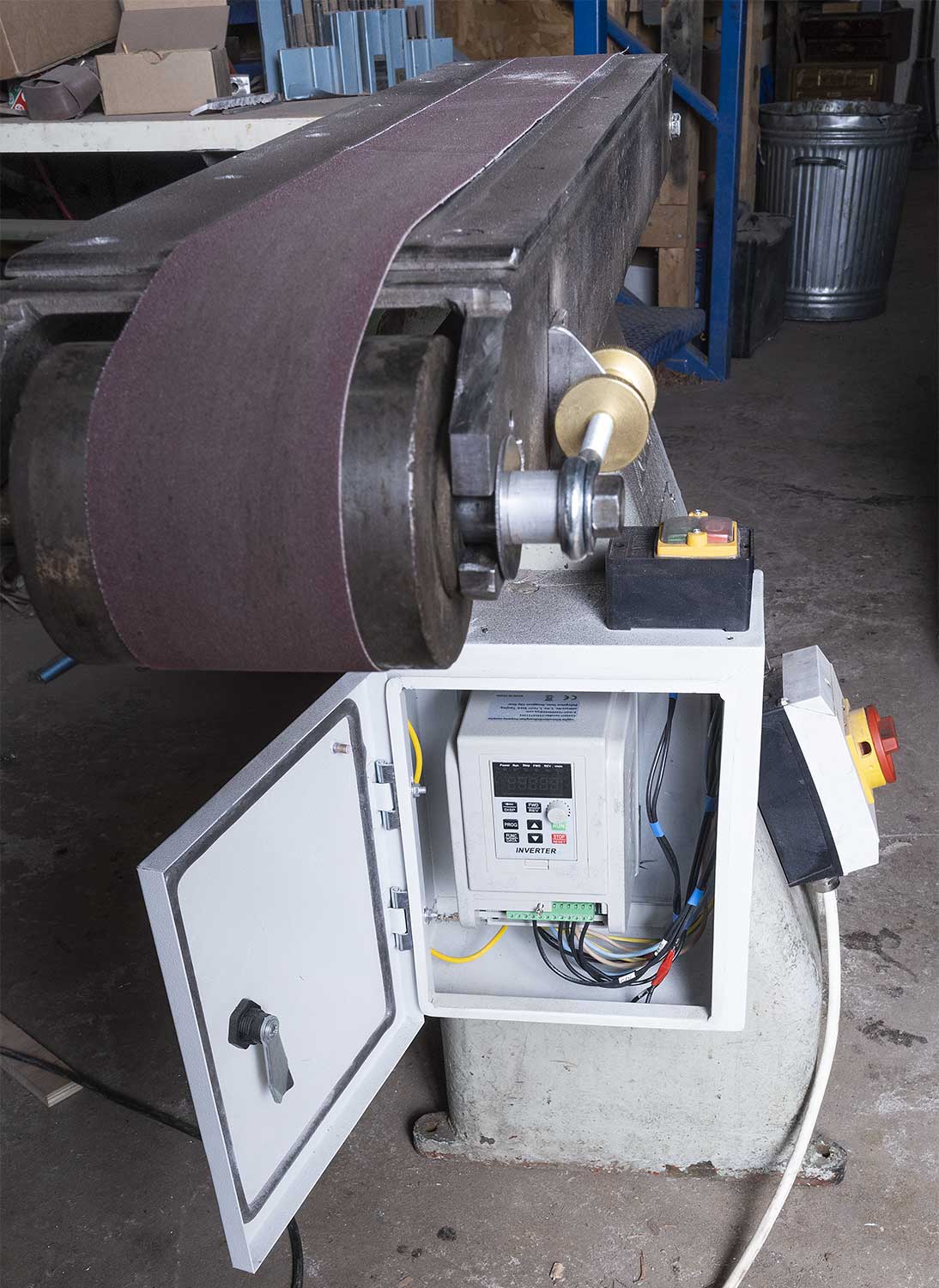
A New Belt sander.
Here is a new belt sander that I’ve just about finished. It has an extra-long, ground flat bed for sanding fingerboards exactly straight. It has clever new belt tensioners, and VFD Inverter control for the belt speed. Most guitar makers have belt sanders, they are one of our most useful tools, but as with any tool, using them still requires skill. When I was at technical school, the woodwork and engineering shops were a big part of my life. I was always taught to do the job by hand, then once I had the skills, the teachers all said the same thing. “Ok, it’s obvious you can do this, don’t damage your hands and waste your time doing it that way anymore”. I wish I’d taken more notice of them.
May: Latest visitors

A few weeks ago, we left a door open and a day later discovered that we had a non-paying guest. This little red squirrel really did not want to leave, I left a window open, and a trail of nuts leading towards it, but no, he preferred the comfort of our spare room curtain pole. Then I did my Bald Eagle impression, that moved him.
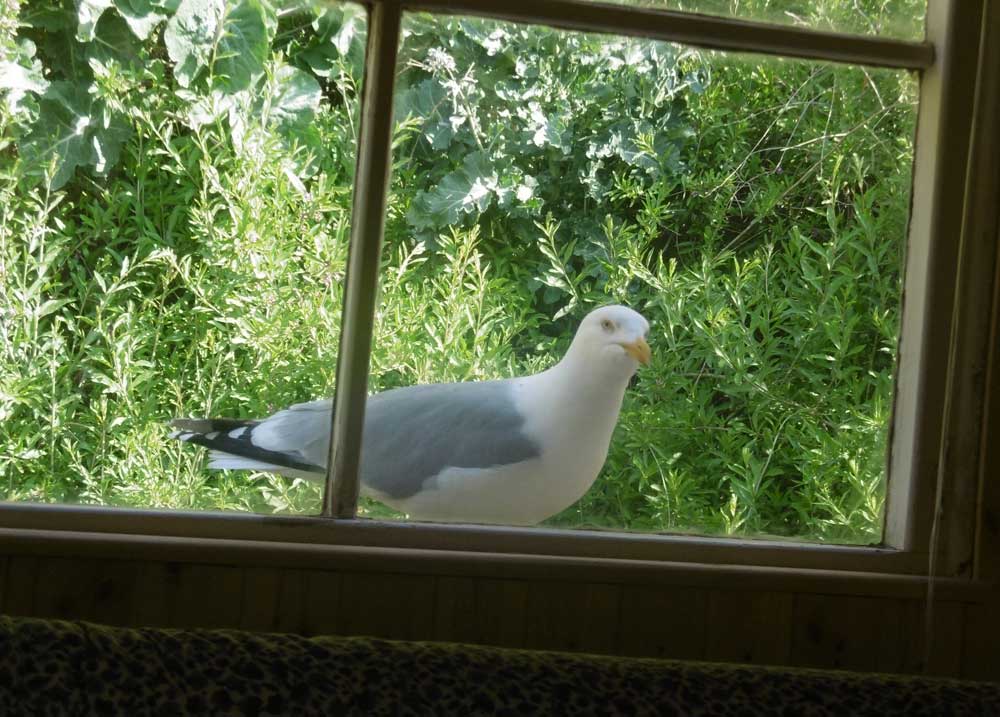
And the seagull tried very hard to join us on our holidays. He knocked on our bedroom window every morning at about 6 am. Mostly he used the V for victory signal – di di di dah, but one morning he hammered out a very passable “shave and a haircut, two bits”. All true.
We seem to attract various wild animals. It’s probably because I think Moira is a bit wild and Moira thinks I’m a bit of an animal.
No comments thank you.
June: Baritone Guitar for Richard Lindsay
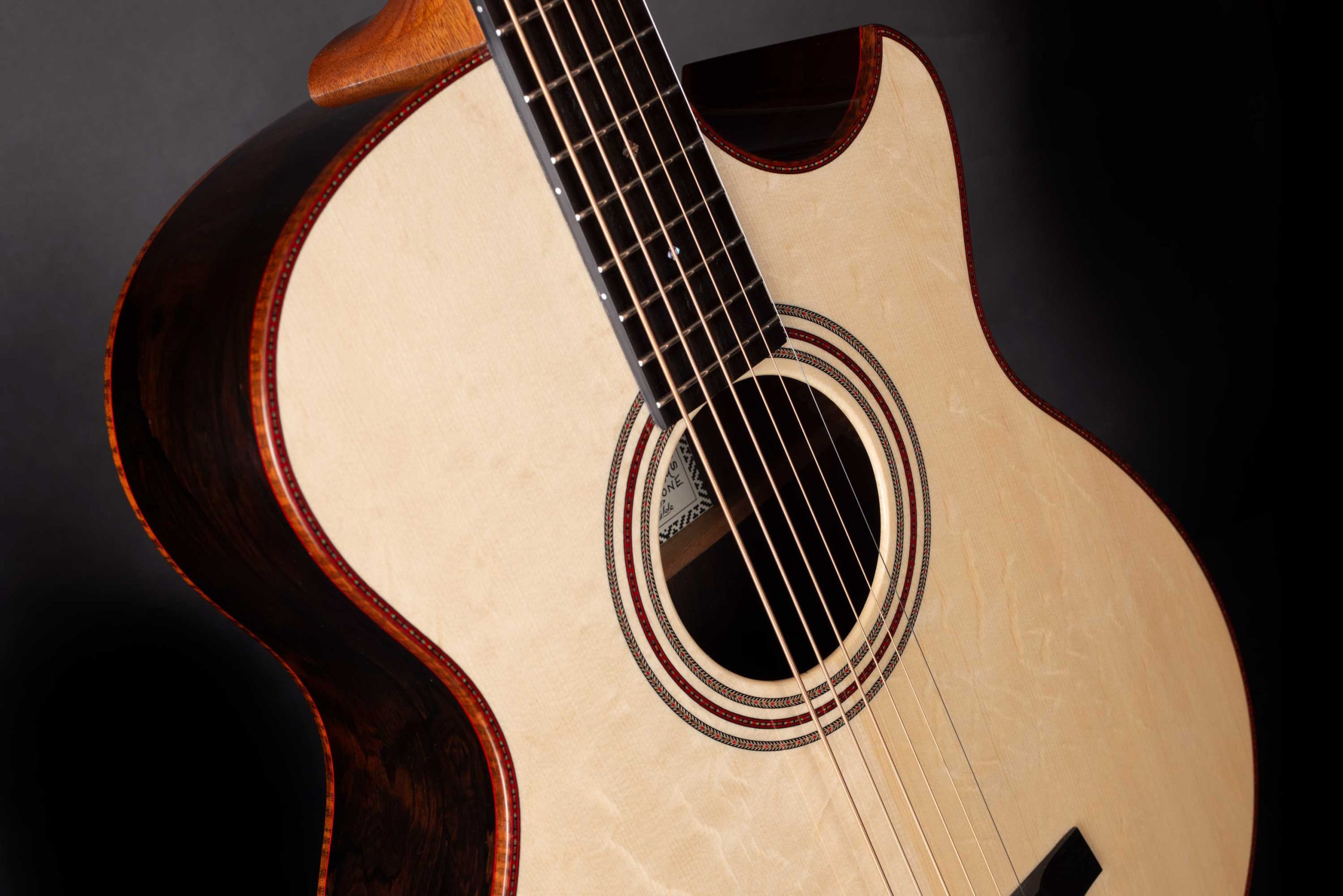
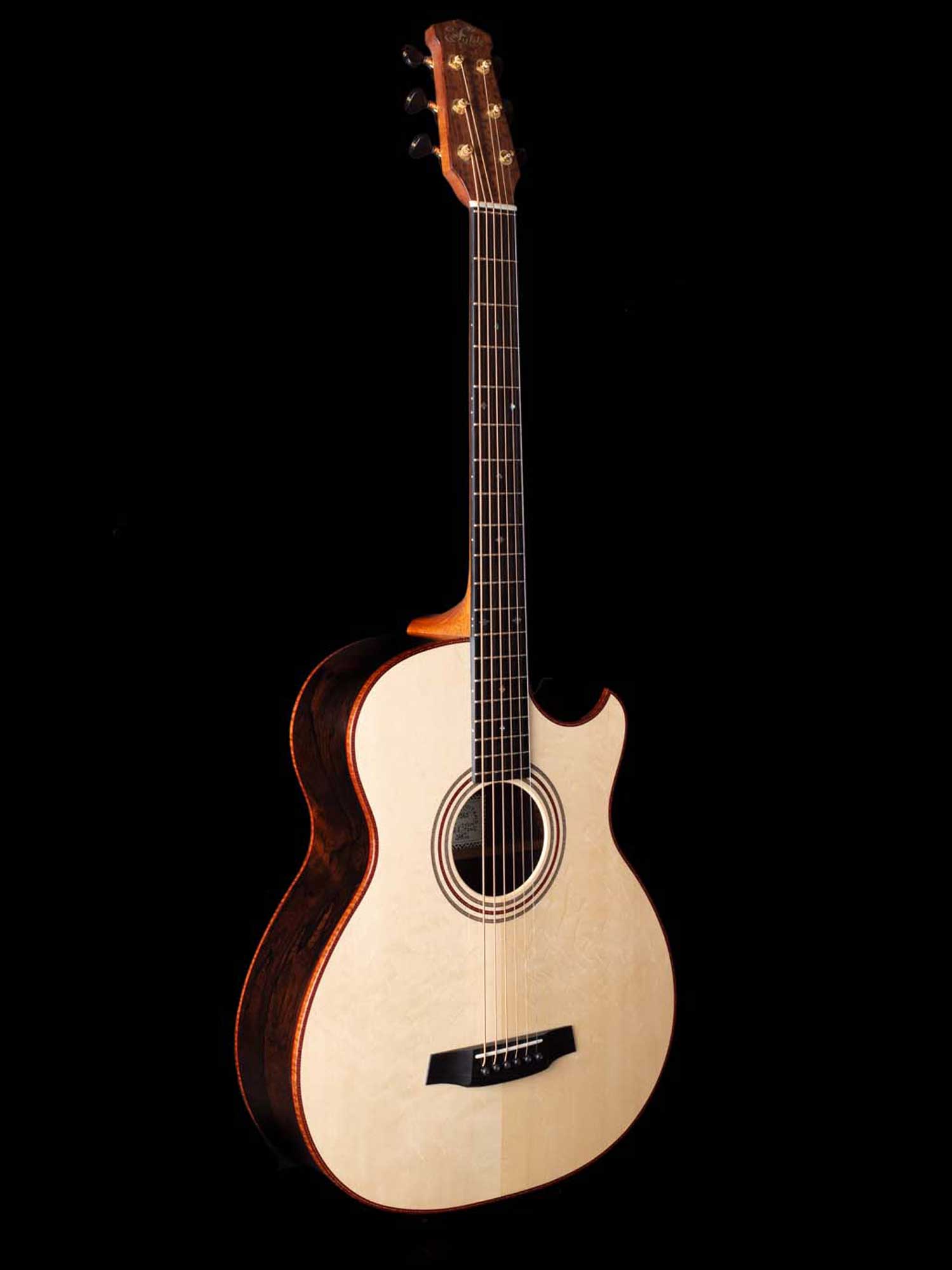
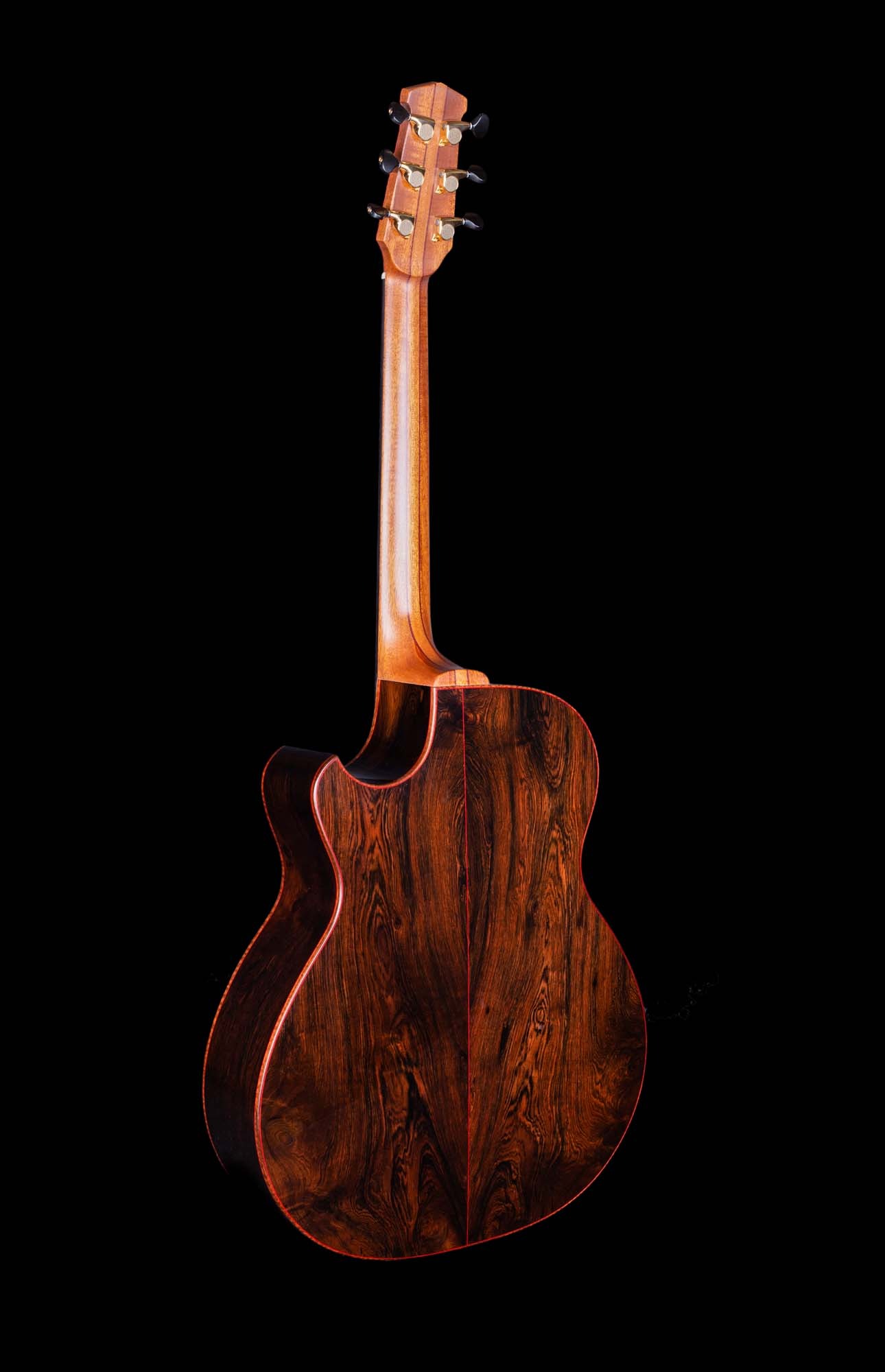
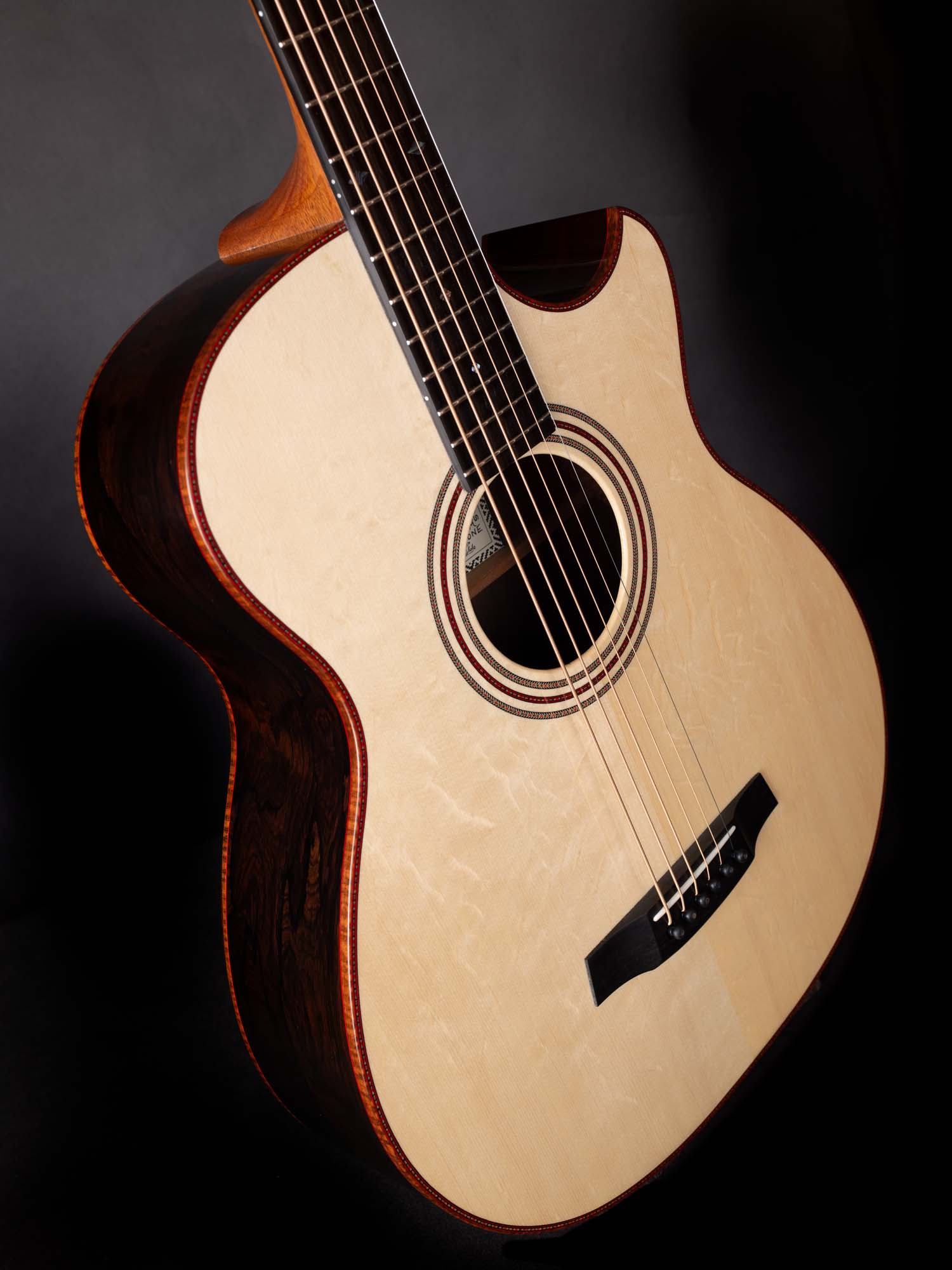
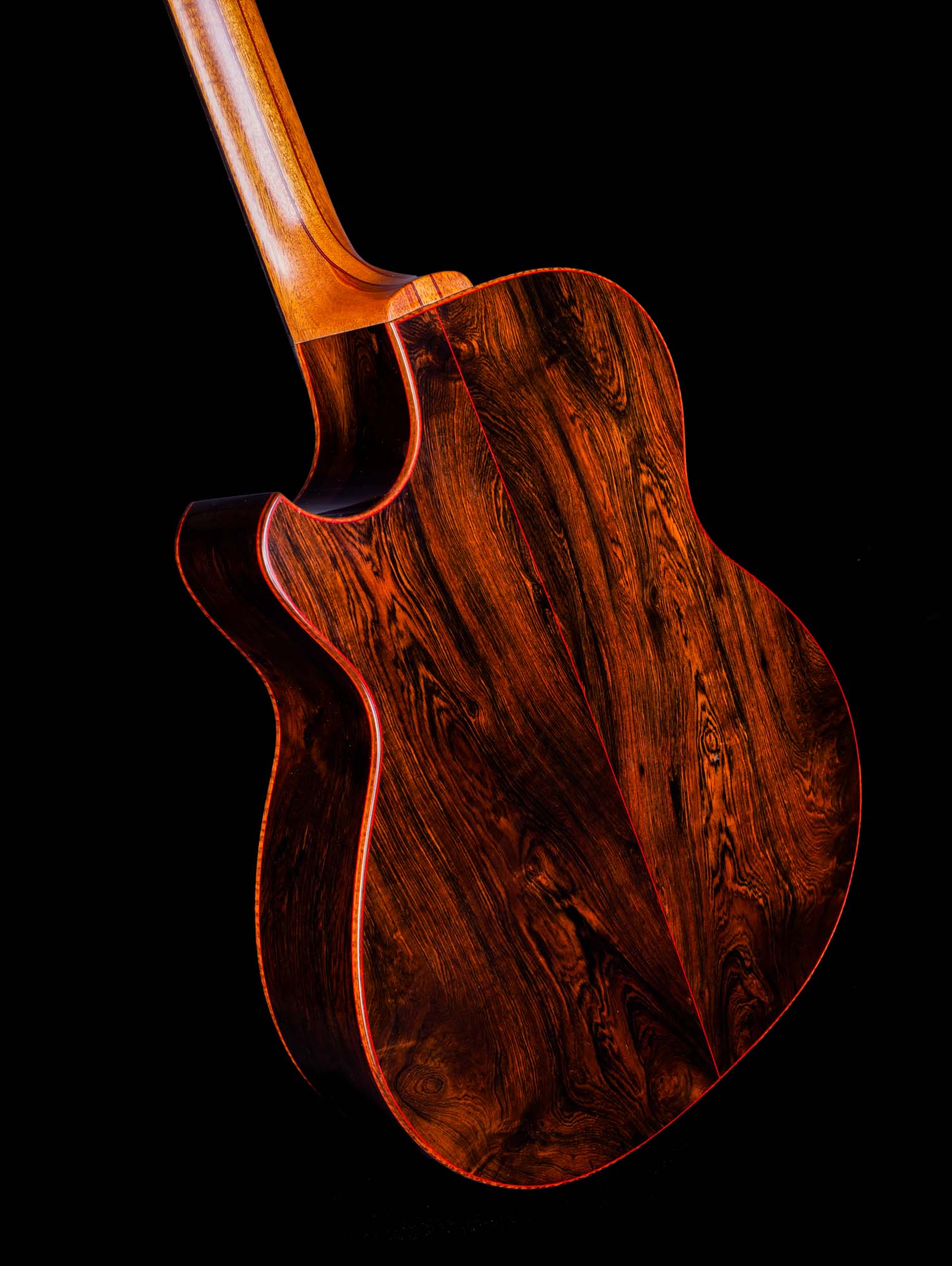
Richard is the wonderful chap who organises the Ullapool Guitar Festival; he saw the Rio Rosewood Falstaff that we had for sale a couple of years ago and his fingers started twitching. Result – a Baritone “Leonardo” made from the very finest of timbers. The Brazilian Rosewood is from a recent discovery of very very old, exceptional wood, with gentle but beautiful colours and grain. The top is Bearclaw Italian Spruce, with red purflings, the bindings are Snakewood with red borders. The neck is laminated from Mahogany with red and black veneer inserts, and an Ebony fingerboard with Abalone diamond inlays. It has a 27-inch scale length and a 45 mm fingerboard – there, how’s that for mixing up Imperial and metric?
The important thing about a Baritone guitar is of course, the tuning, in this case, B – B. With that set in stone, decisions need to be made about size and shape. A large soundboard deals with the amount of air that needs to be moved at low frequencies. A deep body would add a lower resonance but also make it much more uncomfortable to play. Richard and I did discuss a possible bevel, but I was reluctant to stiffen any of the edges and reduce the soundboard area, and it does play like a dream.
It sounds – well, terrific, glorious even. From top to bottom, it’s “solid”, every note is full and sweet. We are all extremely pleased. Richard hasn’t seen it yet and I can’t wait to hear what he says. It will be on display (but not for sale) at Ullapool in October.
June: Julie Bergman's Jubilee mandolin
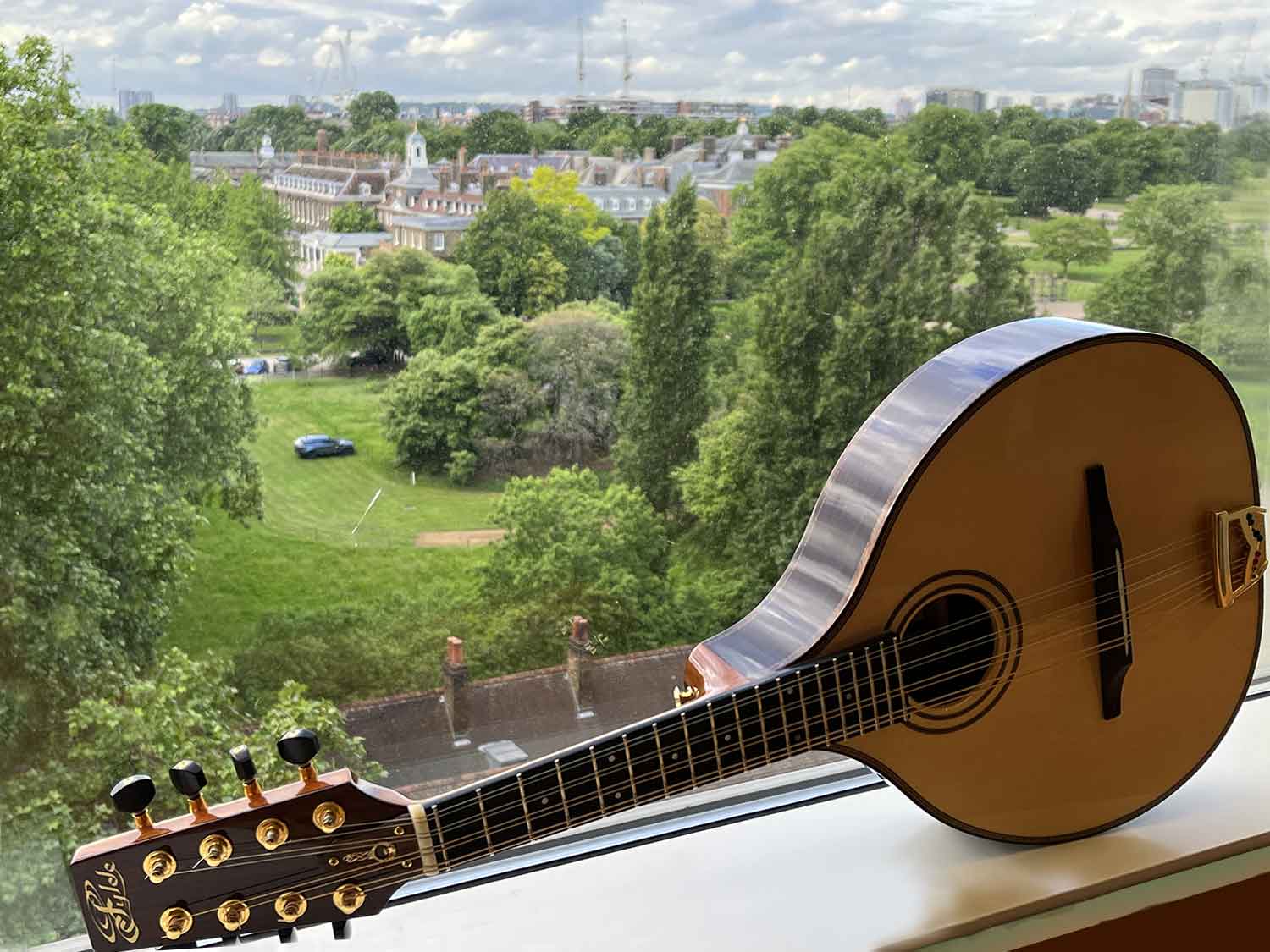
One of our favourite American friends travelled over with her mandolin for the Jubilee. No prizes for knowing where this view is.
June: Gandalf!

I have to tell you this, because you’ll probably see it anyway.
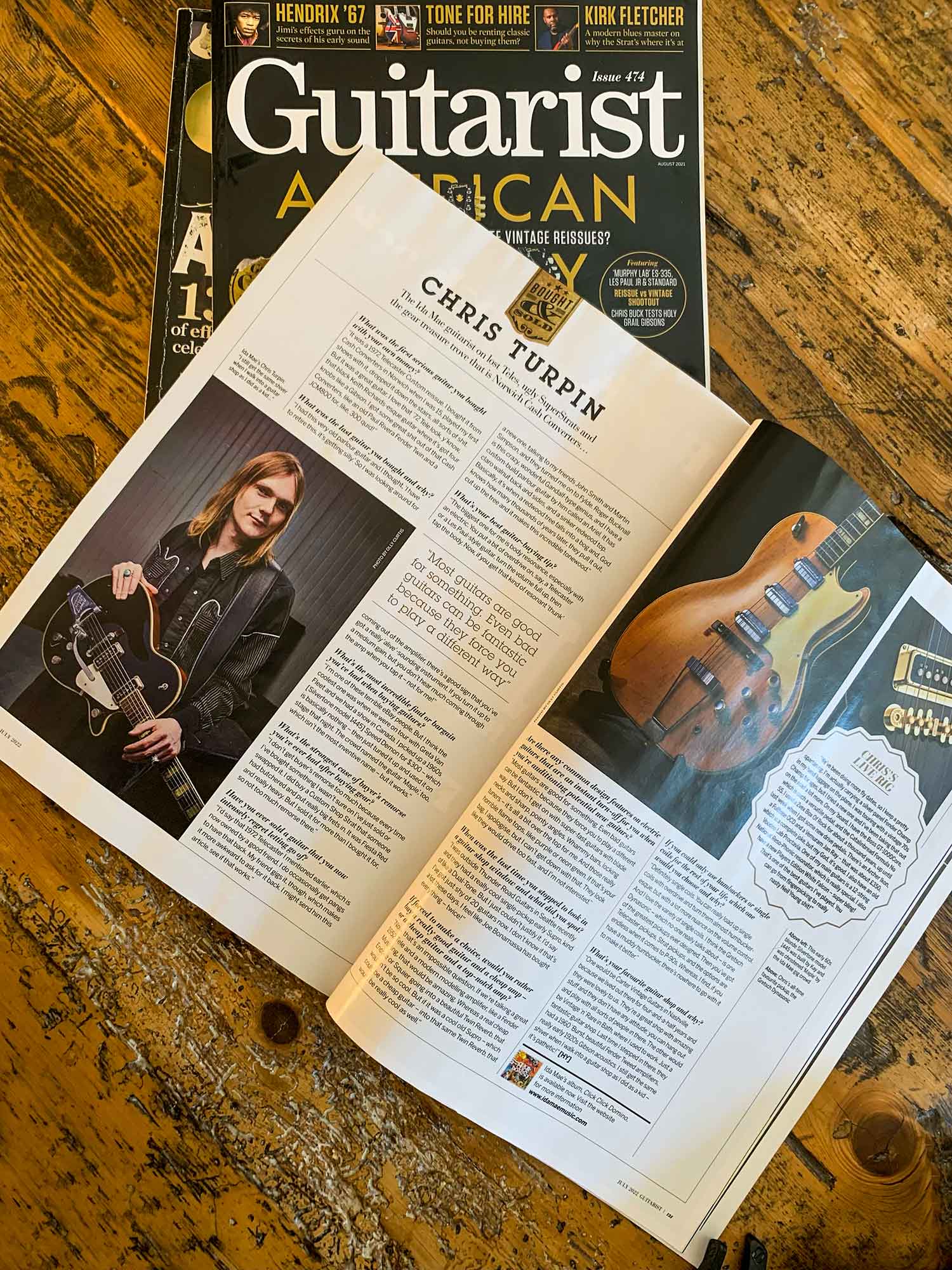
Chris Turpin was interviewed in Guitarist Magazine and described me as “crazy, wonderful Gandalf-like genius.” Oh dear. Parts of that is sort of OK, not sure about the rest, but I will embrace it, what else can I do? Of course, my very good friend Mike English has had some fun with photoshop.
Anyway, making the best of it, let’s have a look at some of Gandalf’s wisdom.
I like this one:
“I was talking aloud to myself. A habit of the old: they choose the wisest person present to speak to.”
and this one:
“Do you wish me a good morning, or mean that it is a good morning whether I want it or not; or that you feel good this morning; or that it is a morning to be good on?”
But this is my favourite, it sort of suits my mood at the moment;
“With a terrible cry the Balrog fell forward, and its shadow plunged down and vanished. But even as it fell it swung its whip, and the thongs lashed and curled about the wizard’s knees, dragging him to the brink. He staggered and fell, grasped vainly at the stone, and slid into the abyss. ‘Fly, you fools!’ he cried, and was gone”.
And as I have said a few times before:
NURSE!!
August: Orleans guitar
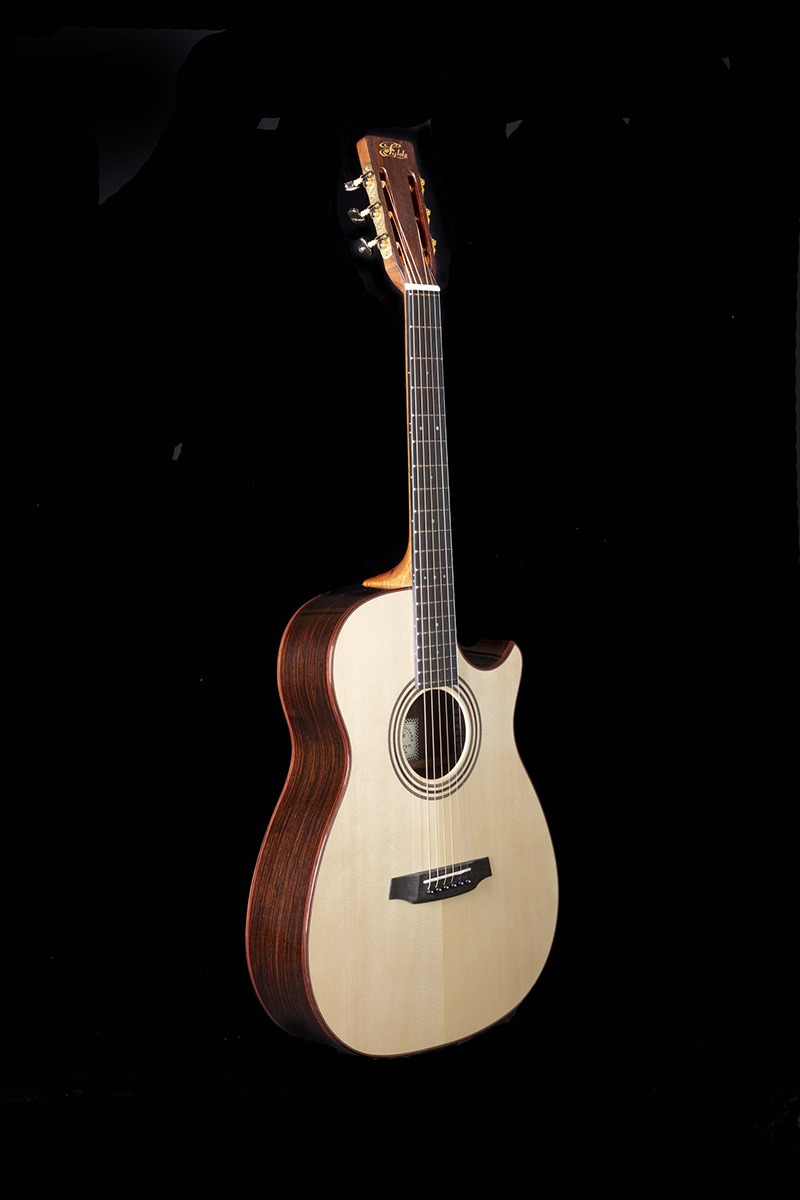
At last, I’ve managed to get something about this splendid new model onto the website. We’ve made it in several variations so far and I haven’t finalised anything, but I do want it to be “out there” for everybody to see. Most of what you might want to know is here.
Martin Simpson was (still is) very involved in the development of this design, and the name comes from a rather nice correlation between the place where Martin used to live, and one of Shakespeare’s more interesting characters – “The Bastard of Orleans”, which in the Bard’s time was almost a compliment.
There is a lot more information in the website details, and if you are interested, I’m happy to discuss, email please, not phone.
August: Fylde at Halsway Manor
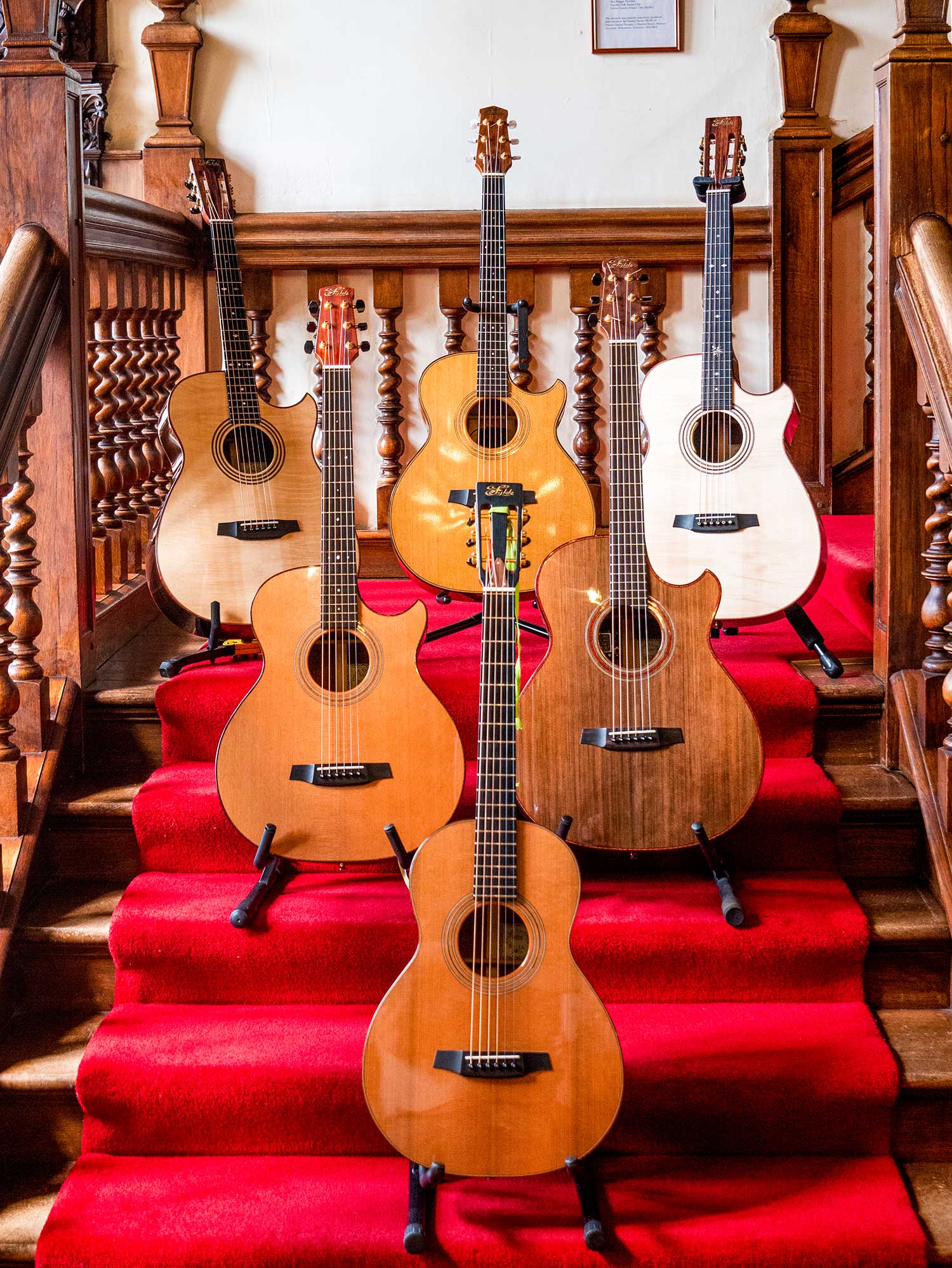
Ben Walker sent me this picture – Six Fylde guitars amongst the advanced students at the Halsway Manor gathering, tutored by Ben. Two of those guitars are the new “Orleans” model featured above. They also had a Fylde mandola amongst the students, our world domination is slow, but it is happening.
August: Nancy Wilson

Nancy send us this latest picture with the Custom Eric Bibb guitar she acquired from Julie Bergman. I’m still hoping to get a video of her playing it. Nancy?
August: Crocodile Rock
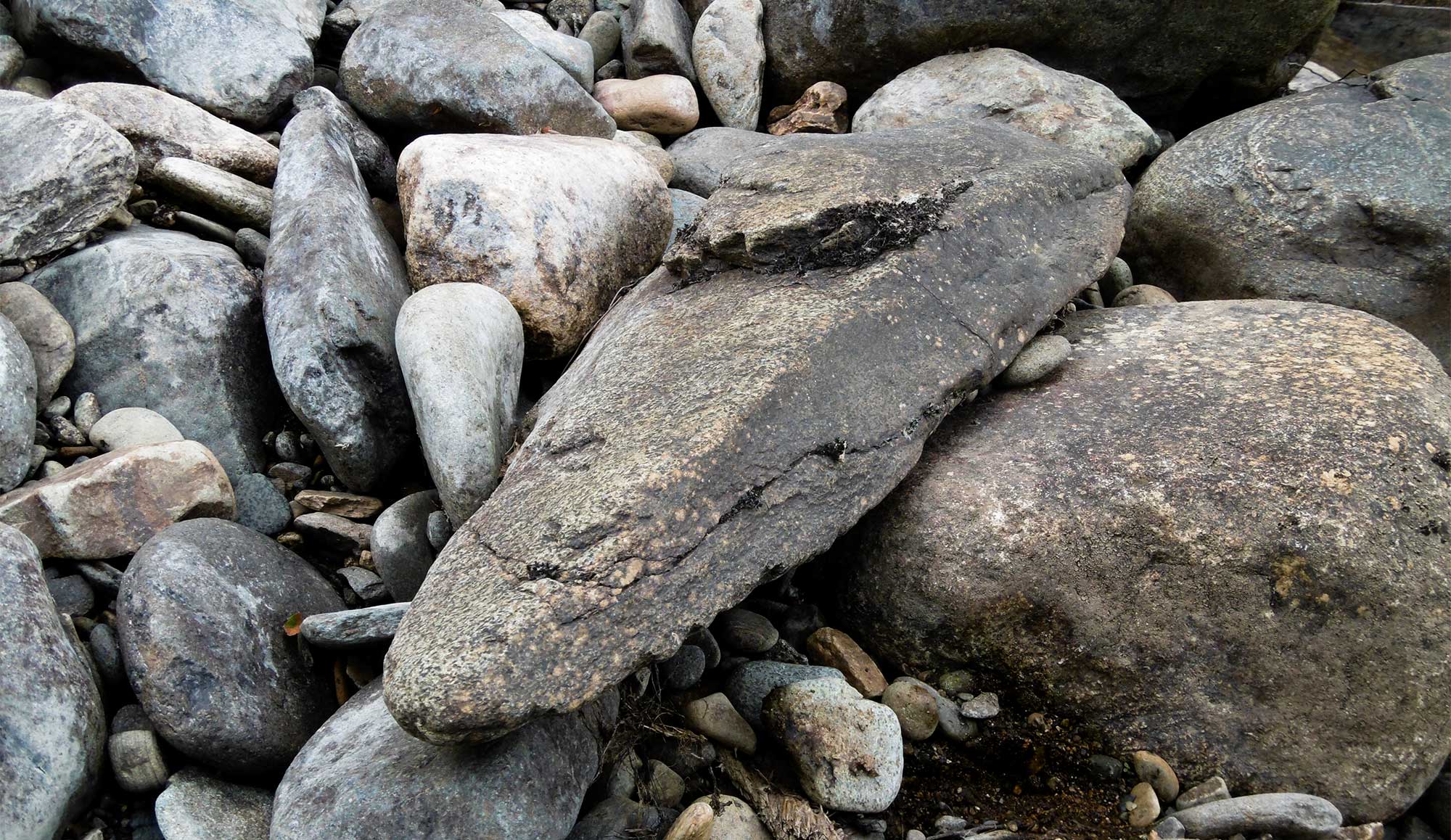
Couldn’t resist, sorry. I do like rocks, so I took a “snap” of this one in the river next to our house.
I have to be careful when I take the grandchildren paddling, I don’t want them to get eaten, I got into terrible trouble last time.
August: New Assistant
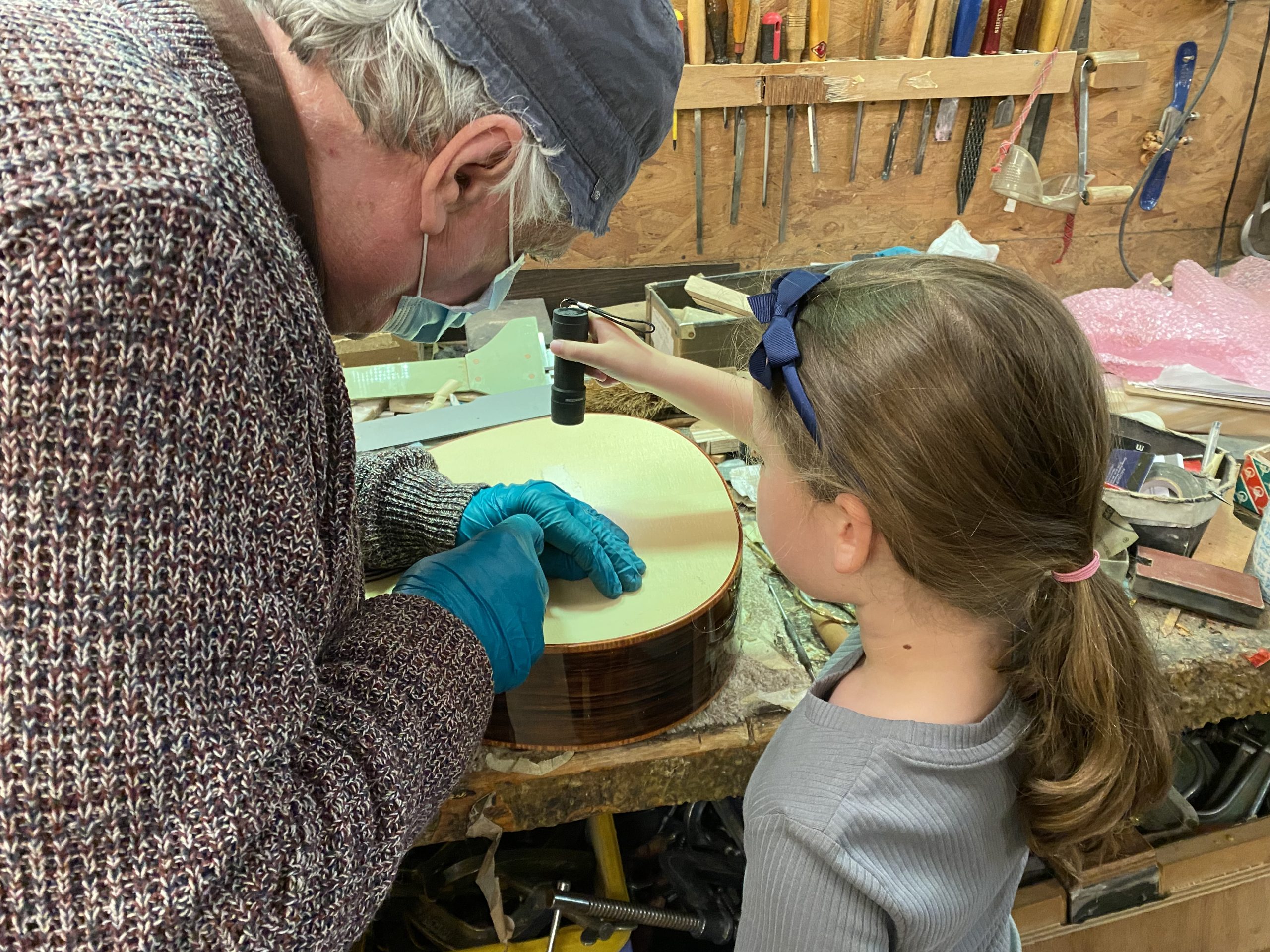
And talking about grandchildren, here is one of them, helping me to fit a bridge, catch em young!
I suppose I’m going to get comments about who is wearing all the protective gear, but I must point out that she will recover quicker than me.
August: Ships mast
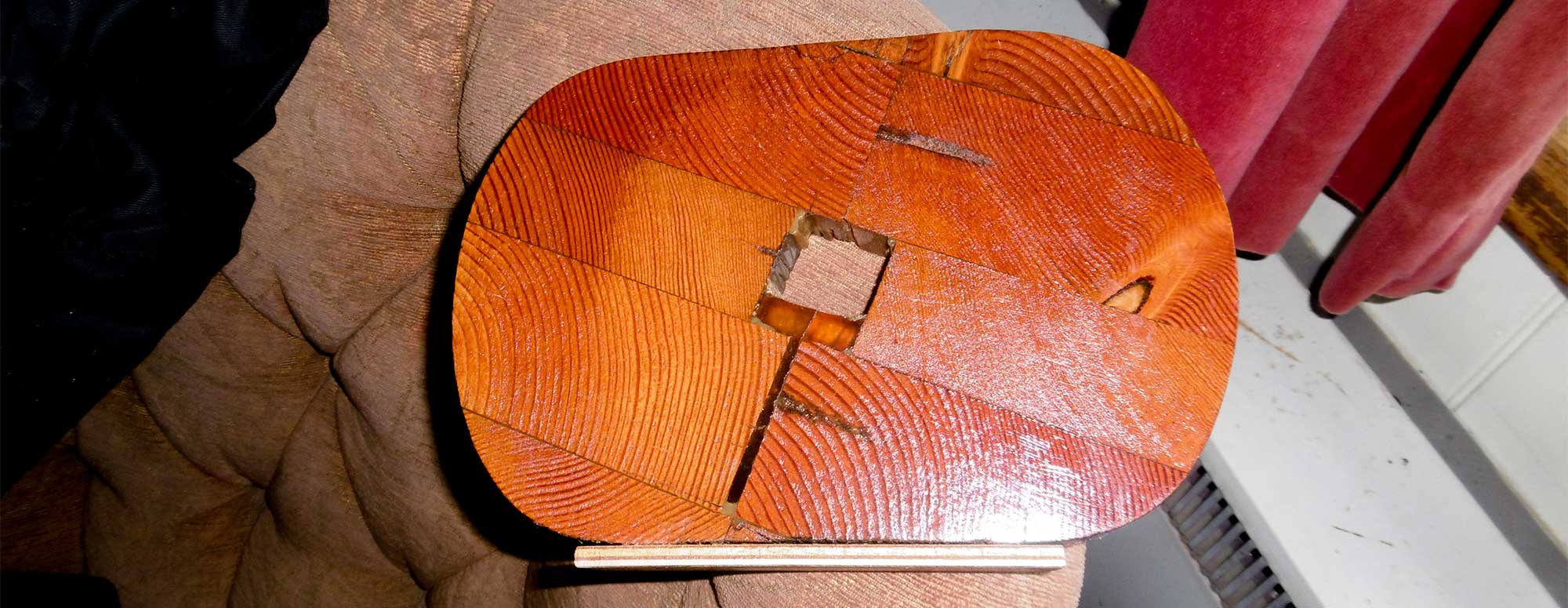
A Gaff Spar from the Brigantine “Eye of the Wind”, built in 1911, broken in Australia in 1994.
This is quite a simple example of the way ships masts are put together from smaller sections of suitable wood, this time I think, Columbian Pine which is still available in long straight lengths. All the pieces are bound together in iron bands and glued with what looks like Araldite, which doesn’t actually match the date of manufacture so perhaps the glue was applied after the damage. This picture was taken in the house of an elderly couple that sailed over from Australia in the Replica “Endeavour”, back to Whitby and Staithes where Captain Cook started his seafaring career on the original ship. Lovely stories
September: Two Special Orders
A lot of our time is devoted to making “one off” custom orders. Here are two of them, both rather sweet.
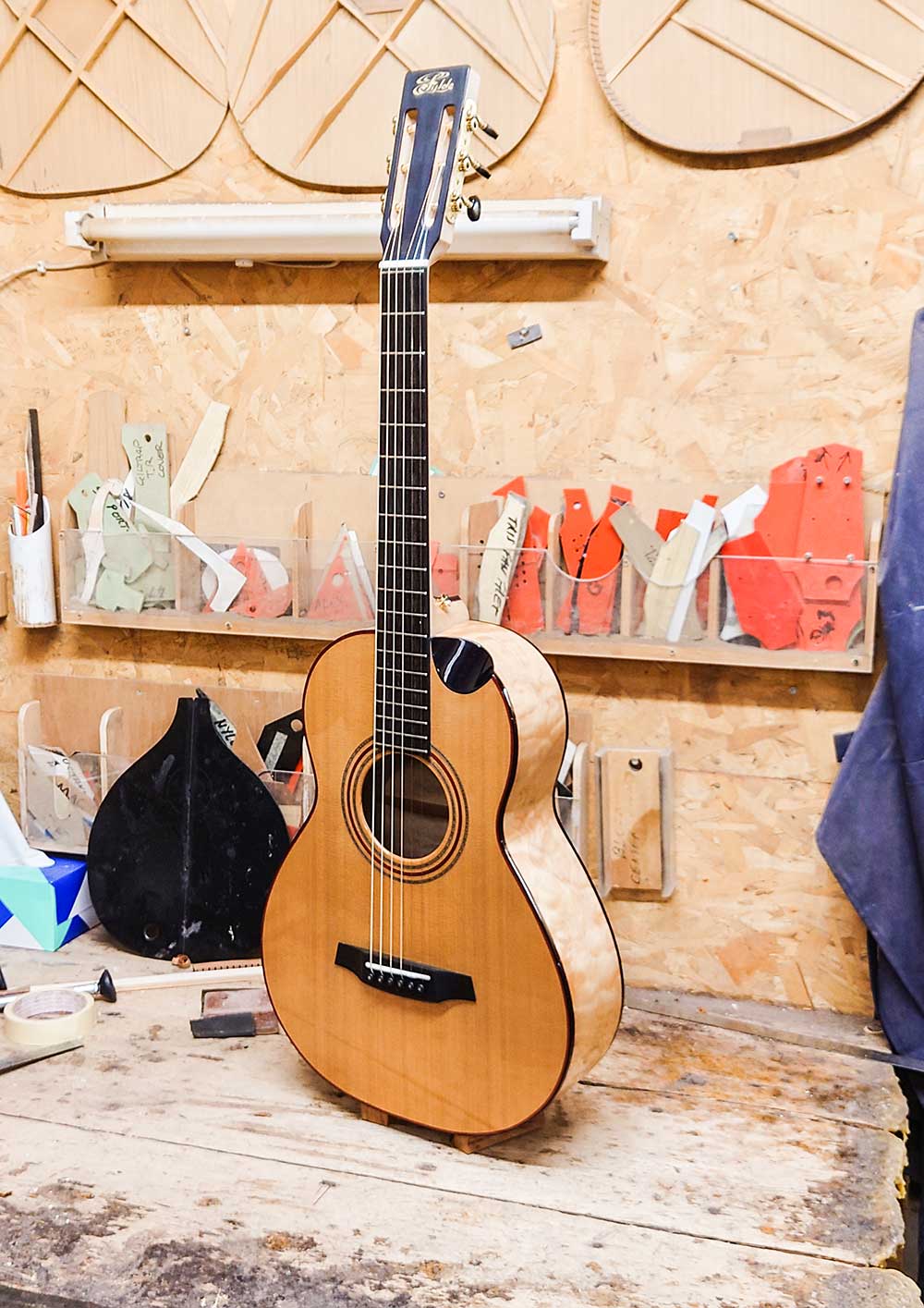
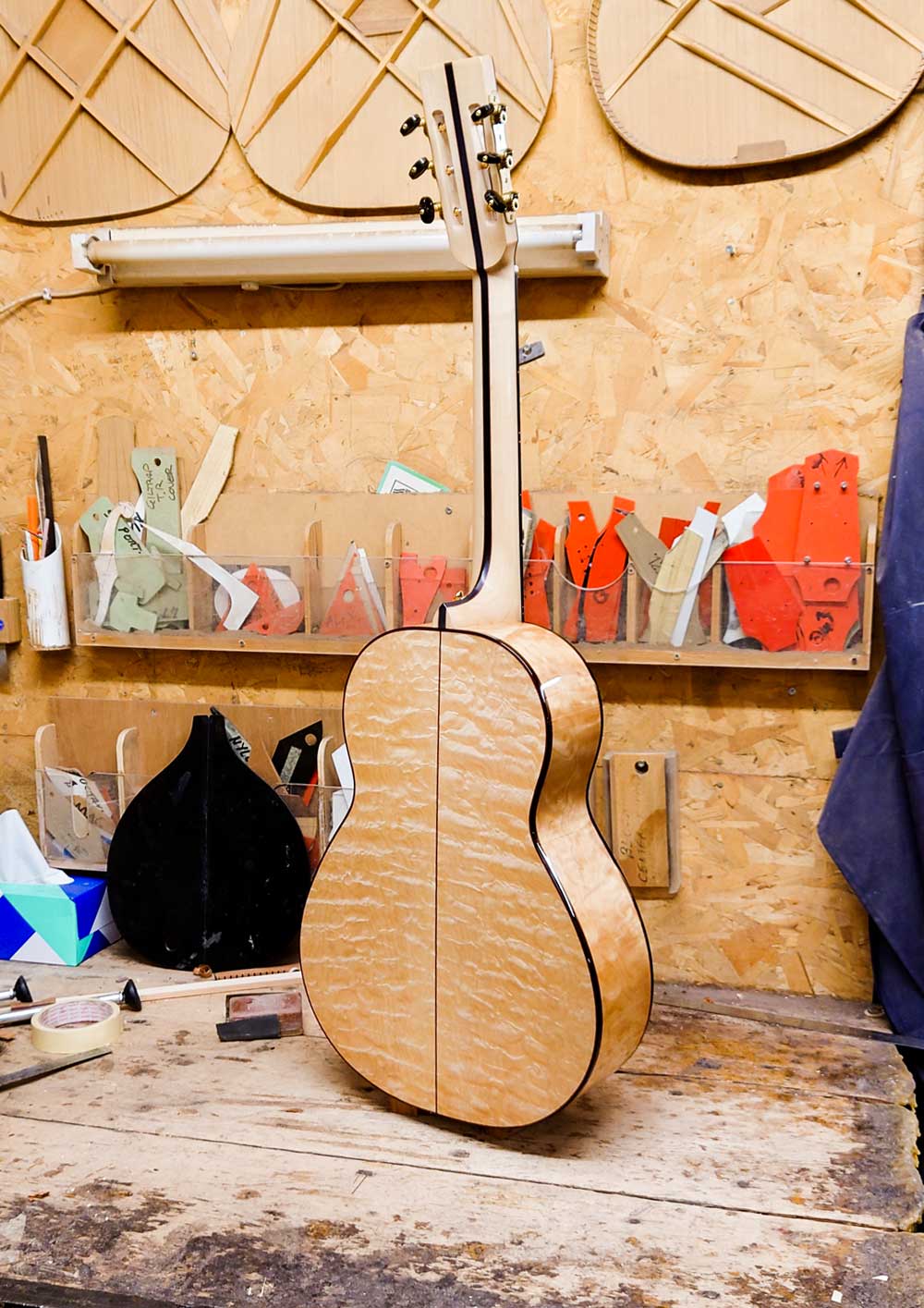
Quilted Maple Ariel
A Maple Ariel, with a Cedar top, Maple neck and Ebony veneered “Scoop”
Maple has various quirks, particularly when it is strongly figured. “Fiddleback” material is so very fragile in bending and loves to explode with little warning while quilted timber bends like butter but definitely has a mind of its own. “Bending” in this case would be better described as “negotiating” exactly what shape it will agree to become
Macassar Ebony Hybrid Tenor
The idea here started as a custom Tenor guitar, but the customer was drawn towards double strings. Compromise solution- double strings on the top two courses. It works very well indeed, with extra tonal content from the melody strings, and solid background from the lower notes.
Macassar Ebony back and sides, Spruce top. Yet another delighted customer. I don’t know how we do it.
Yes, I do, we have a lot of experience and make so many different styles of instruments that its usually easy to extrapolate between two (or more) different concepts and learn from all of them Plus, and this is very important, we all enjoy and benefit from the variety.
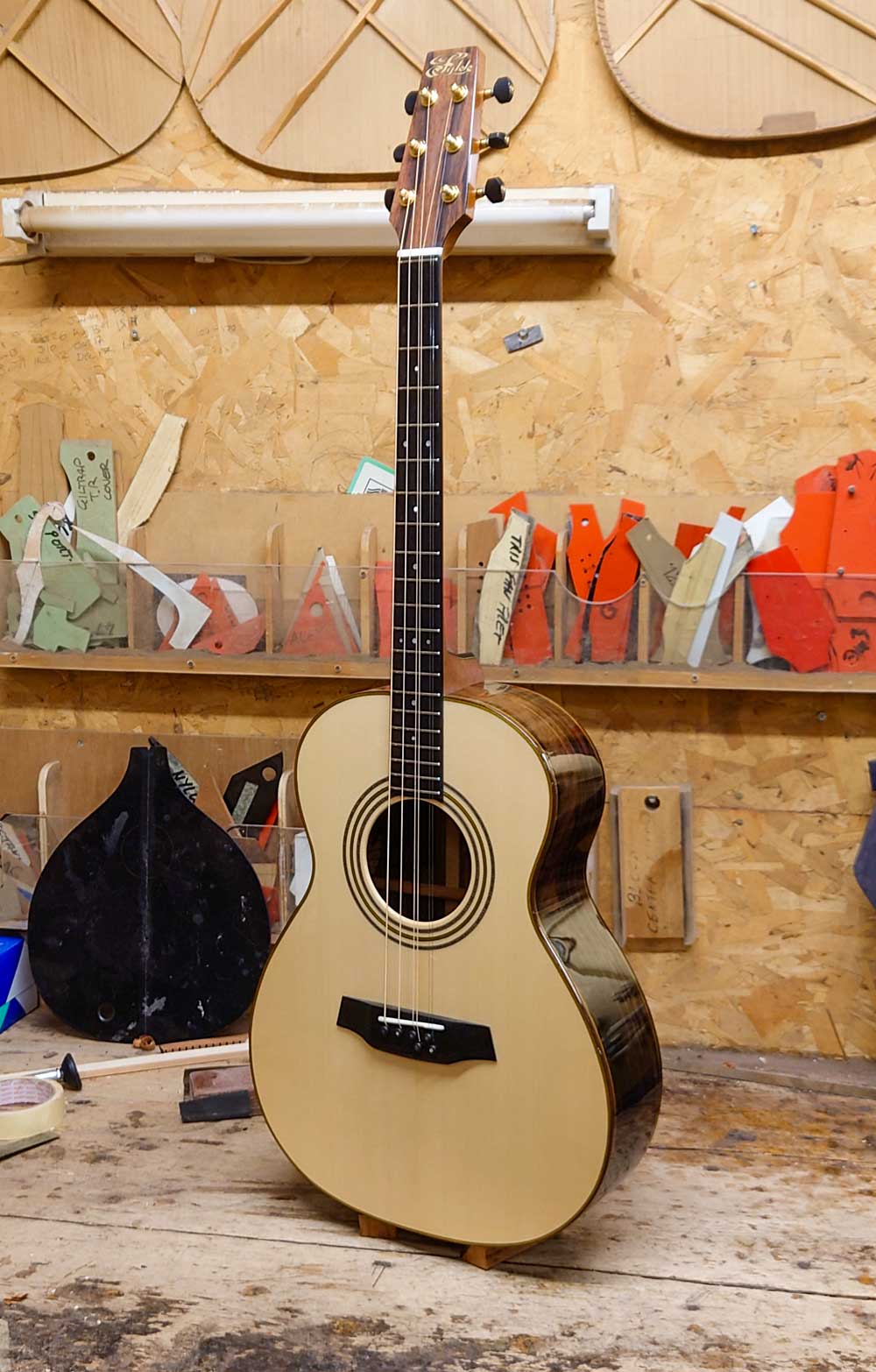
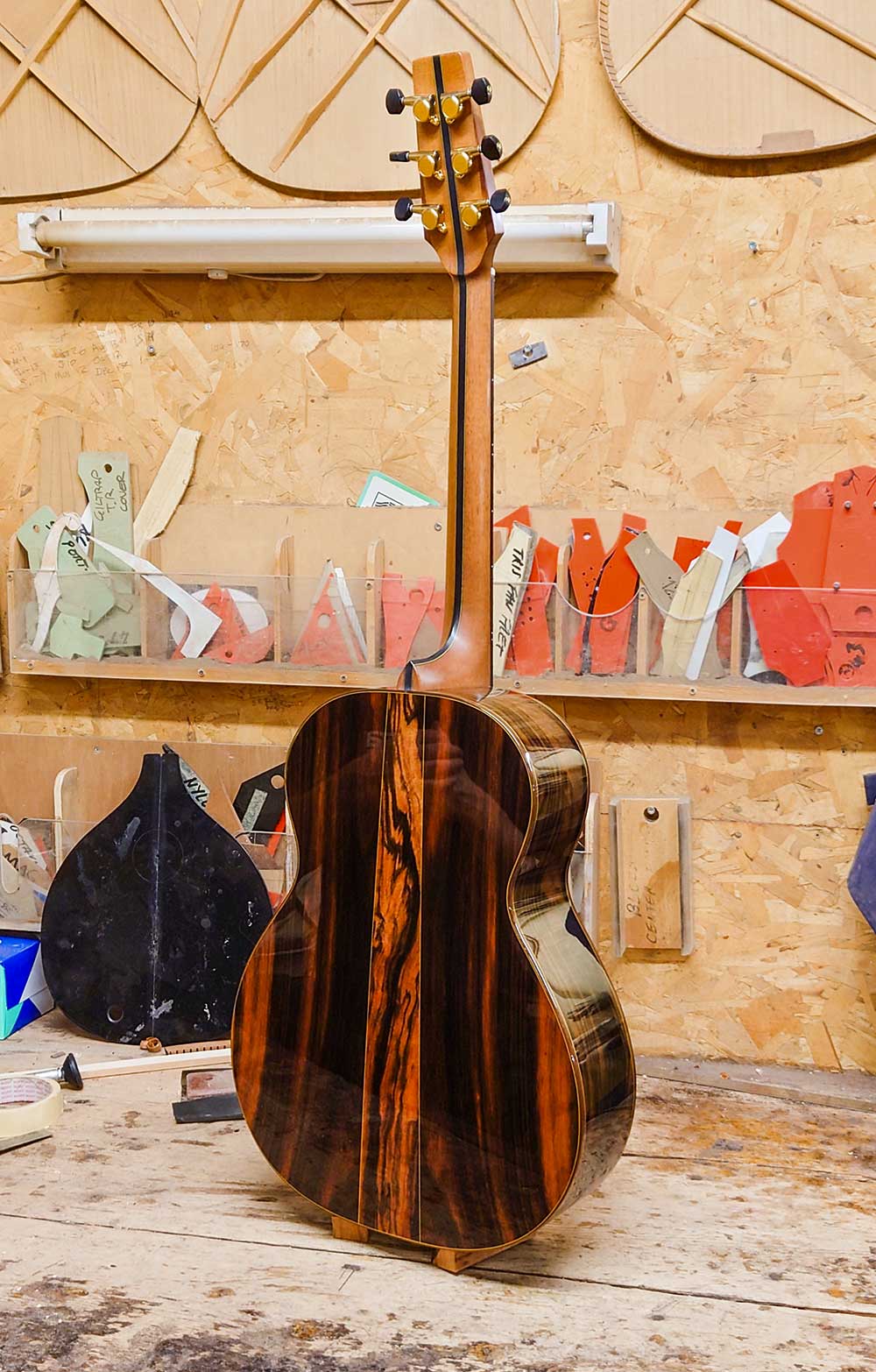
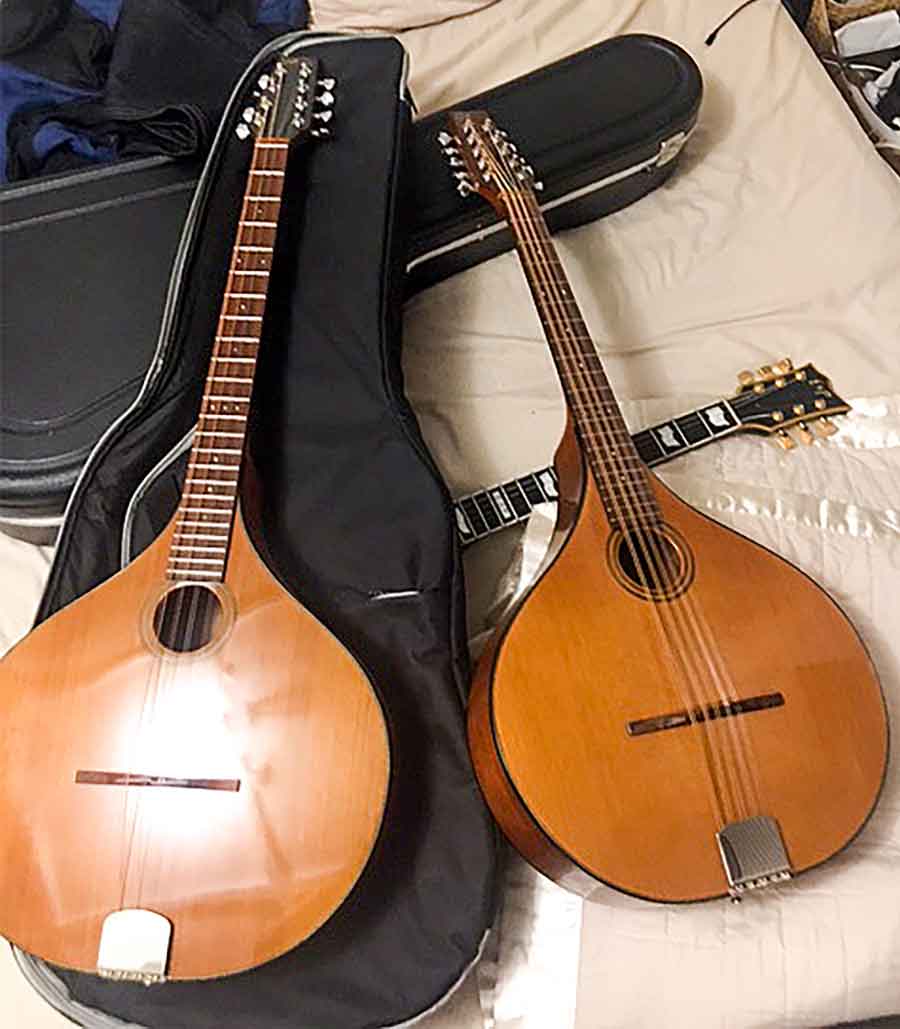
September: Anthony Phillips. Cittern and Bouzouki
Every so often, Anthony’s (Genesis) people get in touch asking for string advice for these two. An early Cittern and Bouzouki, looking in excellent condition. Always good to hear about such things
September: Serial Numbers
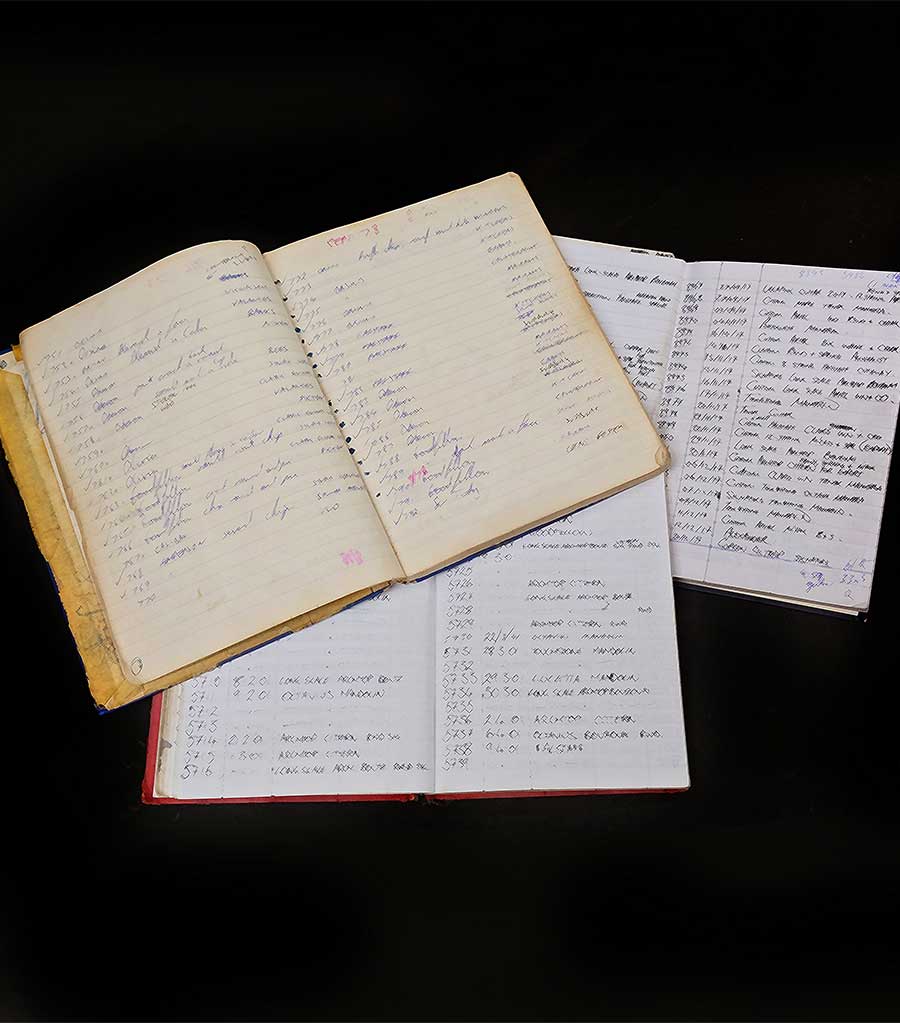
My daughter Charlotte is currently entering every instrument we have made since 1973 into a spread sheet so one day soon I might know some actual total numbers. I’ll be able to look at the standard designs as well, which will be interesting, as they tend to go through fashions. We have had long spells of making lots of Orsinos, then it was Falstaffs, and the Ariel design seems to have “bursts” of popularity.
Once or twice, one of the standard designs seemed to have lost their popularity, so I dropped them from the price list, only to find another surge of enquiries straight away. You customer people are very strange.
I don’t want to publicise these numbers; I like to answer any enquiries directly and tell the customer as much as I can. When Charlotte has finished this, I’ll be able to look up the numbers while I’m in a beach bar somewhere warm.
September: If Only I had an Axe to grind
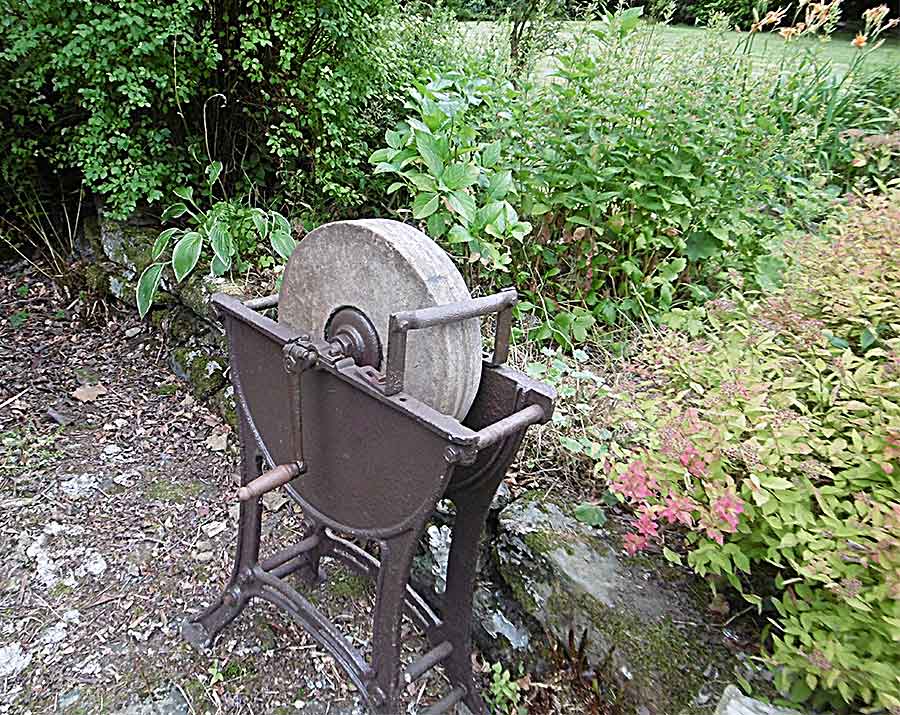
Keith Beardmore found this on Facebook and secretly delivered it to me. I’ve always wanted one and now I’ve got one. Moira tried to put her nose against it, but I said she was being silly. I hope she wasn’t trying to make some sort of statement.
september: Joining a back
Maybe this is the axe I want to grind? It should be interesting to some of you and might even upset a few. Oh dear, what a pity, never mind.
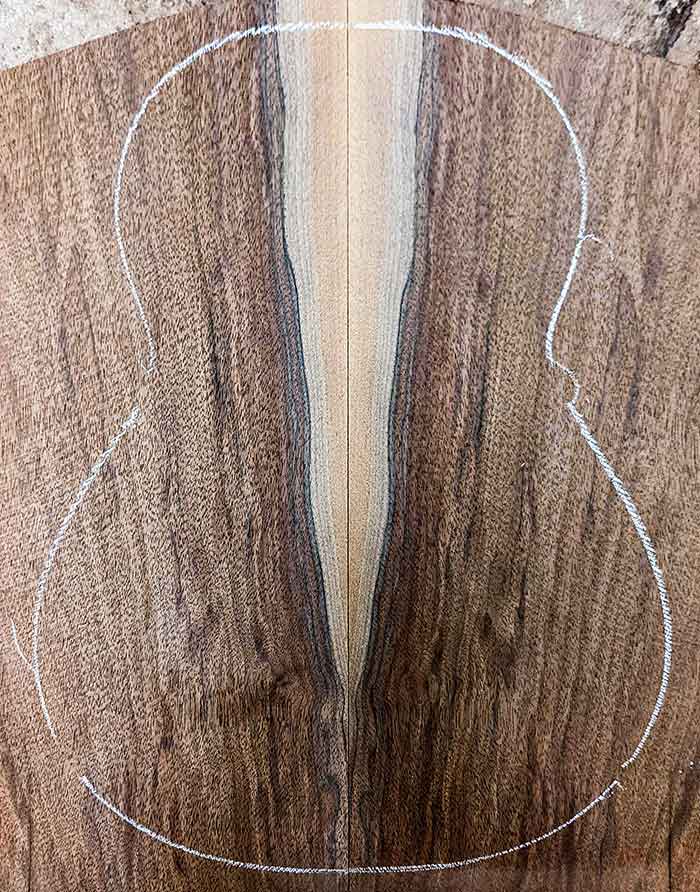
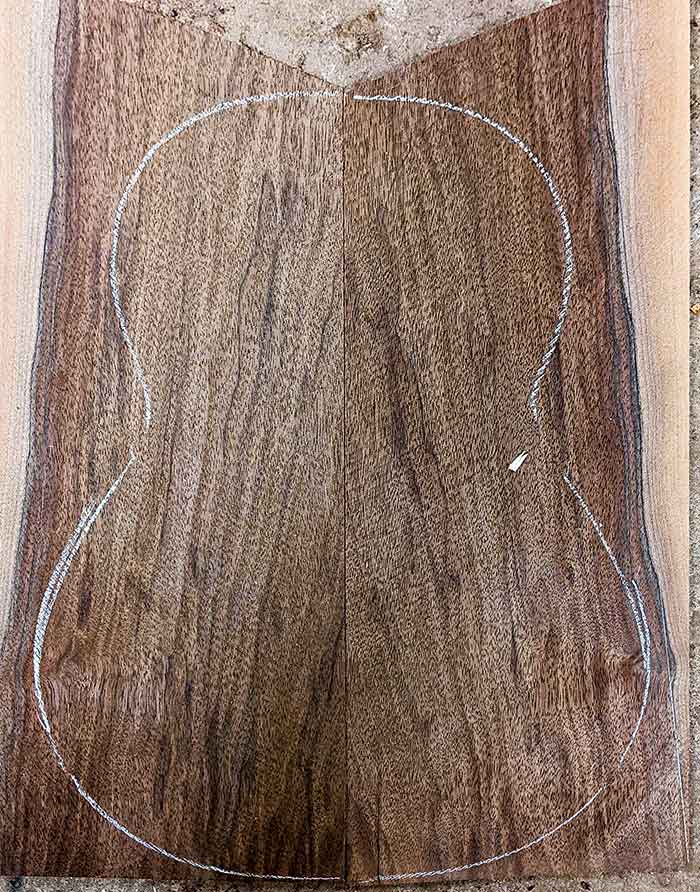
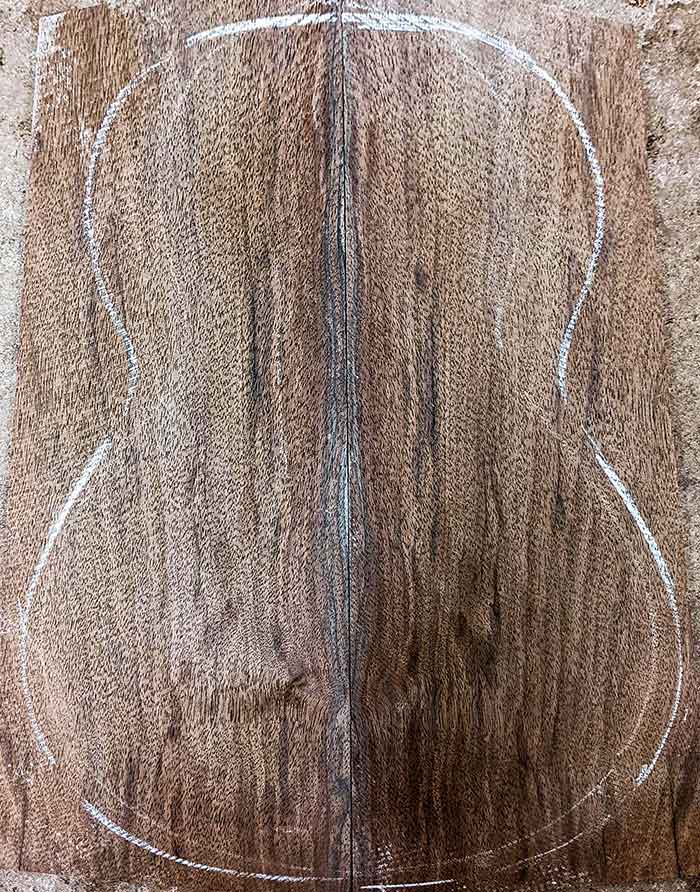
Guitar backs are generally made from one piece of wood, in effect split down the centre and re-joined with the two halves “book matched” to make one, wider piece with matching grain.
But there is more than one way of doing this. I believe that certain parts of the tree need to be avoided if possible.
I hate to see pale “sapwood” included in the back and sides. Sapwood is the living part of the tree under the bark, it’s likely to have insect holes and bark inclusions, and is often a lot less dense than the heartwood. There are a few timbers where the Sapwood is the best part, Maple for instance but In most timbers, Rosewood and Walnut being two good examples, the sapwood does not have any of the qualities that we pay for when buying “tonewood”.
I regard that part of the tree as firewood.
Here we have one piece of wood, cut and joined in three different ways;
September: Big Mac and Me
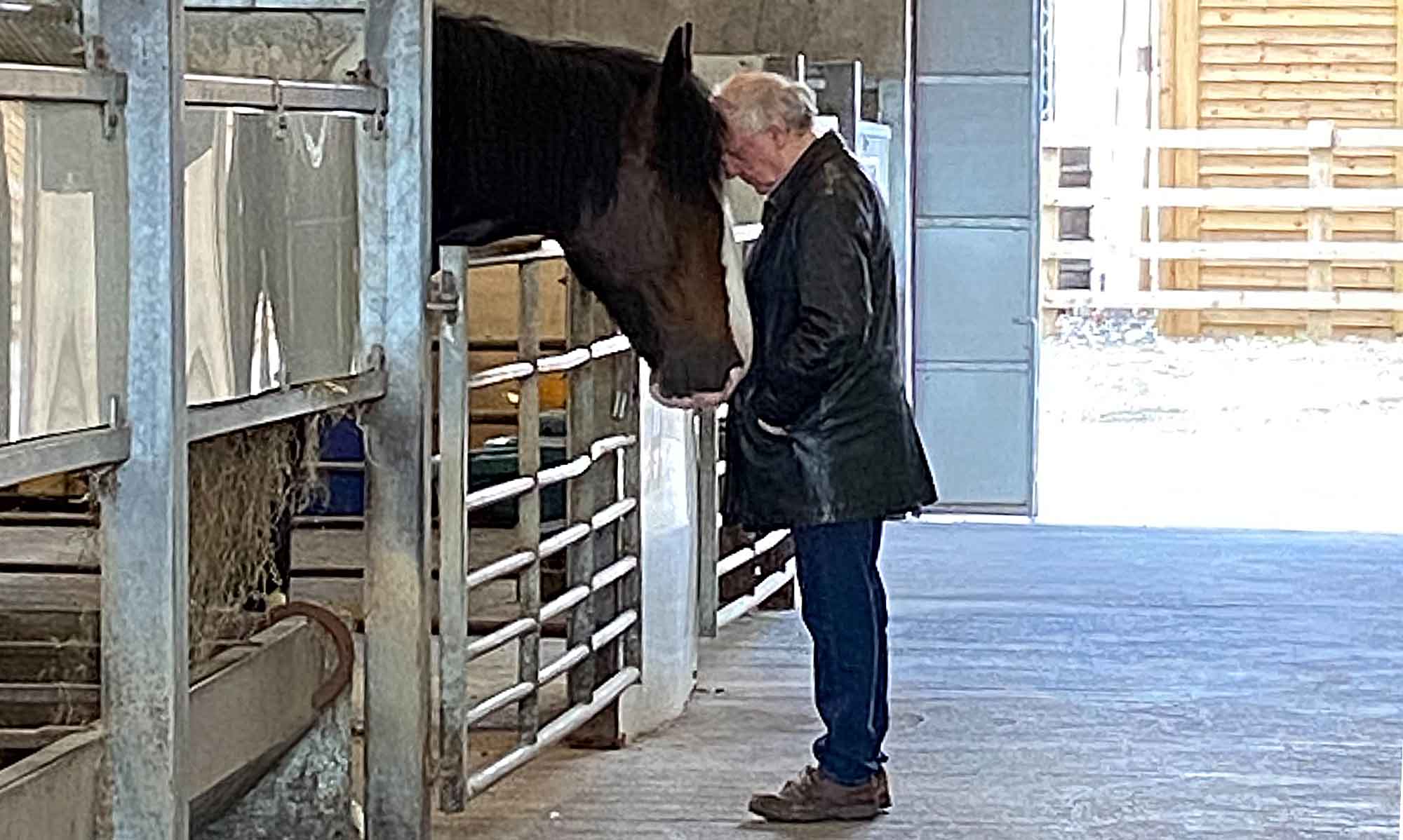
And finally. I’ve always felt comfortable with big horses; they are gentler than small ones and seem to have better communication skills. Here I am with “Big Mac” at Thornton Hall Country Park a few weeks ago, he and I had a lot in common, and no, there weren’t any extra strong mints in my pocket. I am planning to go back soon because there is something I forgot to ask him. I do hope he can help.
October: One thing leads to another
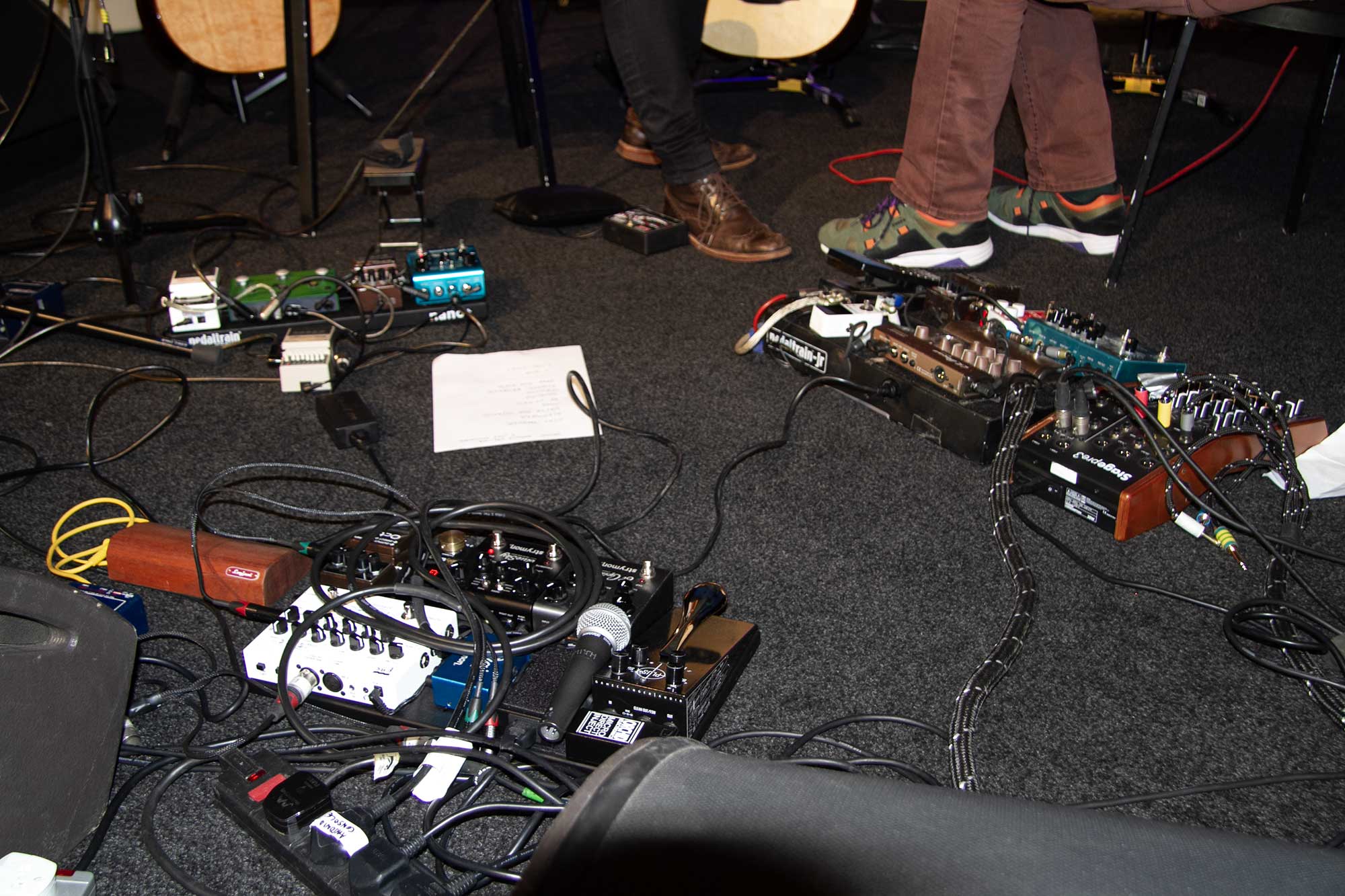
See what I did there – one thing leads –
John Smith, Antonio and Jule’s sound check with three sets of pedal boards on stage.
Making acoustic guitars is no longer all about woodwork. Clive Carroll though, ever a trend setter, is now performing with two microphones and no Di.
October: Antonio's new Mandolin.
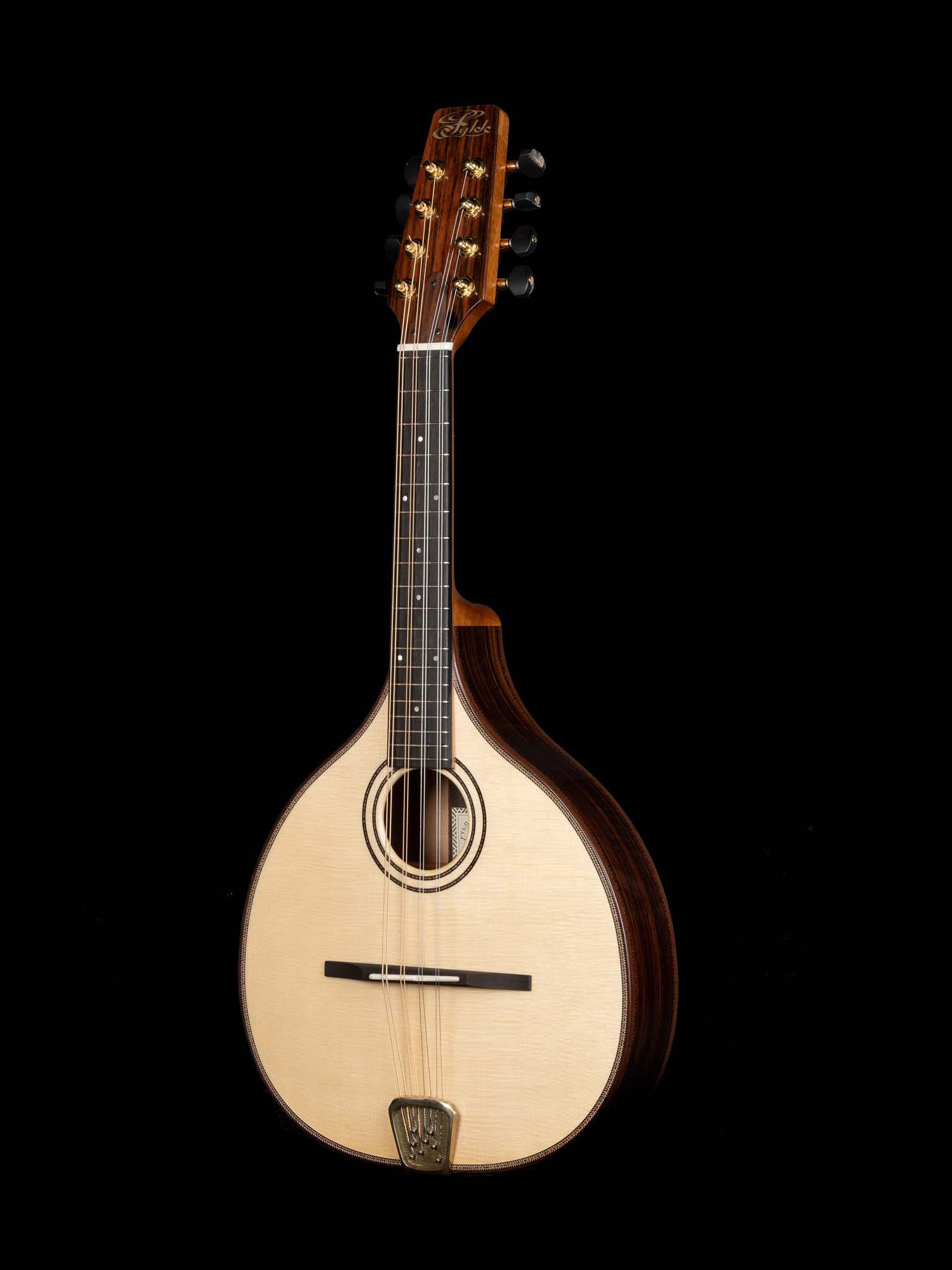
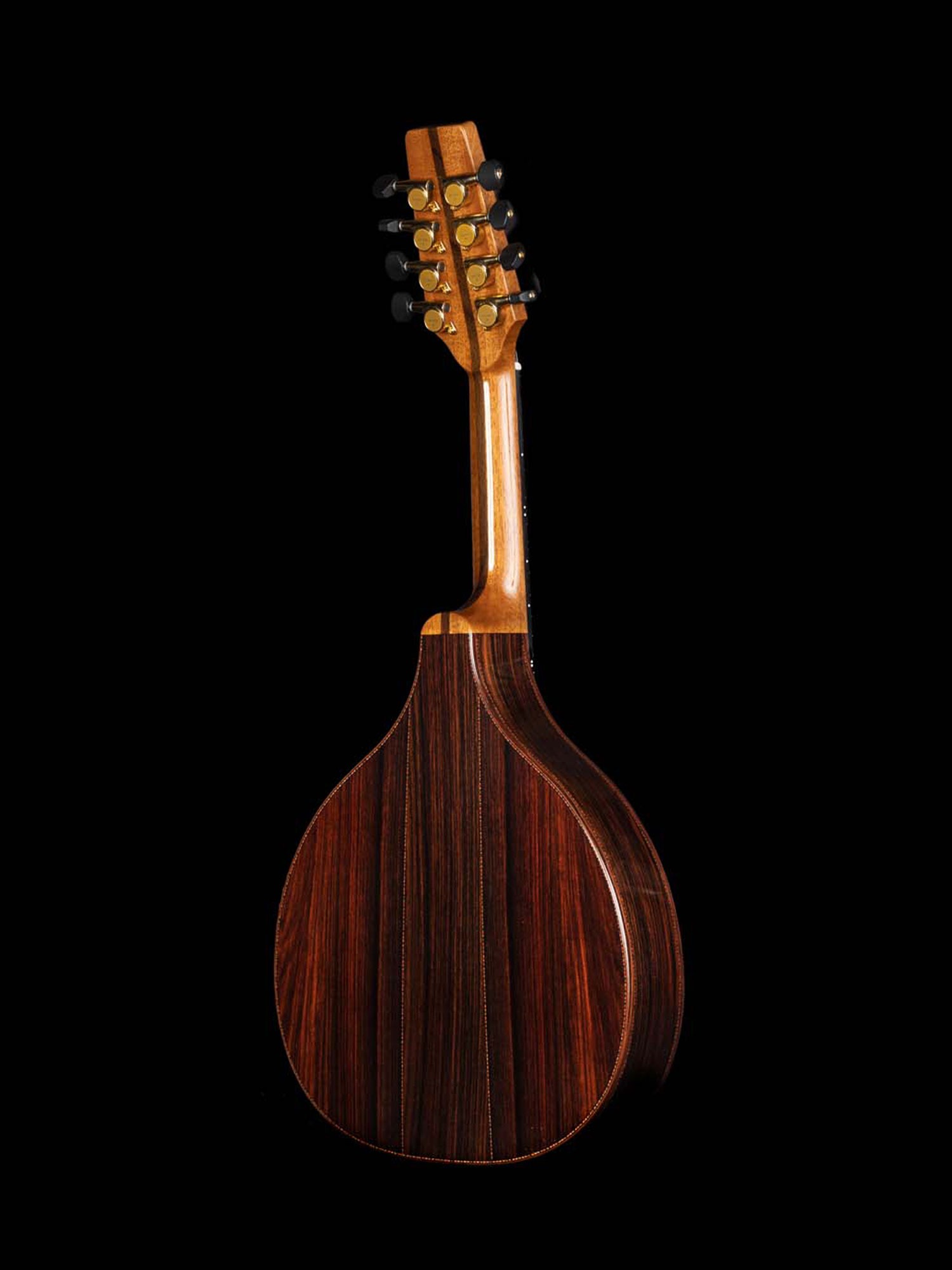
To be 100% honest, the mandolin does not belong to Antonio, it has been commissioned by a friend, to be used by Antonio when needed. It’s a Signature model, but with a much wider fingerboard. I wish I had friends like that. Antonio seems happy!
Antonio’s set with Jule Malischke was a delight. He does not speak German, and she does not speak Italian, so they communicate in English – we do have a function in Europe!
October: The Fastest Guitar in the West
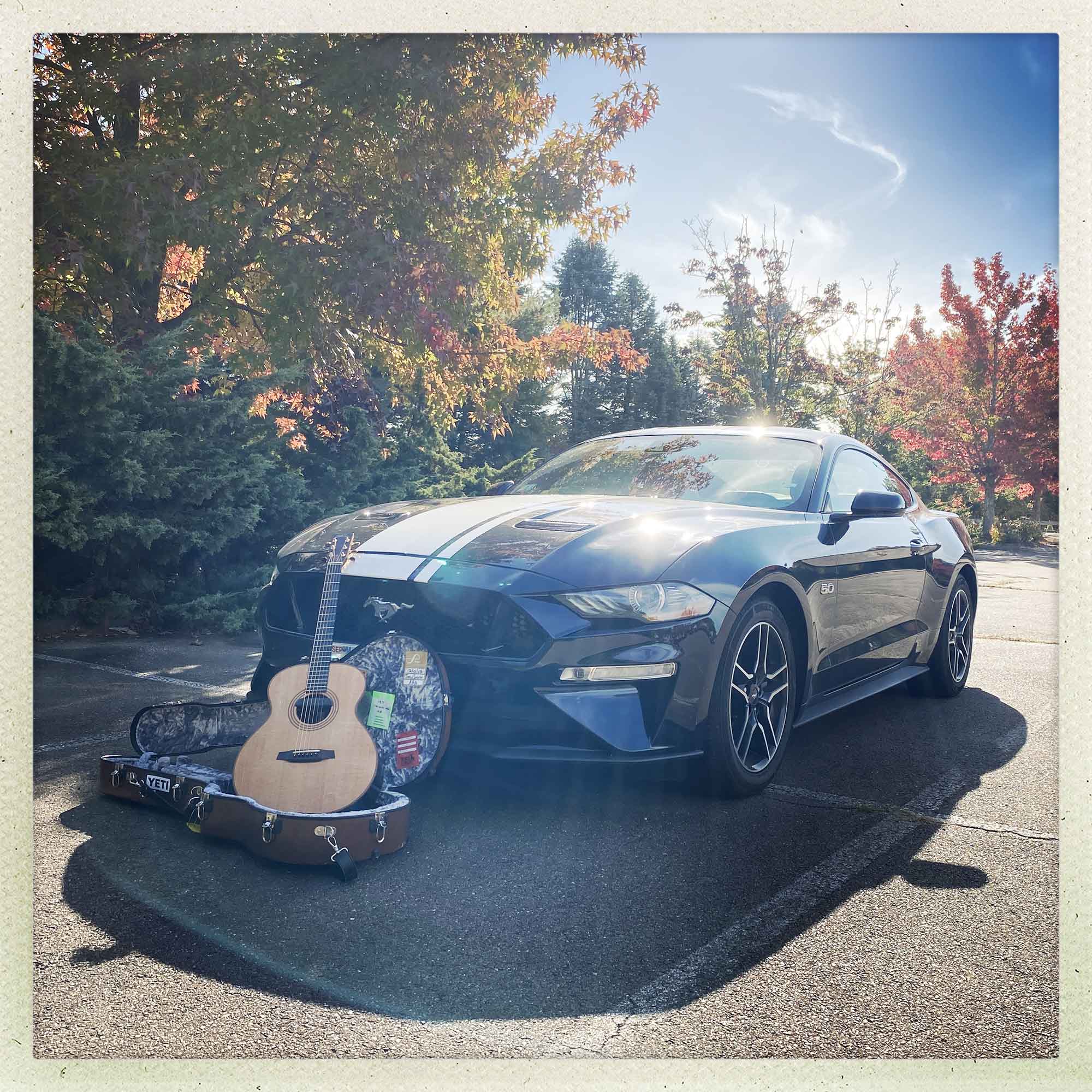
John left the Festival with a day to spare before his USA tour. Upon arrival in America, the car he had booked wasn’t available., and he was upgraded – to a Mustang. No wonder he enjoys his USA tours. He arrived early for all of his gigs. When I drive in the USA, I always get into trouble, I wouldn’t dare drive a Mustang there.
John has a UK tour starting soon, I think he’ll have to downgrade his wheels. At least it will have a proper gearbox this time.
October: Small tools
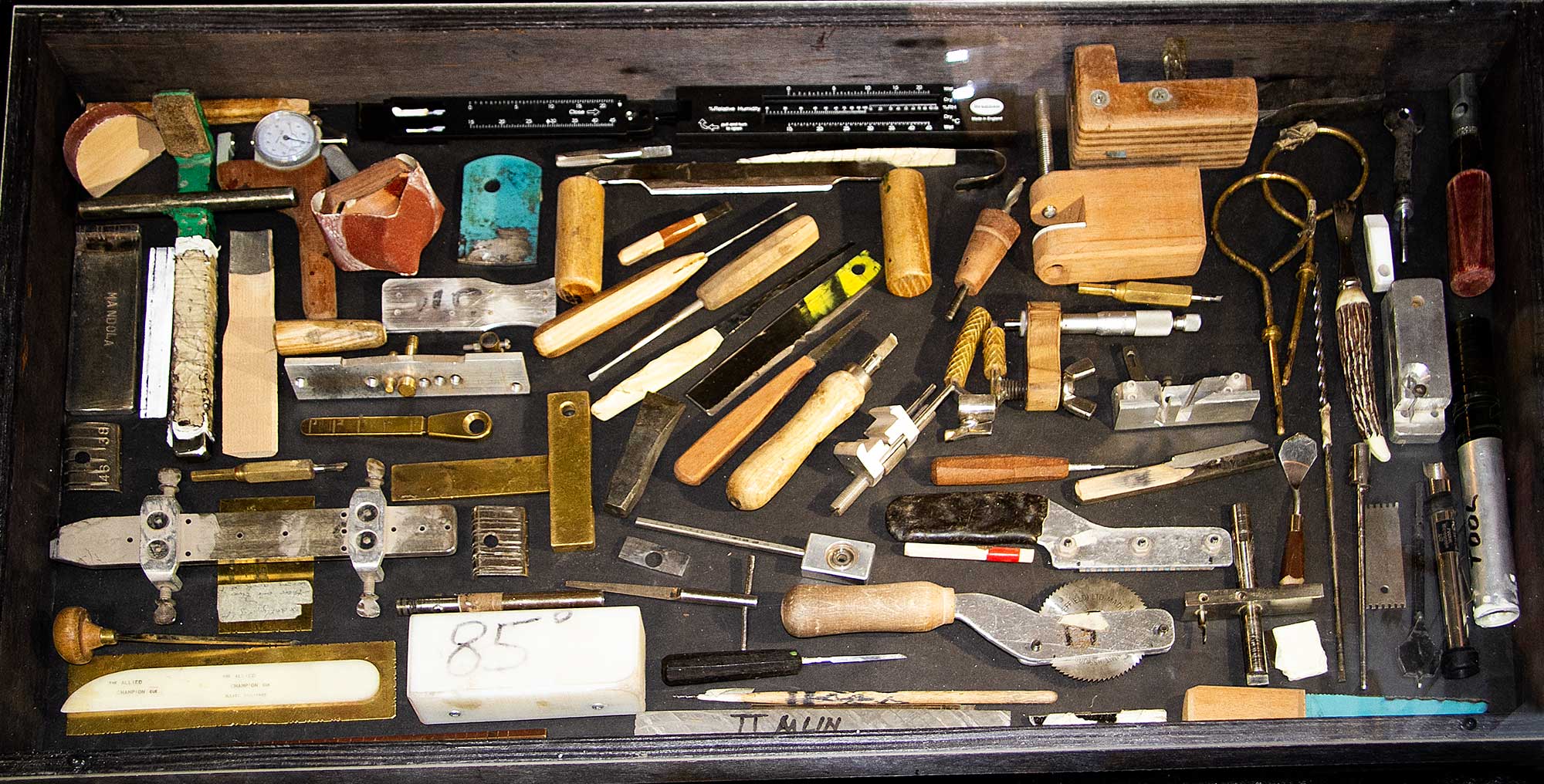
I was looking for something a little unusual to take to Ullapool, and here we are. I made a display case for a selection of special small tools that we have made to solve particular problems.
We all threw bits and pieces into a box and Alex did the arrangement at the show before he started on the whisky. Next year it might be Paul’s turn. I had a few little discussions with other guitar makers about what all these things were. I don’t think they believed me most of the time. There really is a ‘scratch stock’ in there, and a ‘DPA socket’, an ‘excursion micrometer’ a ‘reverse counterbore’ and a ‘bush press’
October: Homeless Pool team
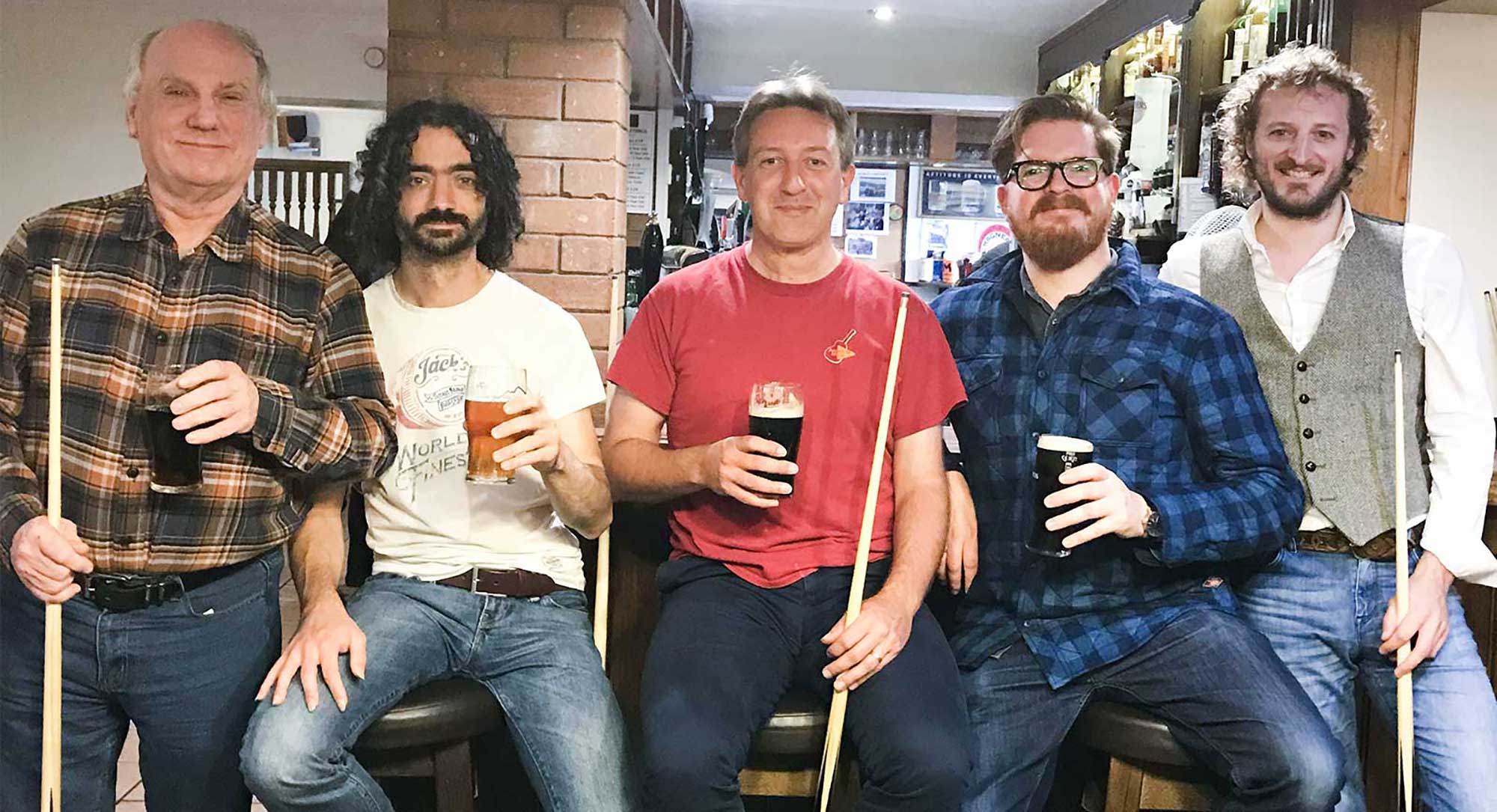
A picture from a few years ago.
There was only one down side this year, there is no longer a pool table in Ullapool. It should henceforth be known as Ulla. Or should it be Ullapoolless? Ulla Pooless – a Scandinavian swimmer with no training facilities.
October: Behind the scenes at Ullapool
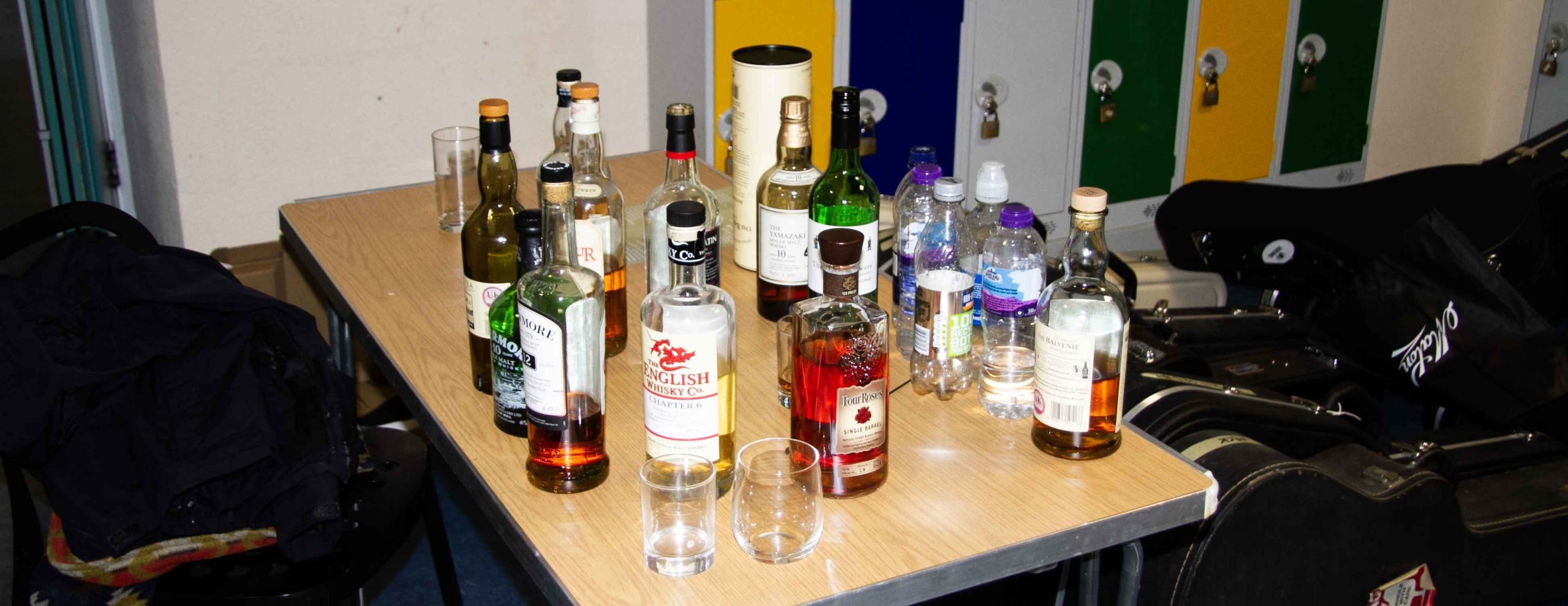
There were lots of stories around this table over the weekend. I took five bottles of Single Malt Scotch and a bottle of English Whisky to the highlands as a sort of cattle prod to start a gentle discussion, it didn’t work. Even the Japanese whisky didn’t start a debate. Basically, we all just drank the proper stuff.
One generous customer put an extra bottle on the table and got a little upset when it had all gone an hour or so later. Then a good friend was asking for a some “Medicine” but I misunderstood completely and actually took him to the first aid cabinet, true. I was a little tired and emotional I suppose; I think everyone was rather concerned for me. It had been a very hard week. Sorry guys, and gals.
On Sunday, I decided that I had to pack all the whisky away in the car to avoid carrying what was left through the streets later that night. Of course, that didn’t work, words were exchanged, and I had to unpack everything again – Ullapool is a thirsty place.
October: More Grandchildren involvement
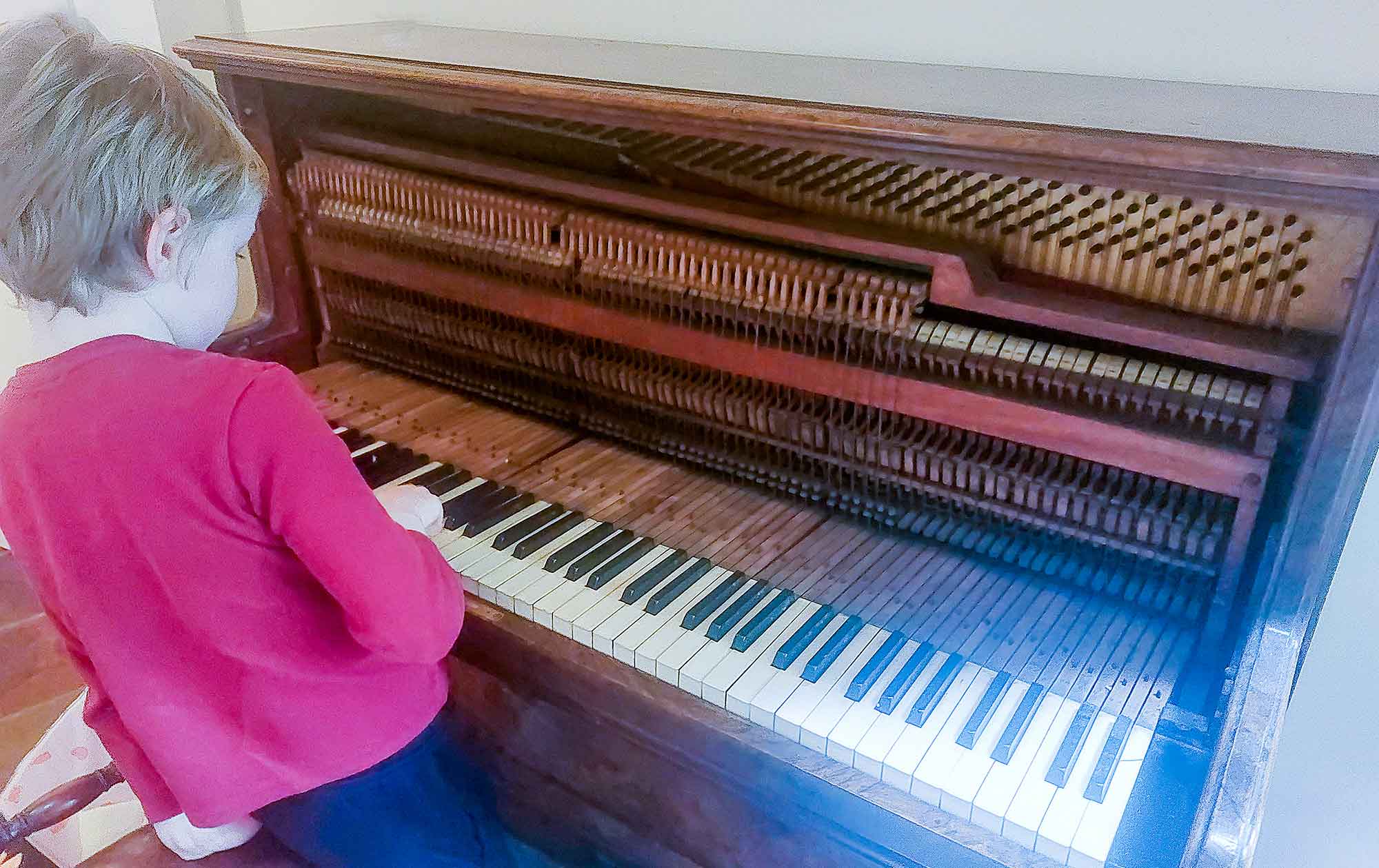
One of the keys on our piano had stuck, so of course I had to take it apart. I’m an old hand at this, in 1973 it was a common sight to see Bill Astley and myself wheeling old pianos through the streets of St Anne’s before breaking them up to get at the wood, quite honestly it was a waste of time, but good fun. Over the years I’ve learnt a lot from studying piano construction.
Anyway, after finding a tiny spring had come loose, probably due to overzealous playing and replacing it using a long screwdriver, it seemed an obvious opportunity to show the workings to an eager audience.
Great fun was had by all. I just need to tune it now.
I’ve noticed, that once they are in pieces, all pianos smell the same, sort of warm, dusty and old. No comments thank you.
November: Remi Harris

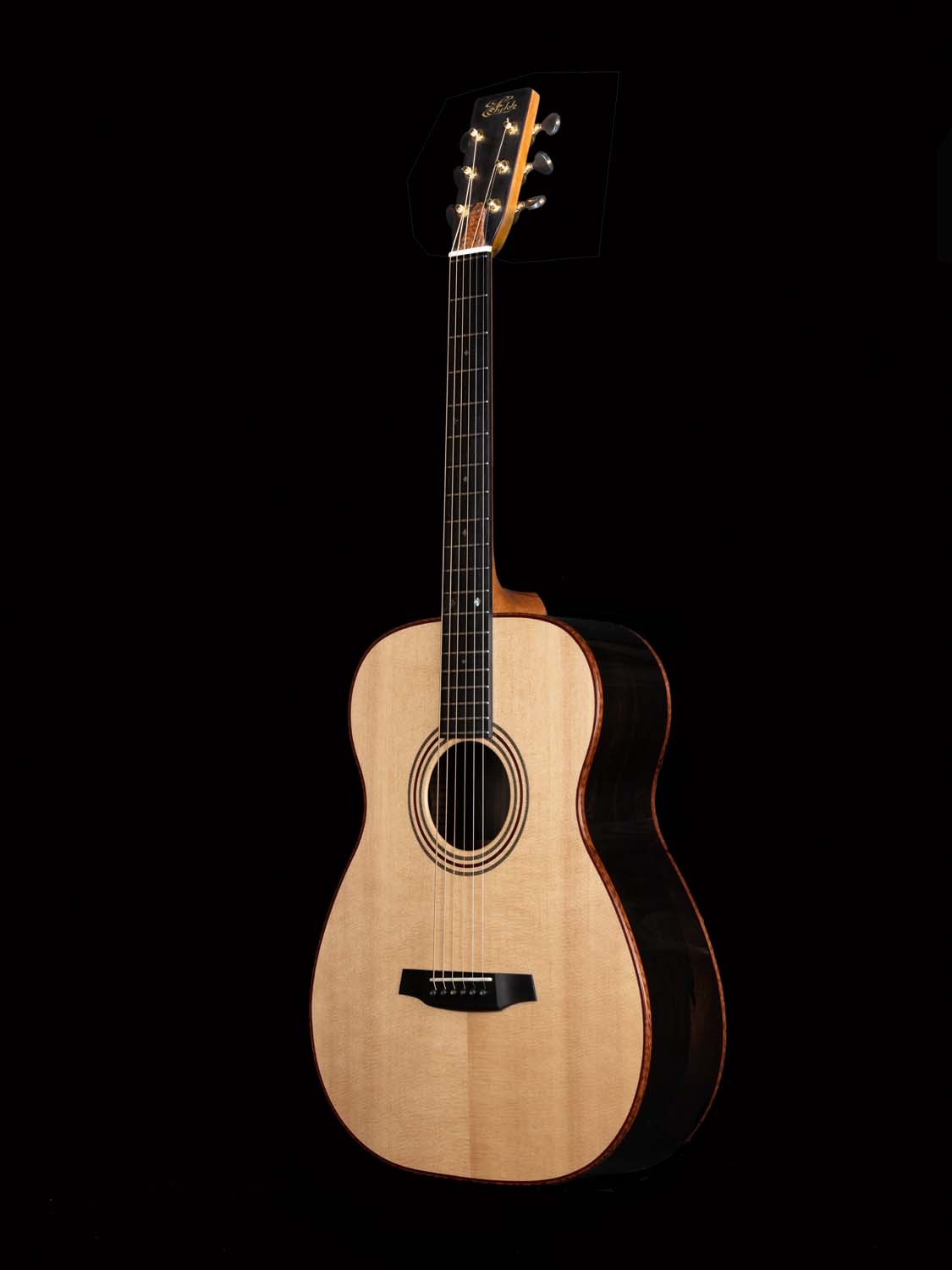
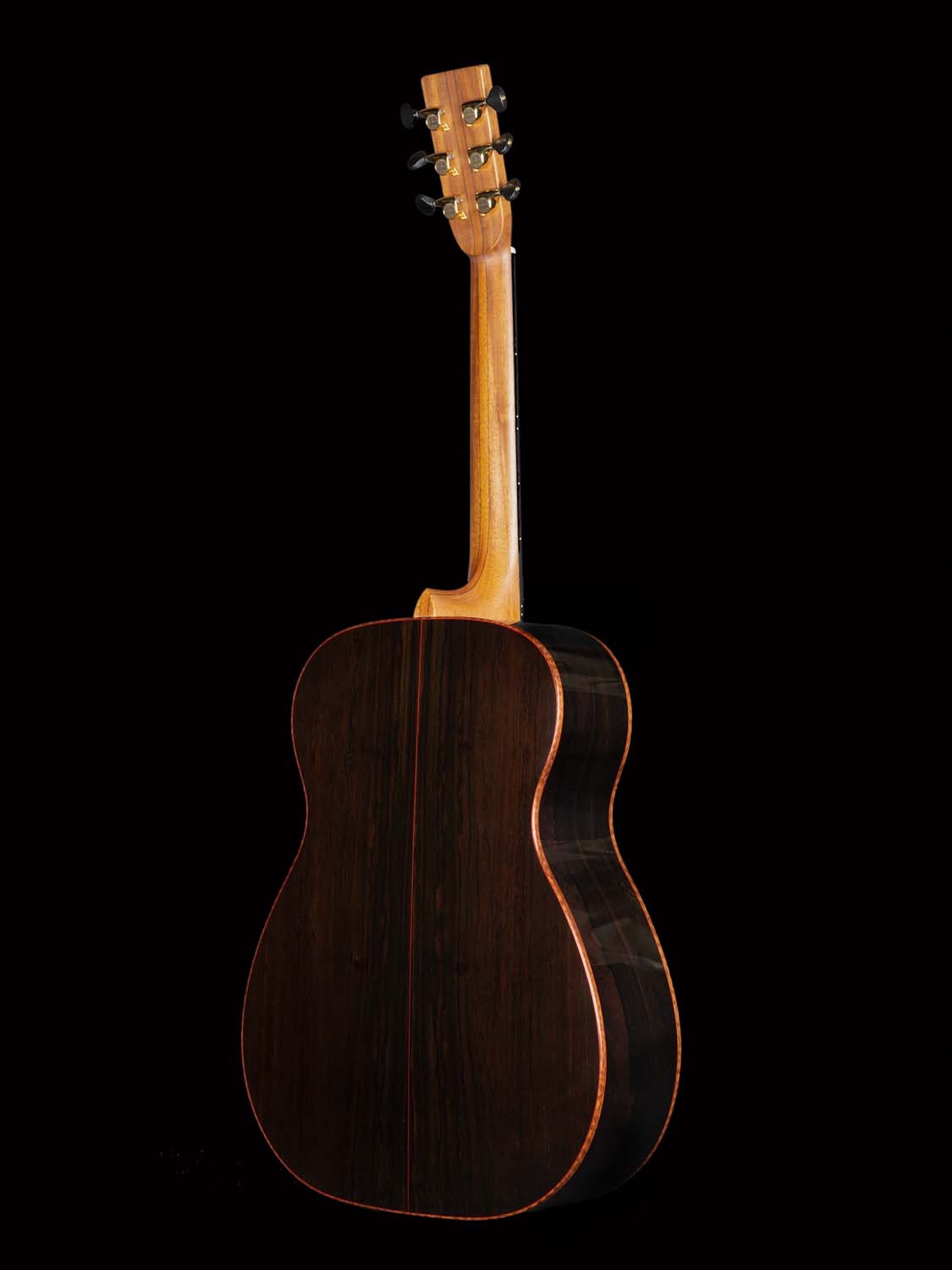
If I made a guitar for myself, this would probably be it, but too much heavy work and damage to my hands means I could never do it justice. I should have made it twenty years ago when I could still play quite well. Maybe things will change and there is still time?
It’s one of a kind, with history going back to “guitars of yesteryear” and with input from many newer sources, including the guitars we have made for Martin Simpson (more of which later).
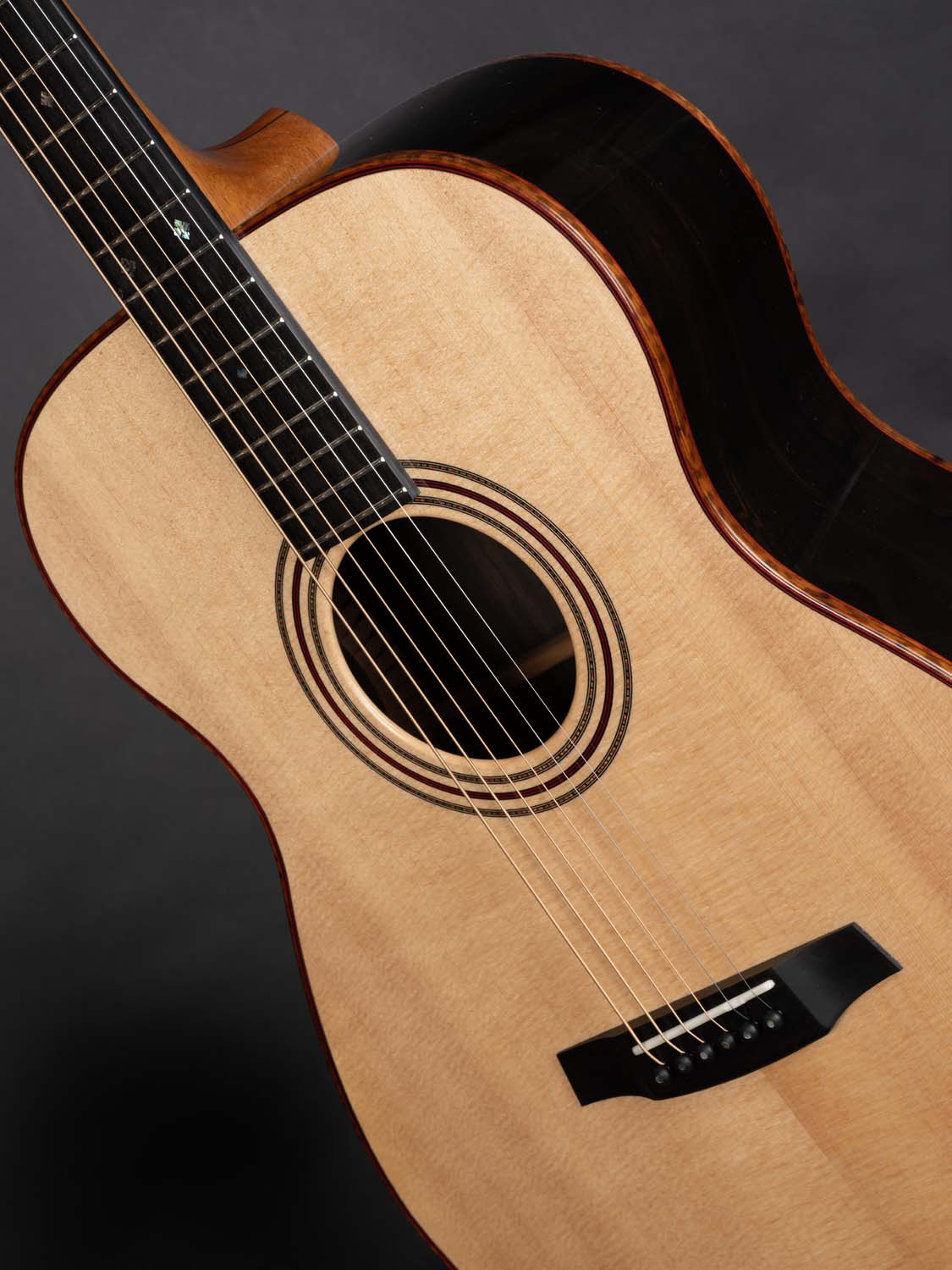
The back and sides are glorious Brazilian Rosewood, so dark that it will easily be mistaken for Ebony or African Blackwood, but it has been tested by Kew Gardens, and has CITES papers to prove it.
The soundboard is Sitka Spruce that I’ve had for probably thirty years, perfectly quarter sawn with fine, straight, even grain, and a little natural colour in the wood. I chose it for its stiffness, but I do like that little bit of “reality” in wood, I suspect it will go quite dark within a few years.
Snakewood binding and truss rod cover. Red lines where I thought it suitable (I enjoy being “suitable” occasionally). Laminated Mahogany neck with Ebony fingerboard, marked with cut square Abalone inlays. Gotoh 510 tuners. The 46 mm neck is quite a shallow profile, 20mm deep with a very slight V shape and well suited to people with a “proper” technique.
Now for the main event, it’s a long scale, 12 fret neck, with the bridge right in the “sweet spot” of the soundboard. I know that many guitar makers love making this style of guitar, it gets the best out of everything, with the minor sacrifice of having to try harder if you want to play high up on the neck…
… and here is a picture of Remi playing that same guitar on a recent visit.
November: Andy Irvine
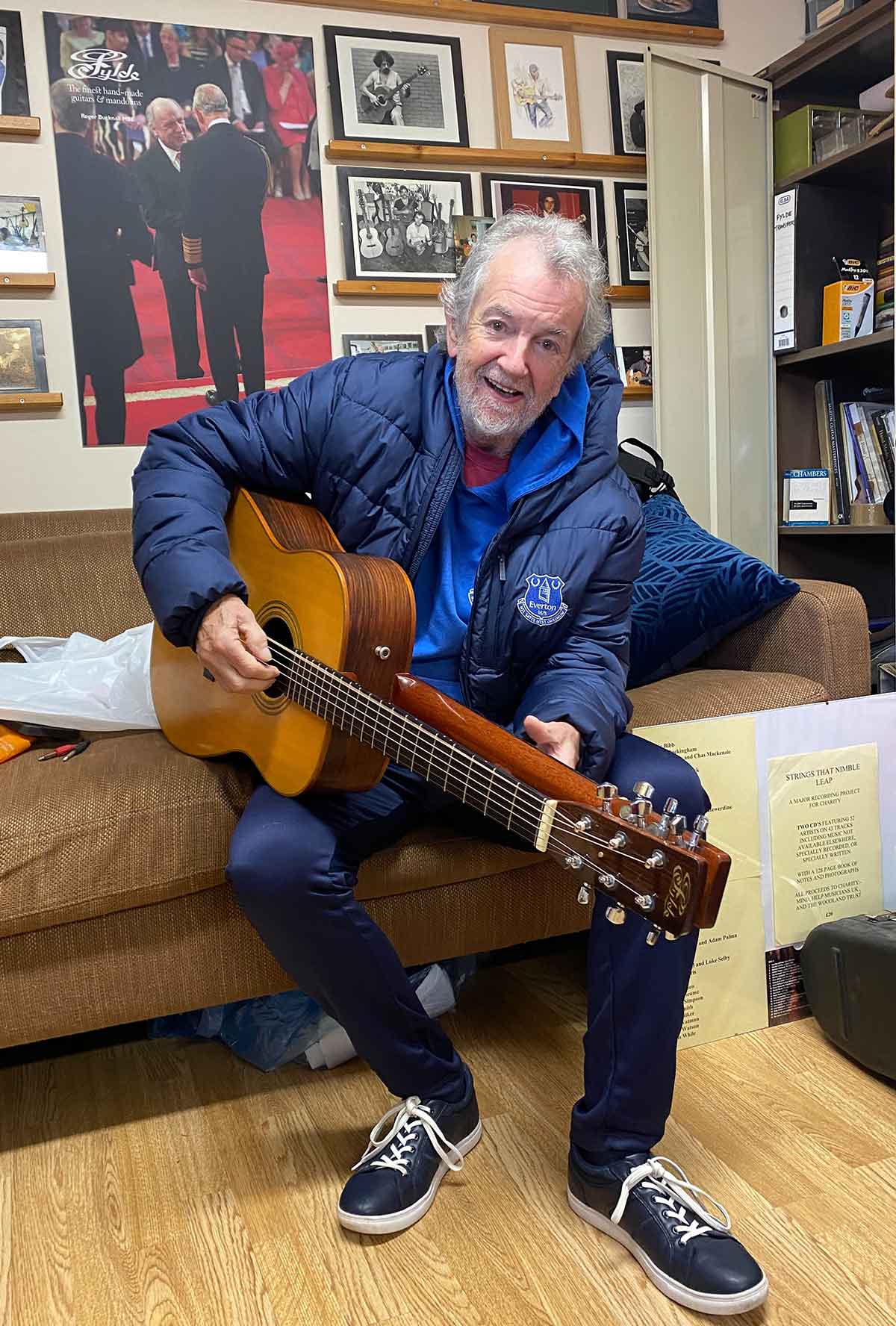
Andy came to buy strings, but I never let a musician off that easily. I couldn’t resist showing him the double neck guitar, and he was mesmerised. We went on to discuss Donal Lunny’s double neck Fylde bouzouki, watch this space.
November: What a coincidence
I do love a good co-incidence. This is my latest.
Recently I phoned a supplier in Manchester who I hadn’t spoken to for about fifteen years and asked if they could send their representative to see me.
Certainly sir, which area are you in?
I’m in Cumbria.
Oh – he’s in your area today sir.
My word! Can I have his number?
So, I phoned him, he answered straight away. He was sitting in his car only a hundred yards away from me, on the same business estate, over 100 miles away from his base in a sales area of about 20,000 square miles. He was with me in five minutes.
I was tempted to run out and put fifty pence on a long odds horse.
December: State of play with Guitar Pickups
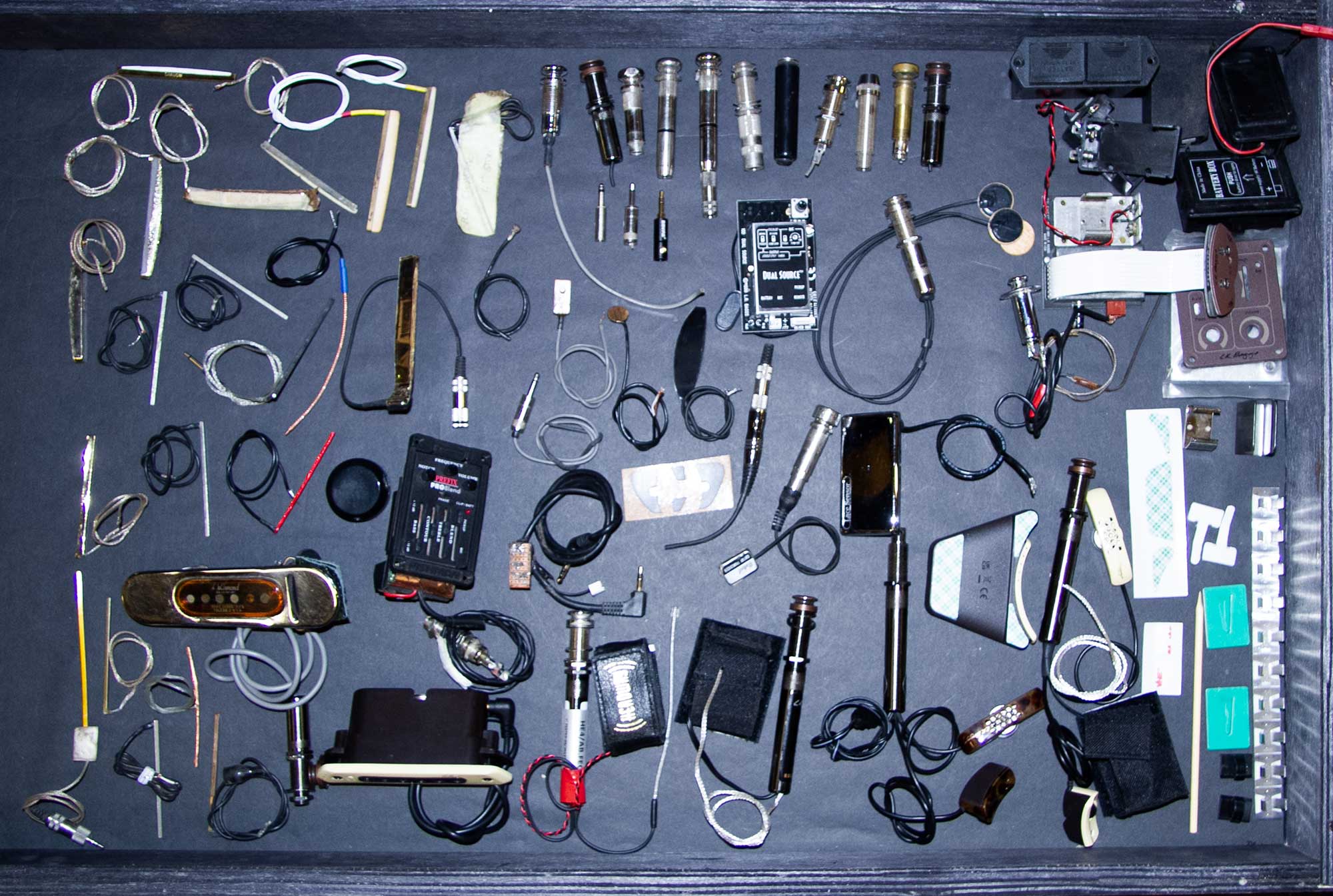
In my teens, in the dim mists of history, I experimented with amplifying my acoustic guitar by making a contact pickup from the cartridge of a record player. I wired it back into the record player as an amplifier. A little later when I worked in the electronics industry, I bought piezo-electric crystals, then piezo cable and made lots of devices for the same purpose.
I also remember the first “real” acoustic pickups, which didn’t sound anything like an acoustic guitar but didn’t feedback, gave the artist much more volume and freedom to move around. It came to the point where that artificial amplified acoustic guitar sound became the norm, and real acoustic tone was hardly ever heard.
Bit by bit, that has all changed. Generally, professional artists have come to need two sources inside the guitar, preferably outputting in stereo so they can be mixed downline as required. There have been several suitable systems available but two of the major manufacturers have now withdrawn from that market, there are too many pitfalls and costs. I’ve recently been speaking to all of them about what is possible and what is not, and most have been extremely cooperative. I’ve learnt quite a bit.
But it’s always changing, a bit like writing new music, a constant pressure to find something new, move forward or rediscover the best from years ago.
Recently, some artists have moved back to older pickup systems, or even away from internal pickups altogether, audiences have changed over the last three years and microphone amplification now offers more than it ever did. Nothing stays still. If it does, someone will shoot it.
Watch Clive Carroll live and see how his stage sound and presentation has changed.
Clive is about to start his coastal walk again. Keep watch!
December: They are coming to take me away haha
In about 1976, there was a very small, but very excellent cafe on the industrial estate where we had our workshop in Kirkham. It opened at 7 am and closed at 4pm, six days a week, It covered everybodies needs and working hours, plus good, simple food and it was always busy from shortly after it opened to shortly before it closed. Bit by bit, decisions were made that not enough people came in at 7 am, or 4 pm, (obvious?) so opening hours were reduced to 8 am until 3 pm. Then it was noticed that not many people came in at 8 am or 3 pm, and so it went until it restricted itself out of business. What a shame. I’ve never forgotten their sausage sandwiches.
A week or so ago, I was waiting for fish and chips in town, and thought I’d look at the new Vegetarian Takeaway that had replaced our favourite Thai Restaurant. On the door was a sign “Opening Hours 11am till 4pm, Wednesday to Saturday”. Well, I thought, they won’t get much business that way, and forgot about it. A week later, I was nearby at midday on a Friday – brilliant idea – I’ll go and get a menu from that new place while it’s open!
Hi, can I have a menu please?
It’s on the wall over there Sir.
Can I have a menu that I can take away with me for when I order a takeaway?
Sorry sir, our takeaway restaurant doesn’t have takeaway menus that you can take away.
So, the takeaway menu from the takeaway has been taken away before I could take one away to order my takeaway.
Shall I stop now?
The only conclusion possible is that vegetarian food is no good for energy, common sense or business acumen.
Now, THAT’S going to get me into trouble.