
STRINGS THAT
NIMBLE LEAP
Fylde Guitars and their players.
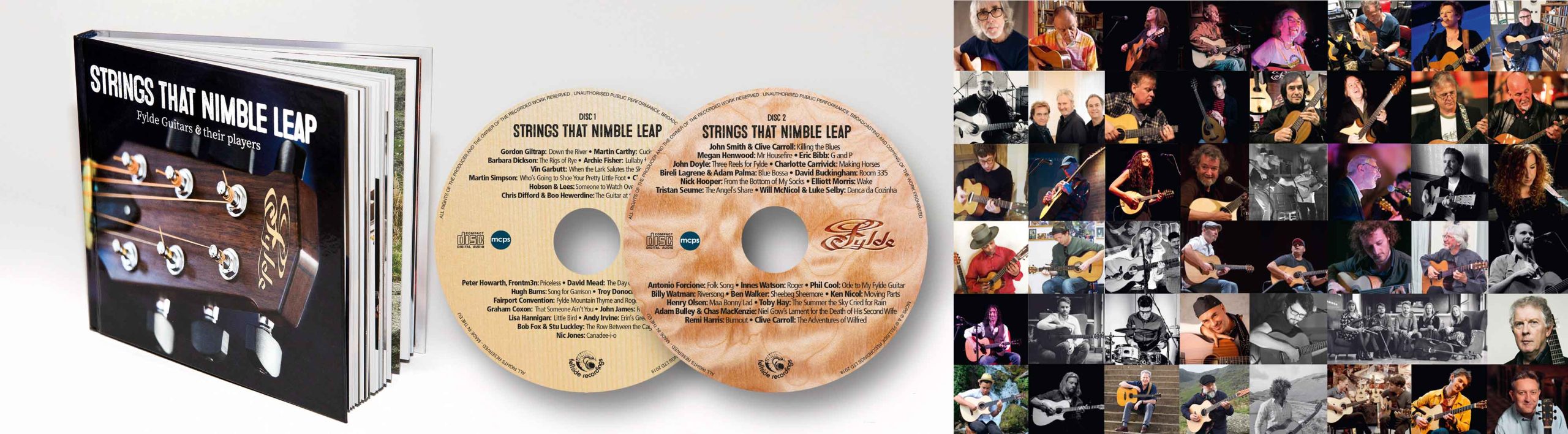
A major recording project, with profits to charity, including MIND, Help Musicians UK, and The Woodland Trust. BUY IT NOW. Please!
Click the PayPal button for UK orders (£22 inc p&p). PLEASE NOTE: We can only ship to a UK address
Featuring 52 Artists on 2 CDs with a 128-page booklet; 43 tracks, 20 specially recorded, 16 specially written. Instrumentals & songs, many of which are not recorded elsewhere.
Six & Twelve string guitars. Nylon string Jazz Tenor & Baritone guitars. Acoustic Bass & Resonator. Mandolins, Mandolas, Bouzoukis and Ukulele.
Why a Double CD
Strings that nimble leap features 52 Artists:
There are 128 pages of sleeve notes
Stars playing their music from Strings that Nimble Leap
Playlist

3:48

4:18

2:34
2:34

5:47

3:03

3:52
2:57

3:02

5:23
4:38
3:49
7:41

2:03

3:04

5:13

2:45

2:45

Martin Simpson: Who’s Going to Shoe your Pretty Little Foot
– who’s going to glove your hand? It’s a long time since I’ve heard this tune. It’s crossed the Atlantic a few times and is very appropriate as Martin’s choice.
John James: Roger’s Roundhouse
The main guitar here is a nine string Oberon, with a cutaway. It came about from discussions with John about playing Welsh harp tunes on the guitar. The top three courses are unison pairs, adjusted for relative height so that an up stroke would catch the pair differently from a down stroke. The bass string is tuned to D. A little extra is added with John’s other recent guitar, another Oberon, again with a cutaway but this time, made from Maple, which was a very popular wood in the guitars that were available when John started his career and when I first met him.
Ben Walker: Sheebeg Sheemore
This is an O’Carolan tune, ‘Sí Bheag, Sí Mhór’, meaning Small Fairy Mound, Big Fairy Mound. It has been reworked and renamed many times by many people. Ben calls his interpretation by a more anglicised name and introduces his own variations. He is playing his custom Fan Fret Falstaff, tuned CGCFCD using Warm Audio WA 14 microphones through an A-Designs Pacifica preamp.
Phil Cool: Ode to My Fylde Guitar
Phil wrote this song shortly after buying his ‘Ken Nicol’ Fylde. He is good friends with Ken and they have toured and recorded as a duo.
The song is in the style of Jake Thackray and when Phil recorded it for his own album, he copied Jake’s style so accurately that many people could not understand what he was singing! If you don’t understand that, look for Jake on YouTube. Phil very kindly reworked if for me here, so you should know what the song is about this time. Listen carefully, particularly at the end.
Tristan Seume:
The Angel’s Share
Tris is playing a custom Goodfellow with Cuban Mahogany back and sides and an Englemann Spruce top, very unusual for a Fylde. Tuning is CGDGCD, with a capo at the third fret.
Here are Tristan’s comments on the tune.
‘“The Angel’s Share”, the whisky lost to evaporation during its maturation, is a nod of appreciation to Roger Bucknall, himself a collector and connoisseur of fine single malts. The tune itself was chiefly the result of scratching a Mixolydian itch until deadline for the recording demanded its sign-off. On many occasions, Roger has encouraged me to get on with it and for this I’m forever grateful. That said, these things must come from somewhere: Tune sessions in Midhurst, late nights in Ullapool and long walks in Langdale are all in the tasting notes and the resulting blend is equal parts place, pressure and perseverance.’
Elliott Morris: Wake
In this piece, Elliott plays an ‘ostinato’ figure on the bass strings by hammering on the strings with the fingers of his left hand, while his right hand taps a melody on the higher strings and higher frets and adds ‘a few bass string taps and slaps’. After the introduction, very few notes are actually ‘plucked’ or ‘picked’. In addition, he hits the body for percussive effect, finding higher and lower tones in different positions.
Nick Hooper:
From the Bottom of My Socks
I think Nick named this tune after I commented on his habit of not wearing shoes while onstage. The soles of his feet are closer to the audience than any other part of him.
Nick is a musician, composer and author. He has won two ‘BAFTA’s for his TV work, including scores for ‘Prime Suspect’ and ‘My Family and other Animals’. He wrote the scores for two ‘Harry Potter’ films, has been nominated for a ‘Grammy’ and for the ‘84th Academy Awards’ for his work on Disney’s ‘African Cats’.
Megan Henwood: Mr Housefire
Megan’s first Fylde guitar, the one used here, is a cross between an Ariel and a Goodfellow. The body is made from Purpleheart and the sound board from Oregon pine reclaimed from Talisker distillery. The decorations are made from Coconut. Megan could have called the guitar ‘Purple’ or ‘Talisker’ but no, she calls it ‘Coco’.
Megan isn’t just a singer or songwriter, her guitar playing is solid as a rock and somehow has some of the character of her voice and personality, warm and deep.
Billy Watman: Riversong
The guitar is a cutaway Classical, made from Indian Rosewood and European Spruce, fitted with a Baggs Anthem pickup system.
The piece exploits the pickup system only to gentle effect, the guitar is tuned dropped D. ‘A multi-track instrumental piece moves from a gentle opening featuring a “Rainstick”, sweeping into the rhythmic section and building to the main theme, which calms down later to find the main theme again. The Fylde Custom Classic has become my go to guitar for recording, the tone is fantastic.’
In 2016, age 14, Billy reached the final of TV’s ‘Guitar Star’, judged and mentored by Toni Iommi, George Benson and Tony Visconti, who described him as a ‘little genius’.
Peter Howarth, Frontm3n: Priceless
Peter Howarth is lead singer of ‘The Hollies’, one of the most successful UK bands ever. The song has Peter playing his much travelled Oberon.
Hobson & Lees: Someone to Watch Over Me
John’s guitar here is a Caliban, which was my reference to gypsy music at the time. Howard’s is a Falstaff, with a cutaway. This track was recorded at the Fylde Folk Festival in 1988 and the lads regard it is as amongst their best work.
Gordon Giltrap: Down the River
Gordon first recorded this with Martin Taylor nearly thirty years ago. The title comes from a book by HE Bates.
The unusual tuning of CGDGBA was suggested by Neville Marten, who was editor of Guitarist Magazine at the time. Gordon used that ‘strange’ tuning to develop this one particular piece.
Charlotte Carrivick: Making Horses.
Charlotte’s guitar is a little unusual. It’s a Falstaff, but with a top made from Adirondack Spruce, almost a prerequisite for bluegrass players. It also has a specially reinforced neck, partly because I suspected that Charlotte would prefer a high action which puts extra load on neck and bridge. ‘The result is the most powerful, best sounding, easiest to play Martin destroying flatpicking guitar I’ve ever played – lucky me! ‘
Charlotte wanted it to have as full a harmonic sound as possible, ‘something that’s always a challenge with flat picking, where you’re relying on single line melodies most of the time. It uses a technique known as “floating” with open strings left to ring as much as possible, within a melody played up the neck.
The title came from a conversation with a friend who, after too much free beer, decided that ‘’making horses’’ would be a suitable alternative career for us if the music all went wrong’.
Will McNicol & Luke Selby: Danca Da Cozinha
Will is a classically trained guitarist who has ‘strayed onto the dark side’ of steel strings and now feels equally at home on both, choosing between them only by the sound character, not ease of playing or unfounded prejudice. On this track, he plays his custom nylon string, in standard tuning, with a ‘Baggs Anthem’ pickup system. The tune is based around various stories of Moira and me dancing round the kitchen when we listen to their music. ‘Danca da Cozinha’ is Portuguese for ‘Dancing in the kitchen’.
Will is partnered by the splendid Luke on drums: ‘the foot pattern is in 3/4… but the hands 4/4… so it all fits, the 3/4 bit is Roger dancing out of time, (HEY!), the drums are very polyrhythmic, 4/4 and 3/4 constantly battling with each other, with both blocks and a cowbell on this track. There is a Samba in the middle, the track as a whole is an amalgamation of influences of Bossa Nova, Cha Cha Cha, Samba and a Tango … this is where the Dorset influence really kicks in you see… and we throw it all into one pot and you very quickly realise Will and I are not from Cuba’.
Toby Hay: The Summer the Sky Cried for Rain
This guitar is a rather special twelve string, based on a Magician, with a twelve-fret neck join to put the bridge in the middle of the soundboard.
Toby has the guitar tuned CC GG CC EE GC CE, with a capo at second fret. You might want to look at that tuning closely. The hybrid idea is very unusual, the only other player I know who has experimented with it is Gordon Giltrap.
‘The track is an improvised piece inspired by an imagined future or half dreamed past. A familiar place, a landscape that is known well, that has almost completely changed. However, something of the place still remains. Somehow still feels familiar’.
Clive Carroll: The Adventures of Wilfred
A Ken Nicol model guitar, basically a Falstaff with a Cedar top, that Clive took a liking to at the Ullapool Festival. Standard tuning. Two microphones, Neumann KM184 and SE Electronics Z5600 A. I’ll let Clive explain everything.
‘The Adventures of Wilfred’ is about a special character who embarks on a short journey in a red open-top two-seater sports car. On his travels, he passes many friends, one of whom says ‘hello’ in the piece. There are also some scary monsters peeking out from behind tree trunks and various little critters dashing across the country lanes. In the case of this recording, perhaps this is all symbolic and actually refers to Roger Bucknall trying to steer his way in the guitar world – with people like me approaching him with requests such as, “Rog, can you lower the action on the third string by a thousandth of an inch, please?”’
.
Vin Garbutt: When the Lark Salutes the Sky
Vin was a dear friend, and this track is still very difficult to listen to. Vin’s wife Pat and their children have been kind enough to let me use it here, it has not been released before. He wrote this song after the death of his parents; the theme of the song is fairly clear when you know the background and the words are engraved on Vin’s headstone.
.